The race toward absolute zero
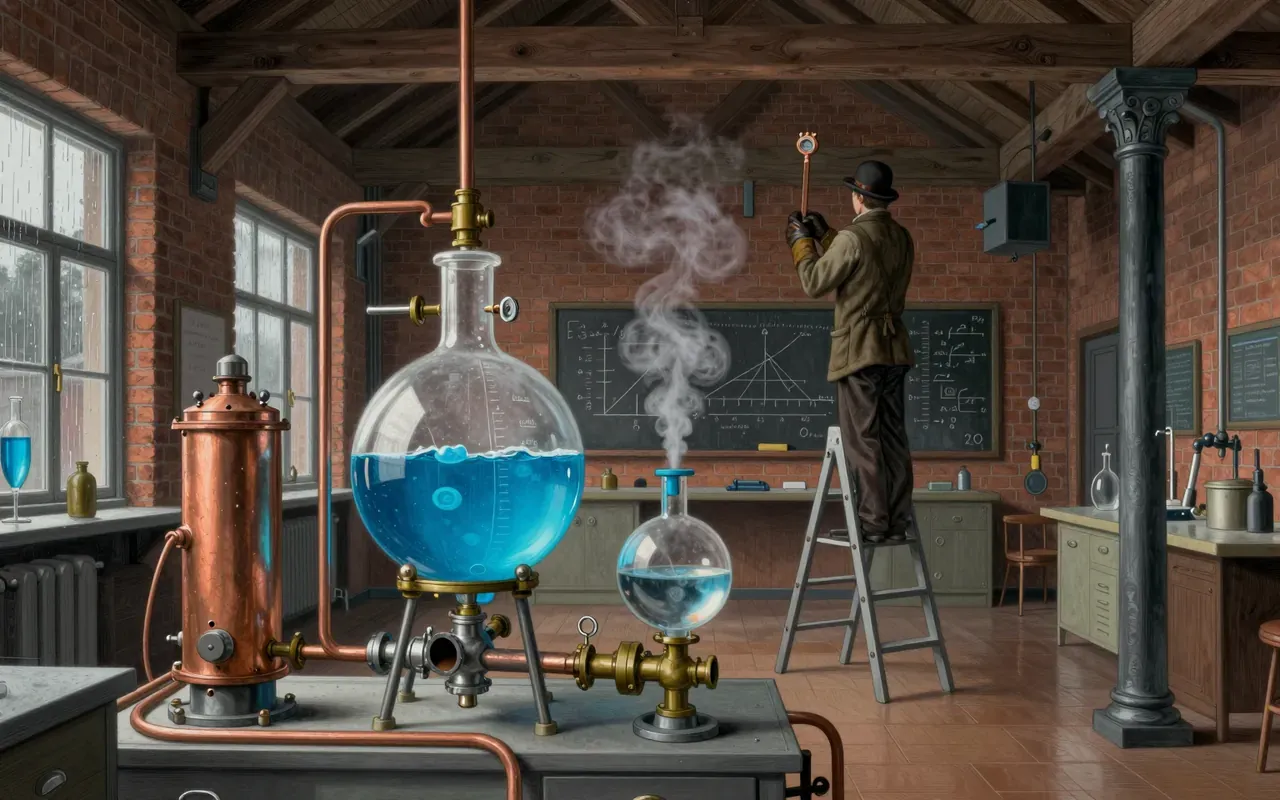
Heike Kamerlingh Onnes spent much of his career at Leiden University pursuing a single technical goal: reaching temperatures colder than anyone had achieved before, and building the equipment needed to study matter once it got there. That pursuit reached a major milestone on 10 July 1908, when he became the first person to liquefy helium, using a sequence of pre-cooling stages, and by further reducing the pressure on the liquid he reached roughly 1.5 kelvin, the lowest temperature recorded anywhere at the time. The achievement mattered beyond the record itself, because liquid helium gave Onnes a coolant capable of holding other materials at temperatures no prior apparatus could sustain, which is what let him ask a new kind of question about how ordinary metals behave that close to absolute zero.
Liquefying helium in 1908
Using his helium-cooling apparatus, Onnes measured the electrical resistance of solid mercury as he cooled it further and further. On 8 April 1911 he observed something that did not fit the expected pattern of resistance gradually declining as temperature fell: below a temperature close to 4.2 kelvin, the mercury’s resistance did not taper off but vanished essentially completely, dropping so sharply that it looked less like an extension of ordinary cooling behaviour and more like a distinct transition into a new state. This abrupt disappearance, rather than a gradual fade, is what marked the discovery as something genuinely new rather than simply very cold, very good conduction.
Resistance that vanishes, not fades
The core observation has held up entirely: what Onnes found in mercury in 1911 is recognised as the first documented instance of superconductivity, and the phenomenon has since been confirmed in a wide range of other materials, each with its own characteristic critical temperature below which the same abrupt loss of resistance occurs. His broader low-temperature research programme, including the helium liquefaction that made the mercury measurement possible in the first place, was recognised with the 1913 Nobel Prize in Physics, awarded for his investigations of matter’s properties at low temperatures generally rather than for the superconductivity finding narrowly, reflecting that the discovery and the instrument that enabled it were treated as one body of work.
A Nobel for the cold, not just the effect
What Onnes’s original experiment did not, and could not, supply was any explanation of why the effect happened. The mechanism remained unexplained for decades; even the Meissner effect, the finding that superconductors actively expel magnetic fields rather than merely allowing current to flow without resistance, was not observed until 1933, more than two decades after Onnes’s original result, and added a further layer to what needed accounting for. A workable microscopic theory, describing electrons forming pairs that move through the material without scattering, did not arrive until 1957, when John Bardeen, Leon Cooper, and John Robert Schrieffer proposed what became known as BCS theory, itself later recognised with a Nobel Prize in 1972, well after Onnes had died.
Decades before an explanation
The practical reach of Onnes’s discovery took even longer to unfold, but has become substantial. Superconducting magnets, exploiting exactly the zero-resistance property Onnes first observed, now generate the powerful, stable magnetic fields used in MRI scanners and in particle accelerators, while the Meissner effect’s expulsion of magnetic fields underlies magnetic levitation technology used in some train systems. None of that infrastructure existed in any form close to Onnes’s lifetime; it depended on later work extending superconductivity to materials with higher critical temperatures and on decades of engineering to make superconducting components practical outside a physics laboratory, but all of it traces back to the mercury wire he cooled in liquid helium in April 1911.
From a lab curiosity to MRI magnets
This is a strong use of an hour because it captures something true about how physics often actually proceeds: an instrument built for one purpose, reaching colder temperatures than anyone before, opens up an entirely unanticipated phenomenon, which then takes generations to explain and even longer to put to use. The story rewards attention precisely because the gaps matter, between liquefying helium and finding superconductivity, and between finding it and explaining it with BCS theory nearly half a century later. Readers wanting the deeper physics of Cooper pairs or the specifics of Type I versus Type II superconductors will need to go further, but as an account of how a single low-temperature measurement in 1911 turned into a century-long research programme, it holds together well.