A compound that wouldn’t behave consistently
The puzzle began with an inconsistency between two samples that should have been identical in every way that mattered. Tartaric acid drawn from living sources rotated the plane of polarised light passing through it, a property Jean-Baptiste Biot had already documented in certain chiral substances back in 1812, but tartaric acid produced synthetically, despite reacting the same way chemically and sharing the same elemental composition, showed no such rotation at all. Nothing in the accepted chemistry of the time offered a satisfying explanation for how two samples of what was supposedly the same substance could behave so differently toward a beam of light.
Sorting crystals by hand under a microscope
Pasteur resolved the puzzle by looking rather than reasoning his way to an answer from theory alone. Examining the synthetic sample’s crystals under a microscope, he found it was not a single uniform substance at all but a mixture of two distinct crystal shapes, mirror images of one another, present in roughly equal numbers. Working through 1848 and 1849, he separated the two crystal forms by hand, one crystal at a time under magnification, sorting the mixture into two visually distinguishable piles based on their asymmetric shape alone, with nothing but patience and a steady hand to rely on.
Two mirror images, two directions of twist
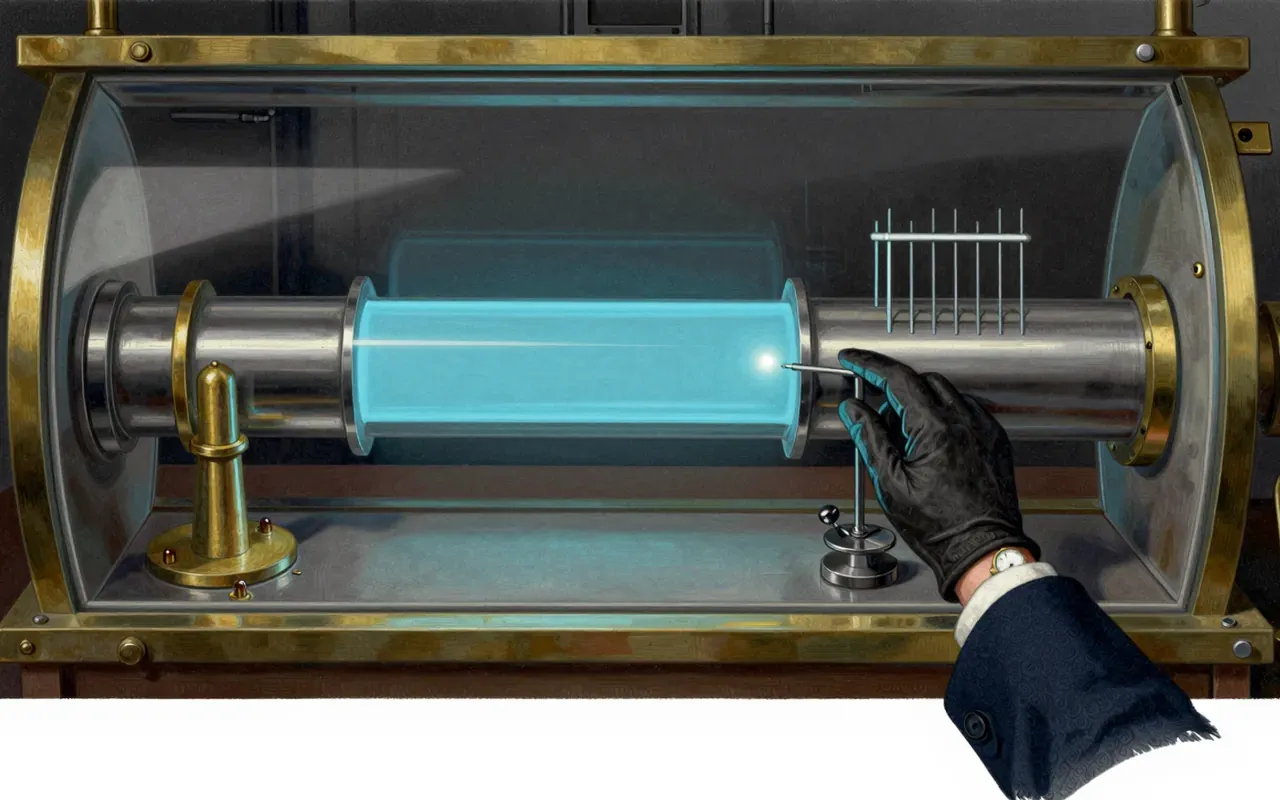
Testing each separated pile on its own settled the question decisively. One form, dissolved and passed through a polarimeter, rotated polarised light clockwise, described as dextrorotatory, while the other rotated it counterclockwise, described as levorotatory; combined back together in equal amounts, the two cancelled each other’s rotation out, exactly reproducing the synthetic sample’s apparent lack of optical activity. Pasteur concluded the underlying molecules themselves must have an asymmetric, handed structure, making this the first direct demonstration that a molecule’s three-dimensional shape, not just its chemical formula, could be a real physical property with observable consequences.
What chirality does and doesn’t change
What chirality changes, and what it leaves alone, is precise. Two mirror-image forms of the same molecule, called enantiomers, share identical ordinary chemical properties and identical physical properties apart from the direction they rotate polarised light — they behave differently only when interacting with something else that is itself chiral, whether that is another molecule, a biological receptor, or in Pasteur’s case, the asymmetric geometry of polarised light itself. This is a narrower claim than it might sound: chirality does not make two enantiomers different substances in most contexts, only in contexts that are themselves sensitive to handedness.
Why a molecule’s handedness can matter enormously
Those handedness-sensitive contexts turn out to include a great deal of biology and medicine. The antidepressant citalopram is sold as an equal mixture of both mirror-image forms, but only one of them, isolated and sold separately as escitalopram, was found to provide the therapeutic effect. D-penicillamine is used to treat rheumatoid arthritis, while its mirror image, L-penicillamine, is toxic because it interferes with the body’s use of vitamin B6. Even taste can hinge on the distinction: L-aspartame tastes sweet to humans while its mirror-image form, D-aspartame, is reported as tasteless, because the receptors doing the tasting are themselves chiral and respond to only one of the two shapes.
A slow, careful discovery worth its reputation
This is worth the time precisely because the method was unglamorous — sorting crystals by hand under a microscope is not a dramatic image, and Pasteur’s own contribution here was patience and careful observation rather than a single flash of insight. That is also what makes the conclusion trustworthy rather than merely clever: the two piles of crystals, tested separately, gave opposite and internally consistent results, and recombining them reproduced the original puzzle exactly. Long before Pasteur became known for germ theory and vaccination, this quieter piece of work already showed the observational discipline that made his later, more famous discoveries possible.