A 1993 protocol, not a sci-fi device
The claim, stripped of its science-fiction connotations, is narrower and stranger than the word teleportation suggests. In 1993, physicists including Charles Bennett, Gilles Brassard, Claude Crepeau, Richard Jozsa, Asher Peres and William Wootters proposed a protocol for transferring the complete quantum state of a particle from one location to another, using a pair of entangled particles shared in advance between sender and receiver, combined with an ordinary message sent through a classical communication channel. Crucially, nothing physical, no matter and no energy, actually travels between the two locations; what moves is the information describing a quantum state, and the original particle’s state is destroyed in the process of measuring it.
First demonstrated in 1997
The theoretical proposal was confirmed experimentally in 1997, when two research teams, one led by Sandu Popescu and another by Anton Zeilinger, independently demonstrated the effect in the laboratory, showing that a quantum state could indeed be reconstructed at a distant location using this combination of shared entanglement and classical communication. This moved quantum teleportation from a mathematical protocol into a demonstrated physical process, though still confined to short laboratory distances and simple quantum states at that stage, a modest starting point for the far more extended distance records that would follow over the subsequent decades of research.
Why entanglement alone cannot send a message
Understanding why this process respects the speed of light requires understanding what entanglement actually does and does not do. Quantum entanglement, the correlation between two particles such that measuring one instantly tells you something about the other regardless of distance, was confirmed decisively through Bell test experiments, building on John Bell’s 1964 theoretical work and carried out by researchers including John Clauser, Alain Aspect and Anton Zeilinger, work recognised by the 2022 Nobel Prize in Physics. These experiments ruled out simpler explanations involving hidden, predetermined properties, but they also confirmed that the correlations entanglement produces cannot, by themselves, be used to send a controllable message, since the outcome each party observes is random and only makes sense once compared after the fact.
The classical message that makes it work, and limits it
This is precisely where the classical communication requirement in quantum teleportation comes in. After the sender performs a specific joint measurement on the state to be teleported and their half of the entangled pair, the outcome of that measurement must be sent to the receiver through an ordinary classical channel, telling them which of several possible operations to apply to their own half of the entangled pair in order to reconstruct the original state. That classical message is the only part of the process that takes measurable time to transmit, and because it must travel at or below the speed of light, the overall protocol cannot outrun that limit no matter how instantaneous the underlying entanglement correlation appears.
Growing distances
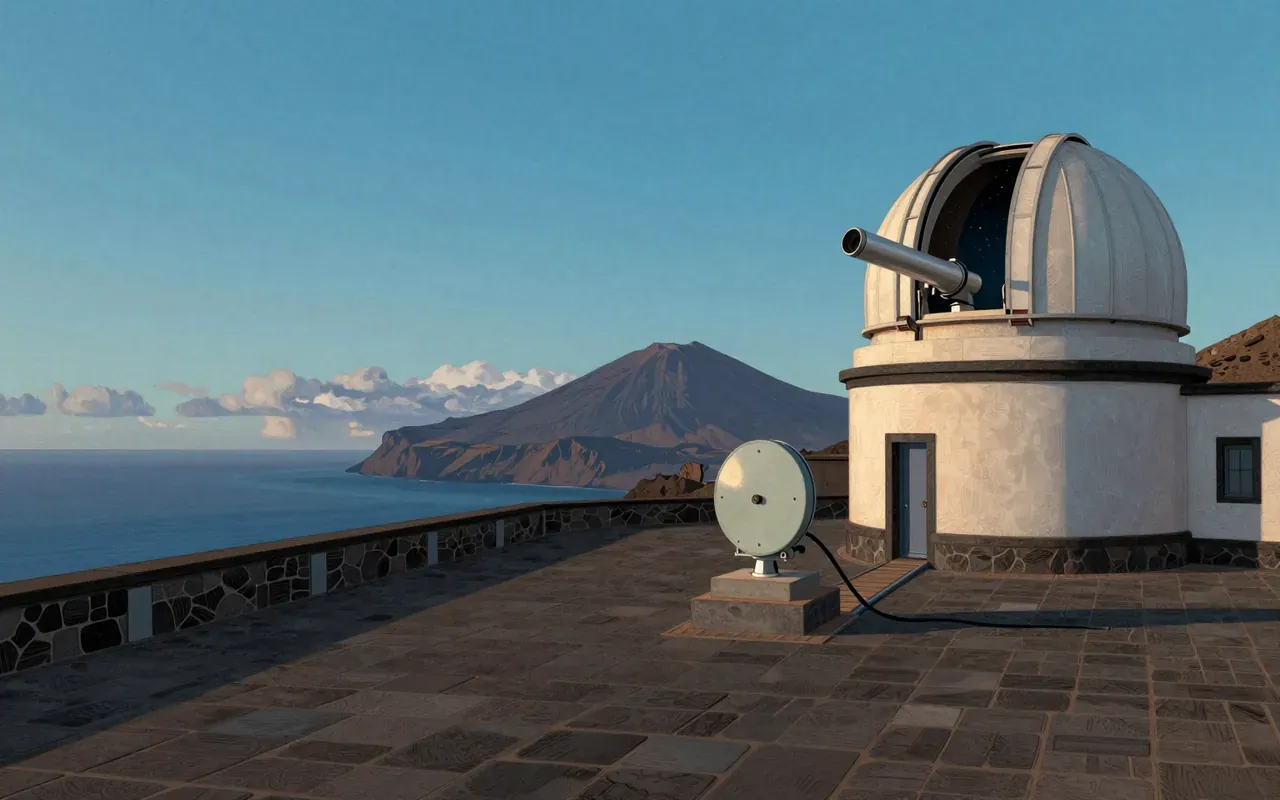
Since 1997, the physical distances over which quantum teleportation has been demonstrated have grown substantially. A 2012 experiment achieved open-air teleportation across roughly 144 kilometres between two observatories on the Canary Islands, and a later experiment using China’s Micius satellite, led by Jian-Wei Pan’s team, extended a ground-to-satellite link to roughly 1,400 kilometres, the longest distance achieved to date. Researchers have also demonstrated teleportation over standard telecommunications fibre carrying ordinary internet traffic alongside regular data, a step relevant to the long-term goal of building quantum networks that could eventually connect quantum computers across large distances.
Still an early-stage technology
Despite this progress, researchers themselves describe quantum teleportation as still in an early stage of development, with ongoing work focused on improving the fidelity of transferred states, which is measured against a classical benchmark that any genuinely quantum protocol must exceed, extending the range and reliability of the entangled links involved, and scaling the approach to handle more complex quantum systems at once. This is worth understanding on its own terms, not as a preview of physical teleportation but as a genuinely useful and actively developing tool for quantum computing and quantum communication, built on a specific, well-tested mechanism rather than the popular fantasy the name evokes.