sciencebriefs
Topic

Quantum mechanics

A theory that works perfectly and nobody can agree what it means.
40
in science
11:06
average
444 min
in total
44
across the network
Quantum mechanics across the network →
All briefs40
9:52

Klaus von Klitzing

A single number, RK, turned resistance into a quantum ruler — but it measures only one kind of perfection.
9:49

Albert Einstein

Einstein didn’t prove relativity — he rebuilt physics from scratch using pens, paper and postulates.
13:00

Bell test

Alain Aspect's early 1980s photon experiments turned Einstein's decades-old discomfort with entanglement into a testable question, and quantum mechanics won, though it took another three decades of closing loopholes before the answer became fully conclusive.
13:00

Bell's theorem

Bell's theorem drew a hard line between quantum mechanics and local hidden variables, and fifty years of Bell tests, from Aspect's photons to the loophole-free experiments of 2015, keep landing on the quantum side.
13:00

Compton scattering

In 1922 Arthur Compton found that scattered X-rays came back with a longer wavelength than the ones he sent in, a shift that depended only on angle, and the only explanation that fit was that light was hitting electrons as discrete particles.
10:34

David Gross

Asymptotic freedom isn’t just clever math — it’s why we can ever see quarks at all.
13:00

Matter wave

Louis de Broglie's 1924 claim that matter behaves like a wave, tested first on electrons and later on molecules weighing tens of thousands of daltons, has held at every scale physicists have managed to test it.
9:28

Dirac equation

Paul Dirac

The Dirac equation is the first consistent relativistic quantum wave equation. It predicts antimatter and derives spin — verified by hydrogen fine structure and Anderson’s 1932 positron detection. It does not prove antimatter; it implies it. It does not go beyond first-order fine structure. It remains indispensable in particle physics.

13:00

Photoelectric effect

Three stubborn facts about light knocking electrons off a metal surface made no sense as waves, and Einstein's 1905 fix, that light travels in discrete packets, was still too radical for the Nobel committee to fully endorse sixteen years later.
9:11

Erwin Schrödinger

Schrödinger didn’t just write an equation — he gave quantum theory its working language and named its deepest mystery.
10:40

Frank Wilczek

Asymptotic freedom didn’t explain quarks — it saved quantum chromodynamics from mathematical collapse.
13:00

Hawking radiation

Stephen Hawking's 1974 calculation showed black holes should slowly radiate and eventually evaporate, a result with no direct astronomical confirmation yet, that also produced a genuine, still unresolved puzzle about where the information inside them goes.
13:00

Uncertainty principle

Werner Heisenberg's 1927 principle is often mistaken for a statement about clumsy measuring instruments, but it describes a limit built into quantum mechanics itself, one later physicists made more precise rather than ever overturned.
11:00

Max Planck

Planck didn’t discover quanta — he invented them to save classical physics, then accidentally broke it forever.
9:25

Niels Bohr

Bohr didn’t fix the atom—he broke classical physics wide open.
9:53

Paul Dirac

Dirac didn’t just predict antimatter — he built the grammar in which all particle physics is written.
13:00

Black-body radiation

Classical physics predicted a heated object should radiate an unlimited amount of energy at high frequencies, measurements showed it does no such thing, and Max Planck's 1900 fix, a trick he did not even believe in at first, opened the door to quantum theory.
13:00

Planck postulate

To make his 1900 blackbody radiation law work, Max Planck assumed energy could only be emitted in fixed units, a device he called a formal assumption and did not believe was physically real.
13:00

Quantum tunnelling

George Gamow's 1928 theory explained why alpha particles with far too little energy to climb a nucleus's confining wall still escape it, by treating the particle as a wave that can pass through a barrier it cannot classically surmount.
13:00

Molecular orbital theory

Ordinary oxygen is attracted to a magnet, a fact the older theory of chemical bonds simply could not explain. Molecular orbital theory got it right by giving up on the idea that a bond belongs to two atoms alone.
13:00

Quantum teleportation

Quantum teleportation moves the description of a quantum state between two locations using entanglement and an ordinary message, not matter or energy, and it cannot go faster than light because that ordinary message still has to arrive.
10:30

Richard Feynman

Feynman didn’t explain quantum reality — he built a working language for it.
10:08

J. Robert Oppenheimer

Oppenheimer didn’t build bombs — he built the mathematical scaffolding for quantum chemistry, nuclear physics, and black holes.
10:16

Sheldon Glashow

Glashow didn’t discover particles — he built the grammar that forced them to exist.
10:06

Steven Weinberg

Weinberg didn’t unify forces — he made mass a consequence of broken symmetry.
13:00

Higgs boson

The 2012 discovery at CERN's Large Hadron Collider confirmed, at five-sigma significance, the particle that three groups of theorists had predicted in 1964, closing the last open piece of the Standard Model of particle physics.
11:08

Pauli exclusion principle

Wolfgang Pauli

The Pauli exclusion principle is not a force or interaction. It is a constraint on how quantum states may be occupied. It arose from spectral anomalies, not theory-first deduction. Its power lies in its austerity: four numbers, one electron, and a sign flip upon exchange. It remains indispensable — and unexplained at root.

13:00

Scanning tunneling microscope

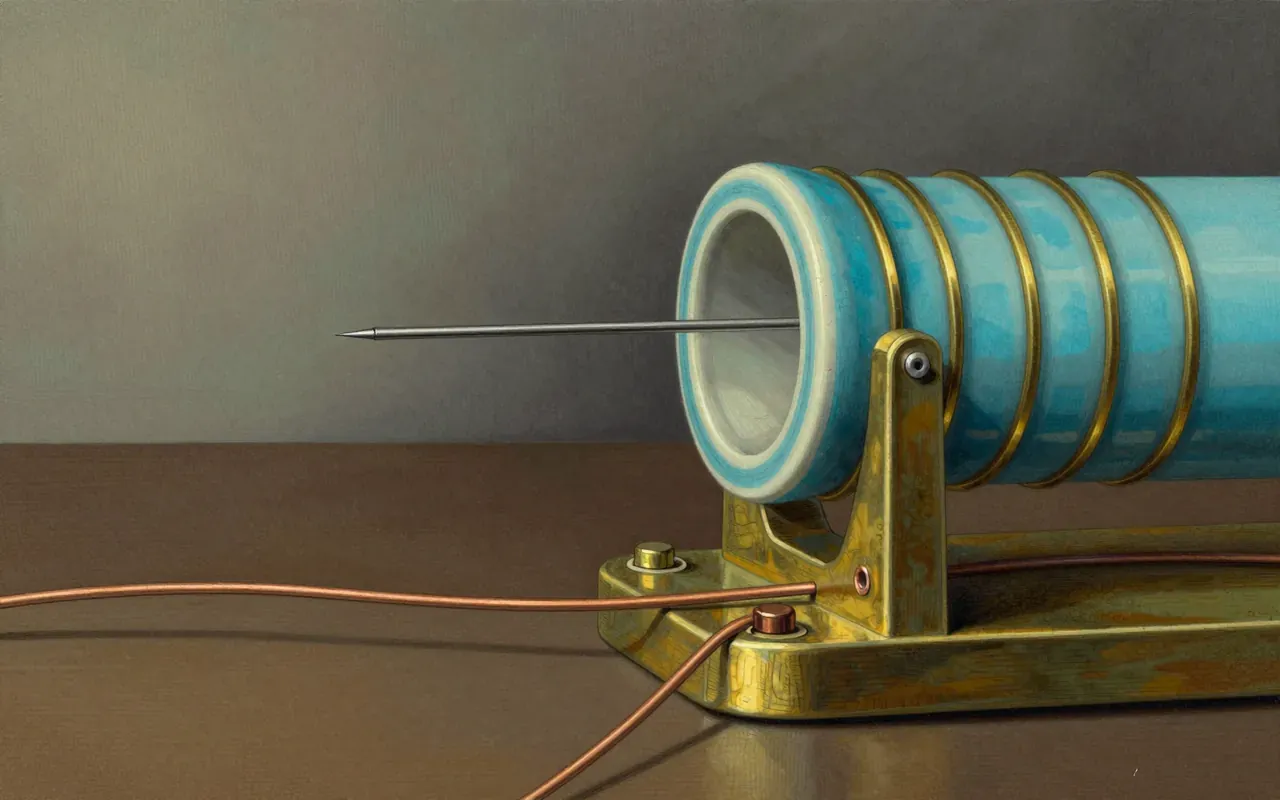
Quantum tunnelling had been known physics for decades before Gerd Binnig and Heinrich Rohrer built an instrument steady enough to hold a metal tip a few atomic widths above a surface and turn that old effect into a working microscope.
13:00

Standard Model

Built up piece by piece from the 1960s to the 2012 discovery of the Higgs boson, the Standard Model correctly predicts particle physics down to its component quarks and forces, while leaving gravity and dark matter untouched.
13:00

Topological insulator

Charles Kane and Eugene Mele predicted in 2005 that a material could conduct only along its edges while remaining insulating throughout its interior, and a mercury telluride sandwich confirmed it two years later.
8:58

Werner Heisenberg

Heisenberg didn’t discover uncertainty — he abolished the idea that particles have definite positions and momenta at all.
9:11

Schrödinger's cat

Erwin Schrödinger

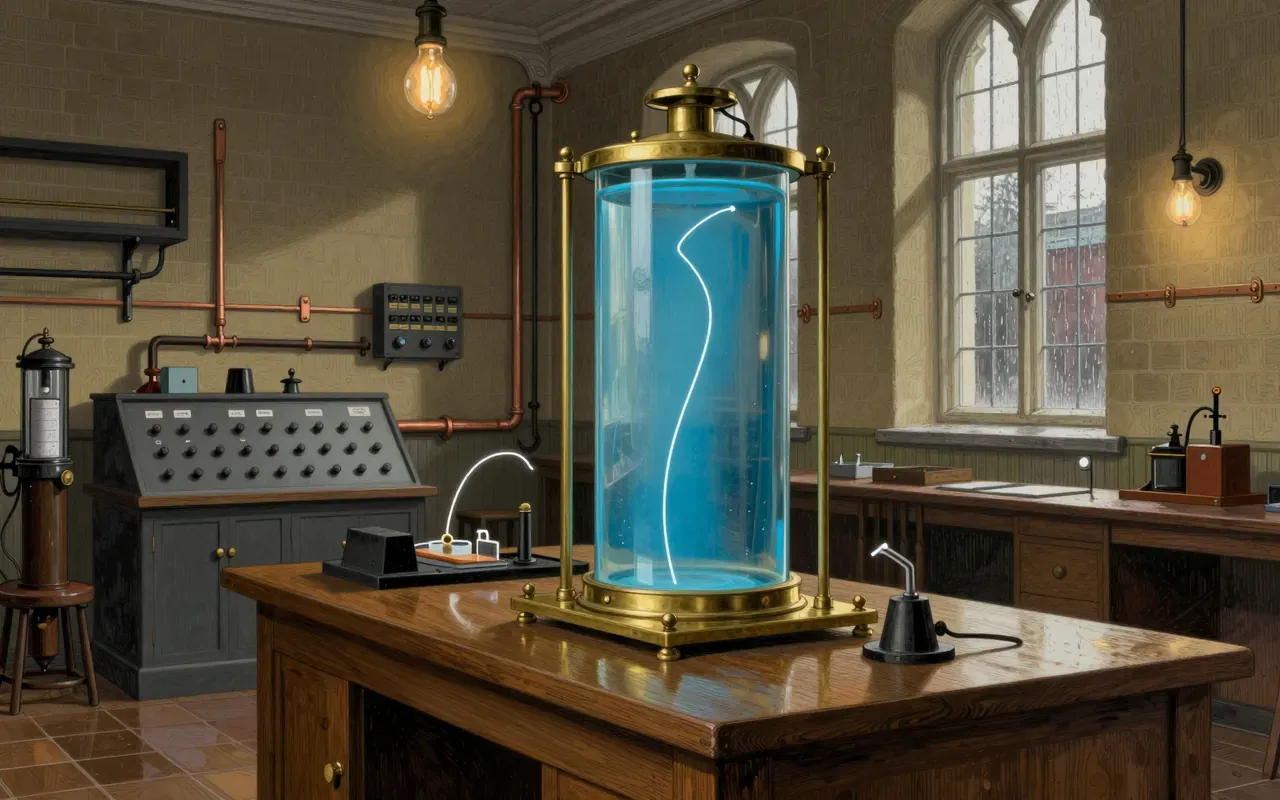
Schrödinger's cat is a 1935 thought experiment designed by Erwin Schrödinger in correspondence with Einstein to critique the Copenhagen interpretation of quantum mechanics. It uses a sealed chamber containing a cat, radioactive source, Geiger counter, relay, hammer, and flask of hydrocyanic acid. The setup links a single quantum event — atomic decay — to a macroscopic outcome. Mathematically, the wave function describes a superposition of 'alive' and 'dead', yet observation always reveals one definite state. Schrödinger intended this as reductio ad absurdum, not as a proposal. No experiment was conducted. The work establishes a tension between formalism and observation — nothing more.
8:03

String theory

String theory is not a theory of nature—it’s a laboratory for quantum gravity ideas that have no experimental anchor.
7:51

Double-slit experiment

Young · 1801

Young’s 1801 double-slit experiment established wave behaviour for visible light. Later versions with electrons (1927) extended it to matter. The interference pattern is real. The disappearance of that pattern upon path detection is real. But Young did not observe particles, nor did he claim duality — he argued for waves only. Duality emerged from later experiments combining his method with quantum detection.