The missing piece of the Standard Model
The July 2012 announcement from CERN claimed the discovery of a new particle consistent with the Higgs boson, the piece of the Standard Model of particle physics that had been missing since three groups of theorists proposed the underlying mechanism in 1964. The Higgs field, which the boson is an excitation of, is thought to fill all of space and to be the reason the W and Z bosons and the fundamental particles that make up matter, such as quarks and electrons, have mass at all rather than travelling at the speed of light like massless particles do. The particle detected at CERN had a mass of roughly 125 gigaelectronvolts, no electric charge, and, crucially, the zero spin and even parity that theory demanded of the Higgs boson specifically, rather than some other unexpected particle. It was the last unconfirmed piece of the Standard Model, not a departure from it.
From 1964 theory to a 26-kilometre collider
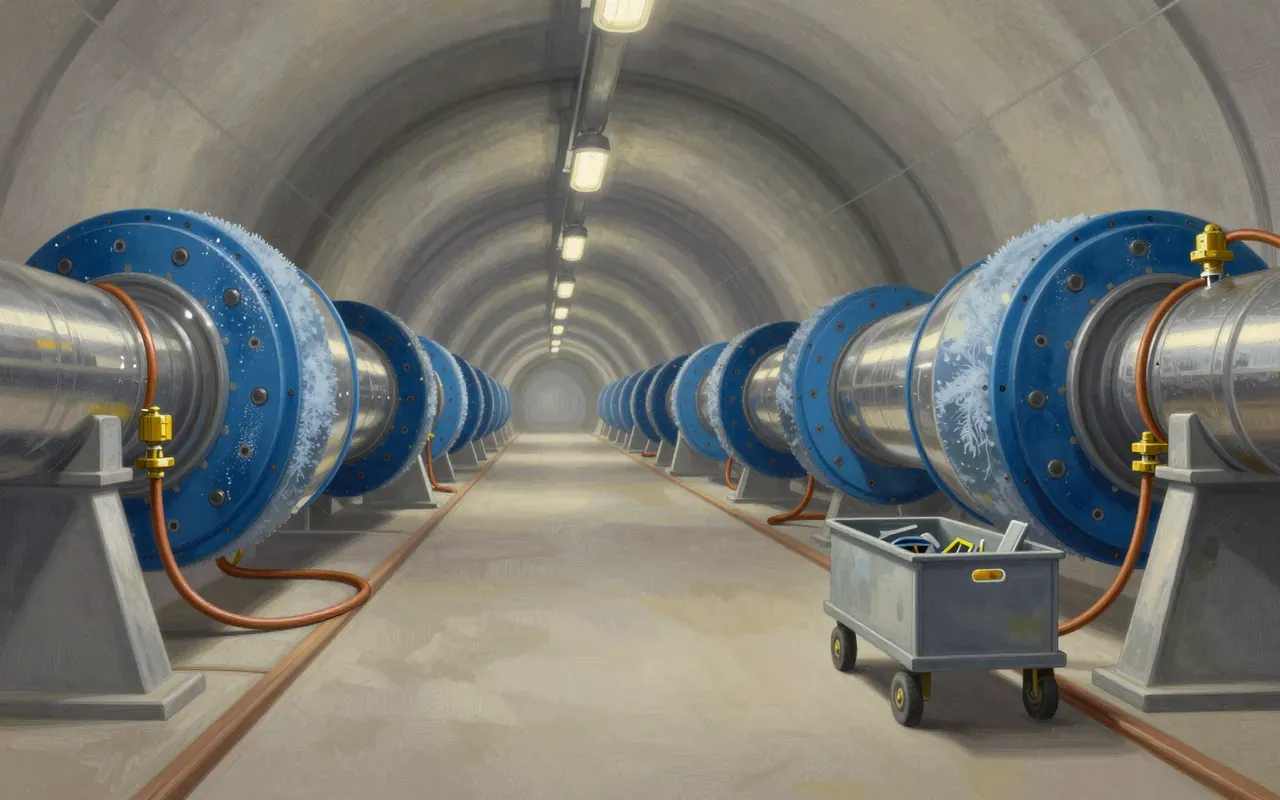
The theoretical case had been built decades earlier: François Englert and Robert Brout, Peter Higgs, and separately Gerald Guralnik, C. R. Hagen and Tom Kibble, each published papers in 1964 describing how a field undergoing spontaneous symmetry breaking could give mass to gauge bosons. Testing the idea required building a particle collider large enough to produce the boson directly, since it does not occur in ordinary matter and decays almost instantly once created. The Large Hadron Collider, a 26.7-kilometre ring straddling the France-Switzerland border, smashed protons together at energies up to several teraelectronvolts and let two independent detectors, ATLAS and CMS, each with thousands of collaborators, hunt for the particle’s telltale decay patterns, including pairs of photons and pairs of Z bosons decaying further into four muons. Both detectors reported a signal at the same mass with a statistical significance of five standard deviations, the threshold particle physics treats as a discovery rather than a fluctuation.
Five sigma, and a Nobel Prize
The core claim has held up well since 2012. Independent measurements by ATLAS and CMS converge on a mass close to 125 gigaelectronvolts, and the particle’s spin, parity and multiple decay channels, into photon pairs, W and Z boson pairs, bottom quark pairs and tau lepton pairs, all match Standard Model predictions rather than any of the alternative particles that had been proposed as stand-ins. Peter Higgs and François Englert received the 2013 Nobel Prize in Physics for the theoretical prediction, with the experimental confirmation cited explicitly as the reason the prize could be awarded at all. Nearly every measurement made in the years since has continued to line up with the plain, unadorned Standard Model version of the Higgs boson, without turning up evidence for extensions such as supersymmetry that many physicists had hoped might also appear at these energies.
What has matched, again and again
Several important properties of the Higgs boson remain unmeasured rather than confirmed. Its self-coupling, the strength with which Higgs bosons interact with each other, has not been pinned down, and this number matters because it shapes the underlying Higgs potential and, by extension, questions about whether the universe’s current vacuum state is stable over cosmological timescales. Whether a single Higgs boson is the whole story, or whether it is one member of a larger family predicted by theories beyond the Standard Model, is also still open. The Large Hadron Collider’s precision has limits, and answering these questions in full is generally described as requiring a future electron-positron collider built specifically to study the Higgs boson with less background noise than a proton collider produces.
What is still unmeasured
Confirming the Higgs mechanism closed out the last missing piece of the Standard Model, the theory that has organised particle physics since the 1970s, and did so by validating a very specific, falsifiable prediction rather than a vague theoretical hope. That matters beyond particle physics because the same collider programme, the international collaboration structure behind ATLAS and CMS, and the detector and computing techniques developed to find a single particle among vast numbers of collisions have since been reused across other fields, from medical imaging to large-scale scientific data handling. The discovery also gave physicists a concrete number, the Higgs boson’s mass, to plug into calculations about the long-term stability of the universe’s vacuum state, connecting a laboratory measurement to genuinely cosmological questions.
Beyond the particle itself
This is worth the time for anyone who wants to understand what the Standard Model actually claims and how a decades-old, highly specific theoretical prediction gets tested rather than merely praised. The story rewards attention to the parts that sound bureaucratic, the five-sigma threshold, the separate confirmation by two independent detectors, the Nobel Prize limited to three of six original theorists, because those details are exactly how particle physics distinguishes a real discovery from a statistical fluke. Readers wanting a dramatic reveal will find instead a careful, incremental confirmation stretched across 2012 and 2013, followed by years of measurements narrowing down what was already suspected. That slower, more exacting shape is the more honest picture of how this kind of physics actually proceeds.