Eight telescopes as one dish
In April 2019 the Event Horizon Telescope collaboration released what it described as the first direct image of a black hole: the shadow cast by the supermassive black hole at the centre of the galaxy M87, some tens of millions of light years away. The picture shows a bright, uneven ring around a dark centre, produced by matter and light bending around the black hole rather than by any surface it might have. From the size and shape of that ring, the collaboration derived a mass for the object and reported the direction it appeared to be spinning, based on the asymmetry in brightness around the ring. The claim was specific: not a photograph of a black hole, but a resolved image of its shadow.
Shipping the data by plane
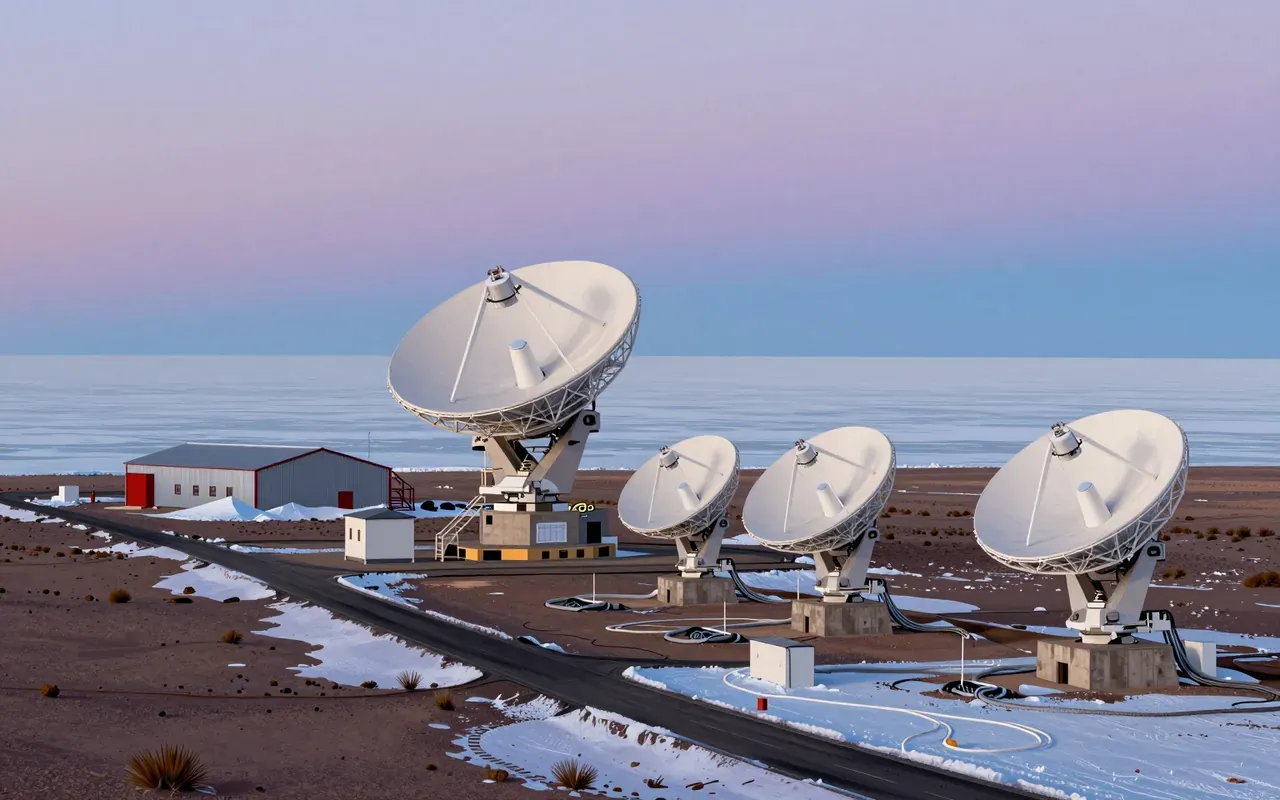
No single telescope has the resolving power to see something this small at this distance, so the collaboration linked telescopes at sites across the world, including facilities in Chile, Hawaii, Arizona, Mexico, Spain and the South Pole, into a single virtual instrument using very-long-baseline interferometry. Each dish recorded its own signal against an atomic clock for precise timing, rather than transmitting data anywhere in real time. The recordings, far too large to send over a network, were physically shipped on hard drives to processing centres, where they were combined and cross-correlated after the fact. Getting a location as remote as the South Pole into the same dataset meant waiting months for a shipment that could only travel once the polar winter allowed flights out.
A shadow, not a photograph
The core result, an image of a ring-shaped shadow with a mass and size in the range expected for M87’s black hole, has held up. To guard against the reconstruction simply showing what the team expected to see, four independent groups built images from the same raw data using different techniques, including the established CLEAN algorithm from radio astronomy and a newer method called CHIRP, along with other statistical approaches. All four converged on a similar ring. That convergence, rather than any single algorithm’s output, is what the collaboration points to as evidence the image reflects the data rather than an assumption baked into the reconstruction. The later, comparable image of Sagittarius A* in 2022 reinforced that the method generalises.
Four teams, one picture
Not every claim built on these images has held equally well. A subsequent claim of having identified a distinct photon ring within the M87 data has been disputed by other researchers, a reminder that extracting fine structure from noisy, sparsely sampled data leaves room for genuine disagreement about what the reconstruction is actually resolving. The project’s own schedule was also disrupted, with a planned 2020 observing campaign postponed by the pandemic to 2021. None of this undermines the headline result, but it marks the difference between the image itself, which four independent methods agree on, and finer interpretive claims drawn from the same dataset, which have not all survived scrutiny in the same way.
From M87 to Sagittarius A*
The images matter beyond confirming that black holes look roughly as general relativity predicts. They demonstrate that a collaboration of over three hundred researchers across dozens of institutions and countries can turn a planet’s worth of separate radio dishes into a single coherent instrument, a capability with uses well beyond this one target. The technique also gives astronomers a direct way to measure the mass and spin of specific supermassive black holes, including the comparatively tiny one at the centre of our own galaxy, rather than inferring those properties only from the motion of stars and gas around them. A 2024 polarised-light image added information about the magnetic fields near the black hole, extending what the same basic method can reveal.
What a shadow can and cannot tell you
Worth the time, largely because the interesting part is not the ring itself but the amount of infrastructure and cross-checking needed to produce it. A reader who wants to understand what was actually achieved in 2019, rather than repeat the shorthand of a black hole photograph, will get more out of this than the image alone conveys. The account is also useful as a case study in how a result assembled from scattered, imperfect instruments earns trust: through redundancy, independent reconstruction methods, and a willingness to let later claims about the same data be challenged. It is less rewarding if you already know the image and only want the headline number for the black hole’s mass.