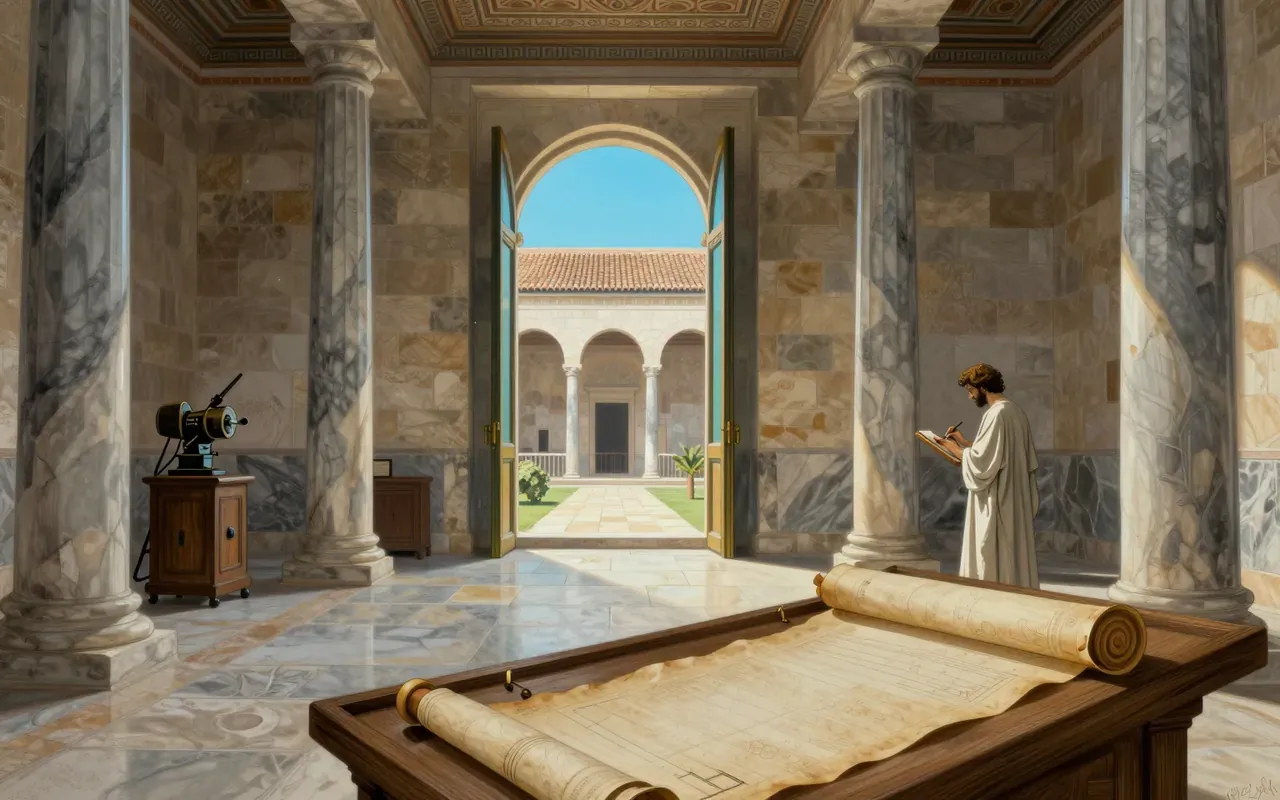
Hypatia didn’t invent new mathematics—she rebuilt the foundations others relied on.
Hypatia’s scholarly impact rests on verified editorial and pedagogical interventions—not original theorems or surviving texts. Her corrections to the Almagest and her Arithmetica commentary shaped astronomical and algebraic transmission across centuries. No evidence supports claims of independent philosophy or breakthrough mathematics. Her work matters as infrastructure: quiet, precise, indispensable.
She corrected Ptolemy’s text—not her father’s notes—establishing direct textual authority over the Almagest.
2:43
The Arabic Link
Her lost Arithmetica commentary is the only plausible source of key material preserved in Arabic manuscripts.
4:44
Computation for the Sky
She improved long division—not for abstraction, but for the daily arithmetic of celestial prediction.
6:36
Lost Work, Known Range
Her commentary on Apollonius’s conic sections survives only as a title—evidence of scope, not substance.
Worth your time?
Yes. Study the whole thing.
4/ 5
What works
editing Book III of the Almagest text itself
providing the most likely source of Arabic additions to Diophantus
improving long-division algorithms for astronomy
What does not
independent philosophical works
groundbreaking mathematical discoveries
surviving commentaries
confirmed authorship of the Astronomical Canon
Study it if
historians of science
mathematical practitioners interested in transmission
students of late antiquity
Skip it if
those seeking proof of early female genius narratives
readers expecting recovered treatises or revolutionary theorems
The written brief1 min read
What the work claims
That Hypatia was a leading mathematician of her day whose editorial and computational work directly shaped astronomical practice in late antiquity.
How it was done
Hypatia edited Book III of Ptolemy’s Almagest by correcting the text itself—not her father Theon’s commentary. She wrote commentaries on Diophantus’s Arithmetica and Apollonius’s conic sections. She devised an improved long-division algorithm for astronomical computation. She may have compiled an ‘Astronomical Canon’, possibly a new edition of Ptolemy’s Handy Tables or a commentary on the Almagest.
What holds up
Her editing of Book III of the Almagest text itself is established. Her commentary on the Arithmetica is the only known ancient one—and the most likely source of Arabic additions. Her improved long-division algorithm is attested as a contribution to astronomical computation.
What does not
No independent philosophical works are attested. No groundbreaking mathematical discoveries are documented. Her commentaries do not survive. Nothing confirms she authored the ‘Astronomical Canon’—only that it is attributed to her.
Why it matters beyond the lab
It repositions editorial rigour—not just invention—as central to scientific continuity. It shows how transmission, correction, and pedagogical refinement sustained technical knowledge across linguistic and political ruptures.
Is it worth your time
Yes—if you care about how ancient mathematical authority was maintained, transmitted, and quietly refined. Not for claims of original discovery, but for evidence of rigorous editorial labour that shaped centuries of astronomical practice.