What the work claims
Geometry is the study of properties invariant under transformation groups. Non-Euclidean geometry has equal logical status to Euclidean geometry. A closed one-sided surface exists that cannot embed in ℝ³. A complex curve with maximal automorphism group PSL(2,7) exists in projective space.
How it was done
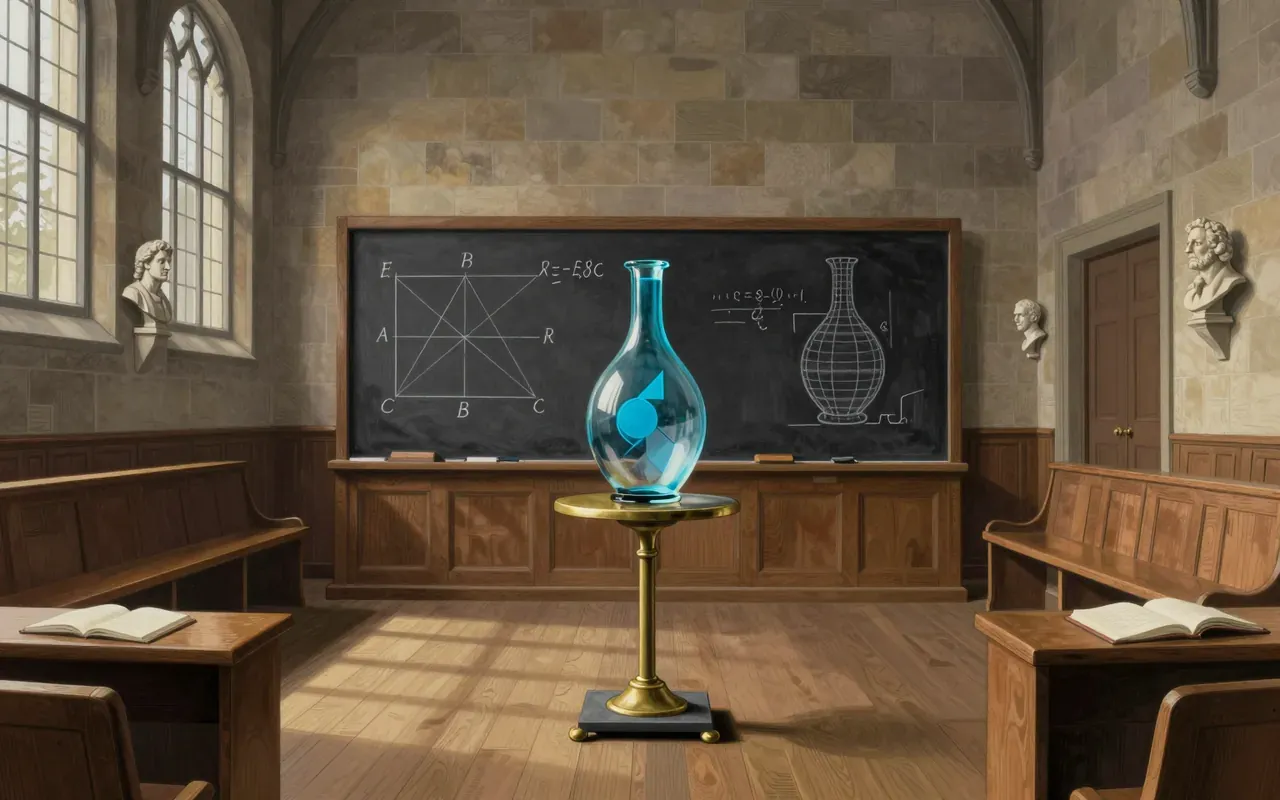
Klein classified geometries by their symmetry groups in the Erlangen program (1872). He used the Cayley–Klein metric to treat Euclidean and non-Euclidean geometries as metric spaces (1871). He devised the Klein bottle as a one-sided closed surface that immerses—but does not embed—in three-dimensional Euclidean space. He examined the action of PSL(2,7) on the complex plane to construct the Klein quartic (1879).
What holds up
The Erlangen program’s classification of geometries by symmetry groups holds. The Cayley–Klein metric’s role in equating consistency of Euclidean and non-Euclidean geometry holds. The Klein bottle’s immersion property holds. The Klein quartic’s equation x³y + y³z + z³x = 0 and its symmetry group PSL(2,7) of order 168 hold.
What does not
The sources do not establish any experimental validation, physical realisation, or technological application. They report no replication, no refutation of alternatives, no consensus-building beyond mathematics, and no extension to physics, engineering or computation.
Why it matters beyond the lab
It redefined geometry as structural rather than spatial—enabling later developments in relativity, gauge theory and topology—but only as conceptual scaffolding, not as applied tool or predictive framework.
Is it worth your time
Yes—if you need to understand how geometry became a language of invariance and group action. No—if you expect empirical data, experiments, or computational applications.