A twin for the electron, on paper
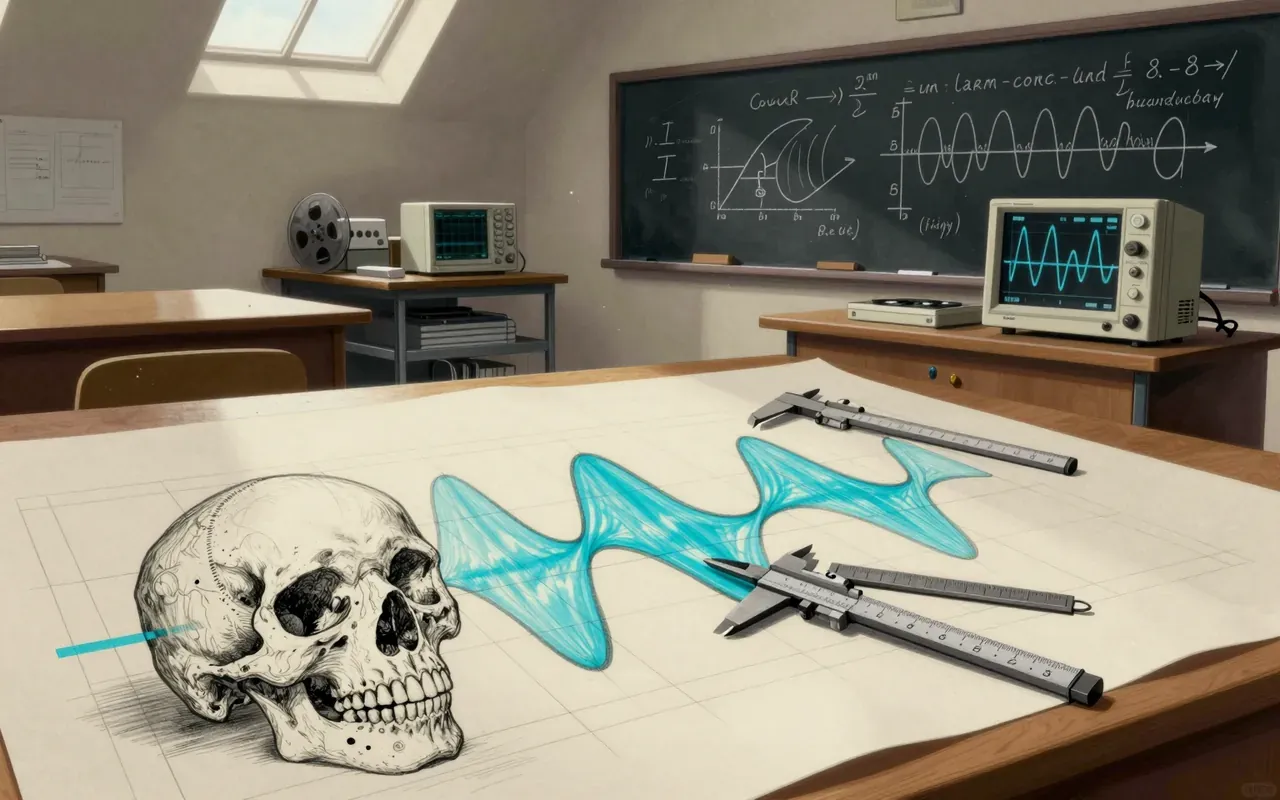
In 1932, Carl Anderson photographed a track in a cloud chamber that curved the wrong way for an electron: it had an electron’s mass but a positive charge. The particle matched what Paul Dirac had predicted theoretically a few years earlier, when solving his relativistic equation for the electron produced solutions that seemed to require a positively charged twin, an idea Dirac had initially struggled to interpret before proposing outright, in 1931, that an unobserved “anti-electron” should exist. Anderson’s photograph gave that prediction a physical object: the positron, identical to an electron in mass and spin but opposite in charge, and capable of annihilating an ordinary electron on contact, releasing the energy as photons. It was the first antimatter particle ever detected, confirming that Dirac’s mathematics described something real rather than a formal curiosity in the equations.
A track that curved the wrong way
Anderson, working at Caltech under Robert Millikan, was studying cosmic rays with a cloud chamber, a device that makes the paths of charged particles visible as trails of droplets. He placed a lead plate across the chamber and surrounded the whole apparatus with a magnet, so that a particle’s track would curve one way or another depending on its charge, and would lose some energy and bend more sharply after crossing the lead plate, which showed which direction the particle was actually travelling rather than leaving that ambiguous. The photograph showing a track curving as if from a positive electron, and slowing down after the plate in a way consistent with an upward-moving particle, was the direct evidence for the positron. Further confirmation followed soon after, when gamma rays directed into dense material were shown to produce electron-positron pairs, matching Dirac’s theory of how positrons should be created from energy.
A lead plate to settle the direction
The discovery has held up completely: positrons are now routine, understood particles rather than a contested claim, produced deliberately in laboratories through pair production and observed naturally in radioactive decay and cosmic-ray showers exactly as the original theory and Anderson’s experiment described. Anderson received the 1936 Nobel Prize in Physics, shared with Victor Hess, for identifying the particle, and the broader idea it confirmed, that Dirac’s equation implied a whole mirror-world of antimatter partners for ordinary particles, has since been extended and confirmed for other particles as well, including the antiproton. The specific experimental method, a magnetised cloud chamber with a plate to break the ambiguity in direction, became a template that Anderson himself reused a few years later to identify a second new particle, the muon, in the same cosmic-ray data.
From one particle to a whole category
What the original 1932 result did not settle, and could not have, was how far the concept of antimatter would generalise, or why the universe around us is made almost entirely of ordinary matter rather than a mixture of matter and antimatter in equal amounts. Those questions belong to later physics and cosmology, not to Anderson’s cloud chamber photograph, which demonstrated one particle’s existence and no more. The discovery also did not, by itself, explain why positrons are so rare in the everyday world despite being straightforward to produce in a laboratory: they annihilate on contact with ordinary matter almost immediately, which is why cosmic rays and particle accelerators, rather than any naturally occurring stockpile, remain the practical sources.
What the discovery left unanswered
The clearest everyday consequence of Anderson’s discovery is medical rather than theoretical. Positron emission tomography, now a standard hospital imaging technique, works by injecting a substance carrying a positron-emitting isotope and detecting the paired photons released when each positron meets an electron and annihilates, letting doctors build a three-dimensional map of metabolic activity inside the body. None of this required resolving deeper questions about antimatter’s cosmological role; it needed only the same physical process Anderson photographed, put to a practical use decades later. Positron-electron collisions are also still used directly in particle physics, in accelerators designed specifically to smash the two together to study fundamental interactions and search for new particles.
From cosmic rays to hospital scanners
This is a tight, well-confirmed story and a good introduction to how theoretical physics gets tested: a strange mathematical consequence of Dirac’s equation, initially unclear even to Dirac himself, turned into a specific, falsifiable prediction and then into a photograph of an actual particle within a few years. It is worth the time for the clarity of that arc alone, since few discoveries move so cleanly from equation to laboratory confirmation to Nobel Prize. It also rewards attention for what came after: the same cloud-chamber technique caught a second unexpected particle, the muon, prompting the famous question of who had ordered it, and the positron itself ended up inside hospital scanners rather than staying confined to particle physics. Readers wanting the deeper cosmological puzzle of matter-antimatter imbalance will need to look elsewhere.