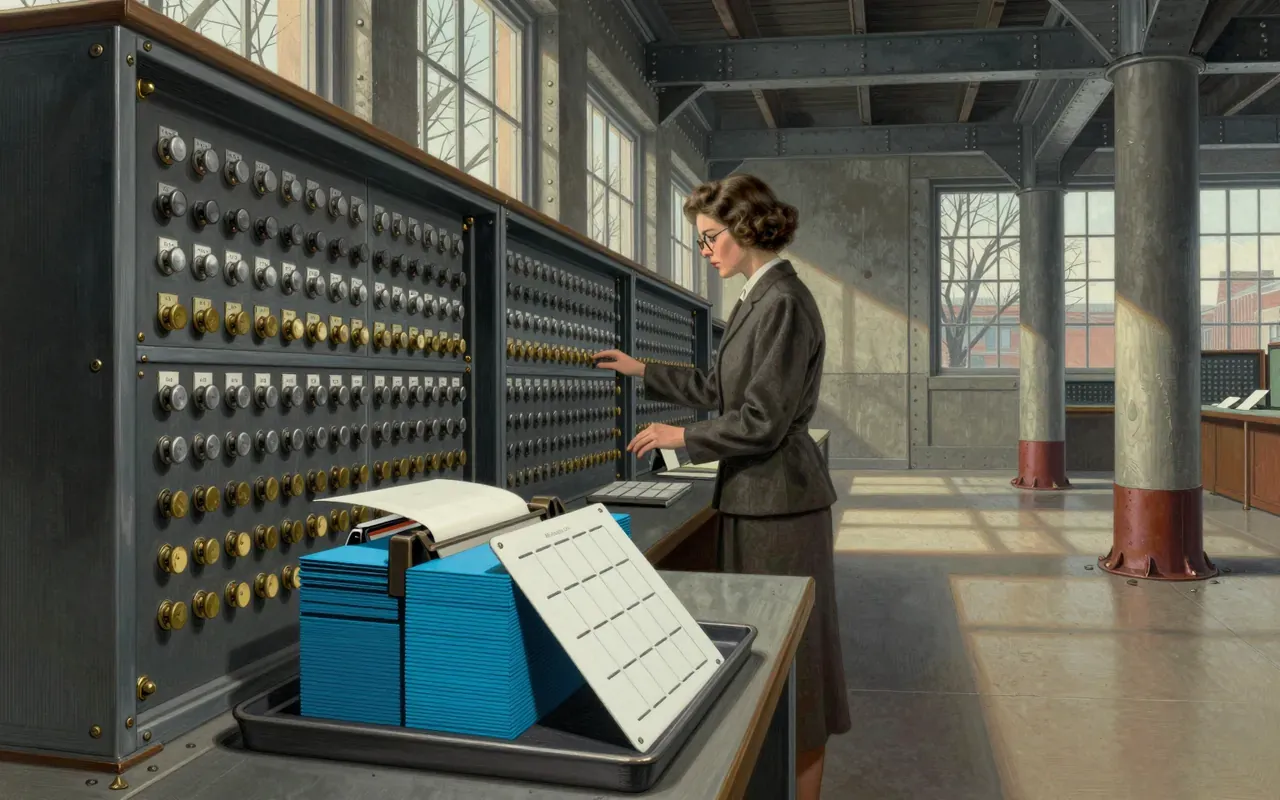
She didn’t invent the compiler—but she proved code didn’t need to speak machine to get work done.
Grace Hopper demonstrated that programming could be abstracted from hardware using English-like syntax—and that abstraction could be standardised, shipped, and scaled. Her work did not originate compilation, but it proved its utility beyond academia. It made programming legible to managers, accountants, and engineers—not just mathematicians. The evidence confirms her role in building, naming, and institutionalising the idea—not in conceiving it in isolation.
In 1952, Hopper delivered an operational link-loader called a compiler for the A-0 System.
2:26
English, Not Algebra
Her compiler translated English terms—not mathematical symbols—into machine code.
4:06
COBOL Was Designed to Travel
COBOL was machine-independent and built on English words, not hardware-specific logic.
5:35
Mark I: Co-Author, Not Just Operator
She co-authored three foundational papers on the Harvard Mark I with Howard H. Aiken.
Worth your time?
Yes. Study the whole thing.
4.5/ 5
What works
proved compilers could translate English-like syntax
delivered an operational link-loader in 1952
helped standardise COBOL as machine-independent
co-authored definitive Mark I documentation
What does not
invented the first compiler
single-handedly created COBOL
worked outside institutional collaboration
Study it if
historians of computing
software engineers curious about language design origins
students confronting the myth of lone inventors
Skip it if
anyone seeking technical details of A-0’s instruction set
those looking for COBOL’s runtime architecture
readers expecting evidence of broader cultural impact
The written brief1 min read
What the work claims
That programming could be decoupled from hardware via English-like syntax and automated translation—and that this approach could be standardised across machines.
How it was done
Hopper developed a compiler that converted English terms into machine code. She built the A-0 System’s program linker by 1952. She co-authored three papers on the Harvard Mark I with Howard H. Aiken. She helped create COBOL through the CODASYL consortium in 1959.
What holds up
Her 1952 A-0 link-loader was operational and called a compiler at the time. Her compiler translated English terms into machine code. COBOL was machine-independent and English-based. She co-authored three Mark I papers with Aiken.
What does not
The material does not support claims that Hopper invented the first compiler in absolute terms. It does not say she wrote the first high-level language, only that FLOW-MATIC and COBOL were English-based and machine-independent. It does not attribute the conceptual origin of compilation to her alone.
Why it matters beyond the lab
It established the principle that software could outlive hardware. That made large-scale data processing viable for government and business. It enabled non-mathematicians to write instructions for computers.
Is it worth your time
Yes—if you need to understand how programming languages escaped hardware lock-in. No—if you assume COBOL was her sole invention or that she ‘invented the compiler’ as a singular, first-of-its-kind act.
In 1735 Leonhard Euler proved that no walk through Königsberg could cross all seven of its bridges exactly once, by throwing away the map entirely and reducing the city to dots and lines — the first proof in what became graph theory, and arguably the birth of topology.