sciencebriefs
Applied science

Computing & AI

47
briefs
11:00
average
517 min
in total
23
researchers
All briefs47
10:48

Ada Lovelace

Lovelace didn’t write code — she wrote the first argument for what code could mean.
10:30

Alan Turing

Turing didn’t invent the computer — he proved what computation *is*, and where it must stop.
10:16

AlexNet

Depth won the 2012 ImageNet challenge—not cleverness, not data, not theory, but raw, GPU-fuelled layer count.
9:31

Arieh Warshel

He did not explain enzymes—he built the first working computational microscope for them.
10:37

Bayes' theorem

Thomas Bayes · 1763

Bayes's 1763 essay solves a narrow inverse probability problem using conditional probability. It computes limits on a binomial parameter—not a general theory of belief updating. Its power lies in precision, not generality.
13:00

Boolean algebra

George Boole wrote down an algebra for pure logic in 1854 with no interest in machinery; Claude Shannon's 1937 thesis is why every digital computer runs on it anyway.
13:00

Cellular automaton

Von Neumann built a grid of simple cells following fixed local rules to answer a question about machines copying themselves, and the idea outgrew its original purpose entirely.
9:03

Claude Shannon

Shannon didn’t invent the computer — he proved electricity could think.
10:06

David Hilbert

Hilbert didn’t build tools—he built the rules for building tools, and then proved some tools can’t be built at all.
10:18

Neural network (machine learning)

Geoffrey Hinton and others

Geoffrey Hinton and colleagues established core methods—backpropagation for representation learning, and Boltzmann machines for unsupervised deep generative modelling—between 1985 and 1995. Their work was grounded in statistical mechanics, experimentally verified on small-scale networks, and explicitly recognised as foundational for machine learning with artificial neural networks. It did not deliver production AI, nor claim to.
10:47

Emmy Noether

Noether didn’t just find links between symmetry and conservation—she rebuilt mathematics so those links were inevitable.
13:00

Hamming code

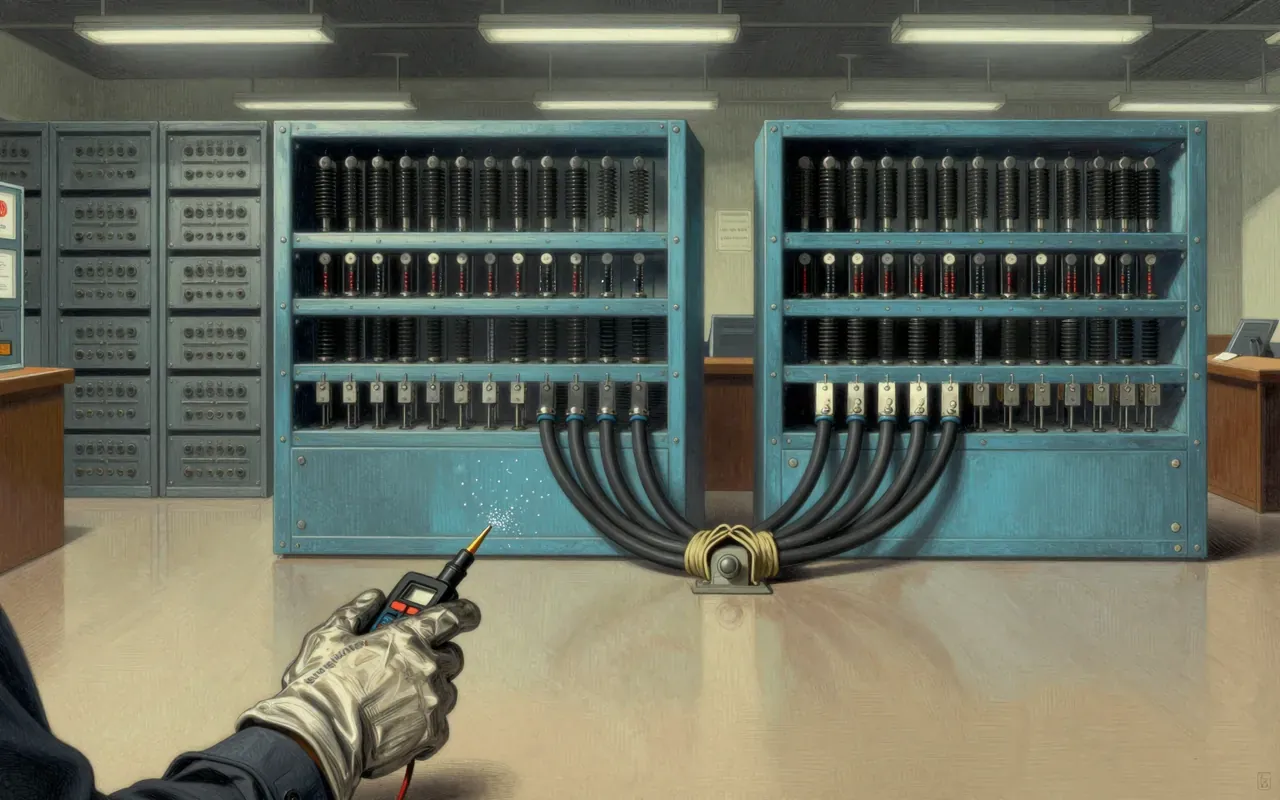
Richard Hamming got tired of his weekend calculations being thrown out over an error the machine could detect but not fix, so in 1950 he built a code that could do both.
10:54

Évariste Galois

Galois didn’t just solve an old problem — he invented the language to say why some problems can’t be solved at all.
9:44

Georg Cantor

Cantor didn’t discover infinity — he broke it into pieces you can count, compare, and order.
10:00

George Boole

Boole didn’t invent computing — he invented the grammar that lets silicon speak.
13:34

Gödel's incompleteness theorems

Kurt Gödel

Gödel’s 1931 incompleteness theorems show that no consistent, effectively axiomatized formal system capable of arithmetic can be both complete and self-consistent. They ended Hilbert’s program. Their method — Gödel numbering and diagonalisation — became foundational for computability theory. They do not apply outside formal systems satisfying strict technical conditions.

9:34

Grace Hopper

She didn’t invent the compiler—but she proved code didn’t need to speak machine to get work done.
10:26

Hedy Lamarr

A Hollywood actress co-patented a jam-proof torpedo system — but never saw it built, tested, or used.
9:58

Hilbert's problems

David Hilbert

Hilbert’s problems are not a discovery in the empirical sense. They are a curatorial act—23 unsolved questions published in 1900 to define mathematics’ trajectory for the next century. Their influence stems from uptake, not truth. They succeeded because mathematicians treated them as a syllabus—not because they were complete, precise or even consistent.
11:29

Entropy (information theory)

Claude Shannon

Shannon’s 1948 theory redefined communication as a mathematical problem of uncertainty reduction. He proved entropy is the irreducible cost of lossless encoding — not a metaphor, not a heuristic, but a bound. It applies only where messages are statistically structured, and only to syntactic information — never semantics. Its power lies in its narrowness.

10:03

John von Neumann

Von Neumann didn’t build computers—he built the logical floor they stand on, and then proved the floor could hold two floors at once.
10:04

Kurt Gödel

Gödel didn’t break mathematics — he mapped its borders with surgical precision.
13:00

Lambda calculus

Alonzo Church built computation from three constructs and one substitution rule in the 1930s, a system minimal enough that its equivalence to Turing machines still defines what "computable" means, and specific enough to have real blind spots.
10:34

Norbert Wiener

Wiener didn’t invent AI — he invented the idea that purpose could be noise-filtered, feedback-driven, and machine-simulable.
13:00

Perceptron

A 1958 Navy press conference promised a machine that would walk, talk and think; what Frank Rosenblatt had actually built was a simple trainable classifier, and a decade later a single technical proof about it nearly ended neural-network research.
9:44

Shor's algorithm

Shor · 1994

Shor’s algorithm is a quantum algorithm for integer factorisation, developed by Peter Shor in 1994. It runs in polynomial time in log N and places factorisation in BQP. It is asymptotically faster than the general number field sieve.

8:32

Antikythera mechanism

The Antikythera mechanism proves ancient Greeks built analogue computers — not myth, not reconstruction, but physical evidence.
11:03

Church–Turing thesis

Alonzo Church and Alan Turing

The Church–Turing thesis is not a theorem but a foundational assumption — one that equates human-effective calculation with machine computation. It holds because no counterexample exists, not because it is proven. Its endurance is its strength — and its limitation.
13:00

Colossus computer

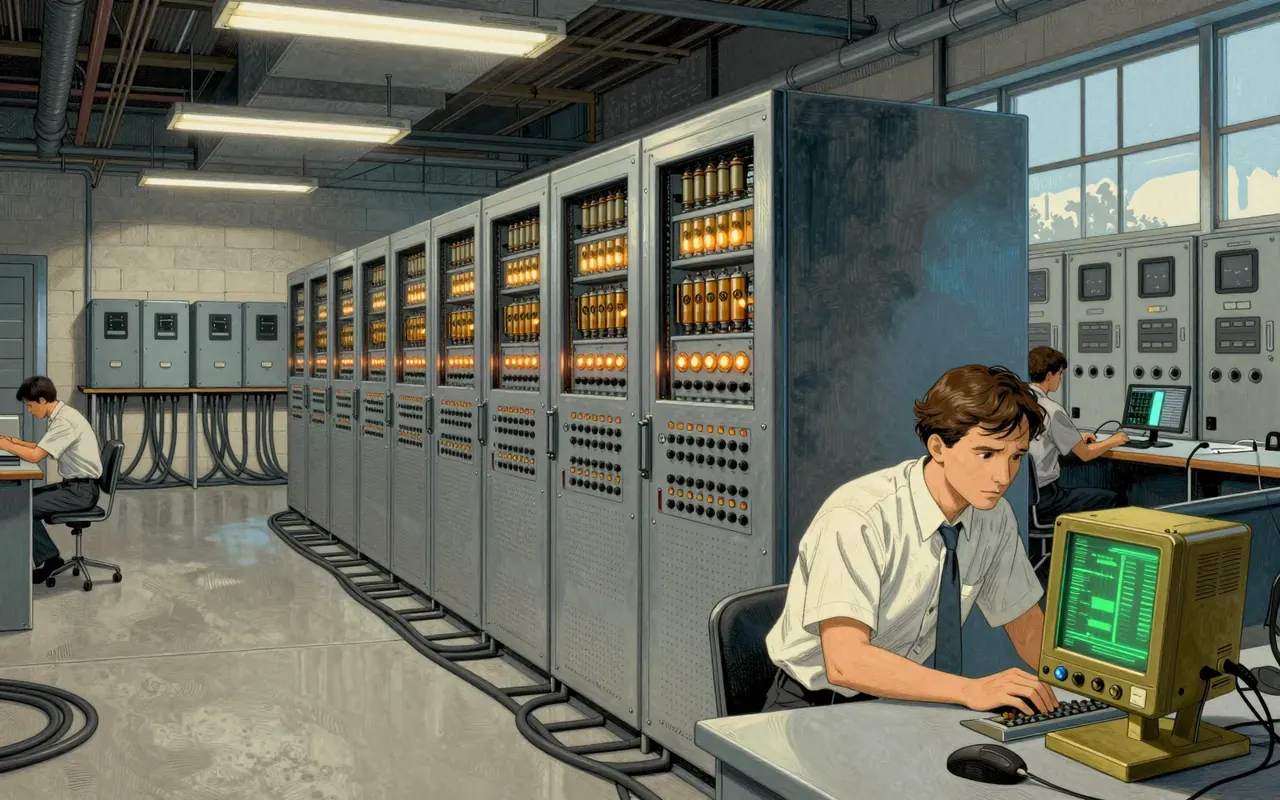
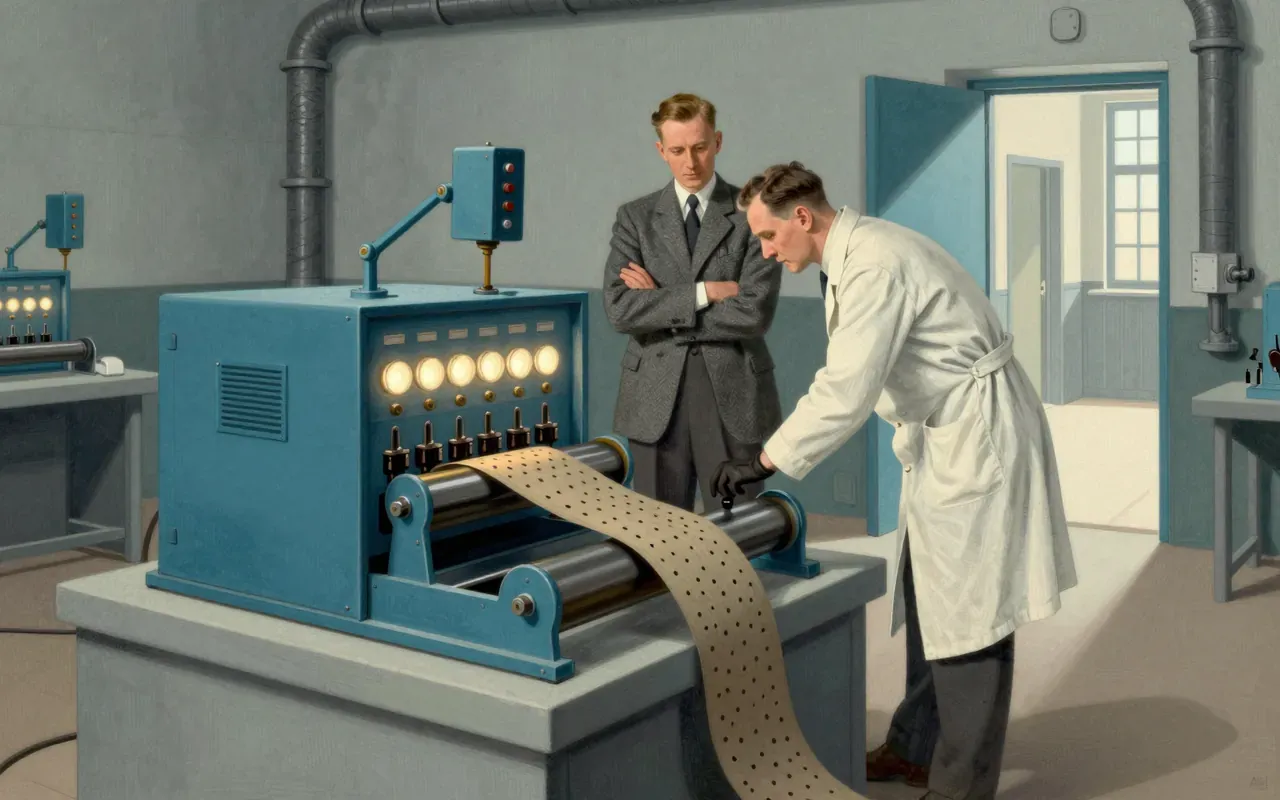
Tommy Flowers built Colossus on a bet that thousands of valves could run reliably where convention said hundreds was the limit. It worked, breaking Lorenz traffic through the war's final years — then vanished into thirty years of secrecy.
9:52

Dartmouth workshop

The Dartmouth workshop didn’t build AI — it invented the idea that AI could be built.
13:00

ENIAC

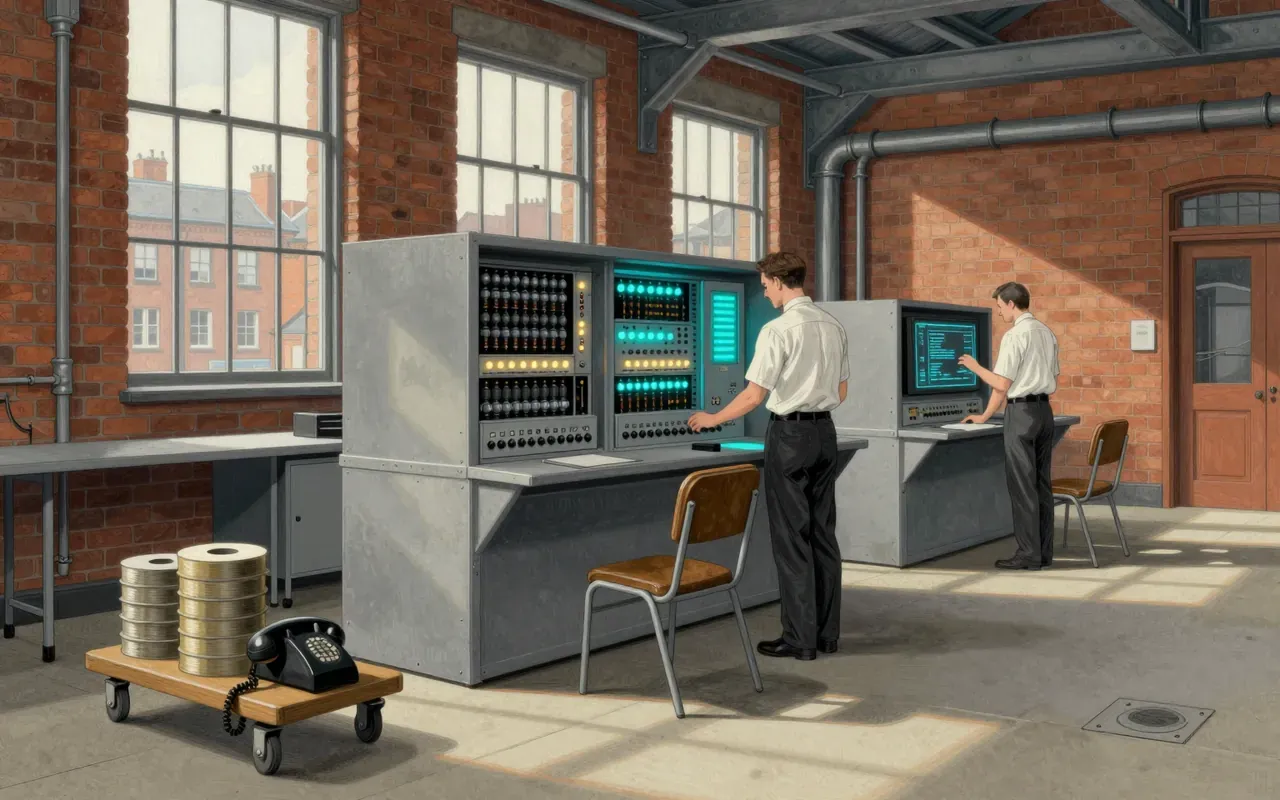
ENIAC filled a room, ate 150 kilowatts, needed weeks to reprogram by rewiring plugboards, and was legally stripped of its patent in 1973 when a court ruled its core idea had come from a machine most people had never heard of.
13:00

Numerical weather prediction

Richardson's 1922 hand-calculated weather forecast was correct in method but wildly wrong in result, and it took until a 1950 computer at ENIAC to finally calculate weather faster than the weather itself changed.
13:00

Halting problem

Turing's 1936 proof that no algorithm can tell, for every program and input, whether that program will ever stop running set a permanent boundary on what computation can decide.
13:00

Integrated circuit

Two engineers solved the same wiring problem months apart in 1958 and 1959, and it was the less-famous first version, not the one modern chips descend from, that reached the Nobel committee.
11:07

Mandelbrot set

Benoit Mandelbrot

Mandelbrot visualised a known mathematical object with unprecedented clarity — making topology legible through computation.
13:00

P versus NP problem

Stephen Cook's 1971 paper didn't solve P versus NP — it proved one problem could stand for all of them, which is why the question cryptography rests on is still open.
13:00

Transistor

Three Bell Labs physicists built a working solid-state amplifier in December 1947, and the falling-out that followed shaped how the transistor reached the market as much as the physics did.
9:04

Turing test

Alan Turing

The Turing test is a precise, behaviour-first redefinition of intelligence—not proof of thought, but a standard for functional equivalence in dialogue. It endures because it is simple, testable, and ruthlessly limited.
13:00

Transformer (deep learning)

A 2017 Google paper argued attention alone, without the recurrent processing every prior language model relied on, could handle sequences better and in parallel, and that architectural bet underlies essentially every large language model built since.
13:00

Turing machine

Alan Turing's 1936 paper described a machine that never got built, made of an infinite tape and a table of rules, to answer a narrow question about mathematical logic — and in doing so proved some problems can never be solved by any computer at all.
9:11

Schrödinger's cat

Erwin Schrödinger

Schrödinger's cat is a 1935 thought experiment designed by Erwin Schrödinger in correspondence with Einstein to critique the Copenhagen interpretation of quantum mechanics. It uses a sealed chamber containing a cat, radioactive source, Geiger counter, relay, hammer, and flask of hydrocyanic acid. The setup links a single quantum event — atomic decay — to a macroscopic outcome. Mathematically, the wave function describes a superposition of 'alive' and 'dead', yet observation always reveals one definite state. Schrödinger intended this as reductio ad absurdum, not as a proposal. No experiment was conducted. The work establishes a tension between formalism and observation — nothing more.

7:51

Double-slit experiment

Young · 1801

Young’s 1801 double-slit experiment established wave behaviour for visible light. Later versions with electrons (1927) extended it to matter. The interference pattern is real. The disappearance of that pattern upon path detection is real. But Young did not observe particles, nor did he claim duality — he argued for waves only. Duality emerged from later experiments combining his method with quantum detection.