Replacing the vacuum tube
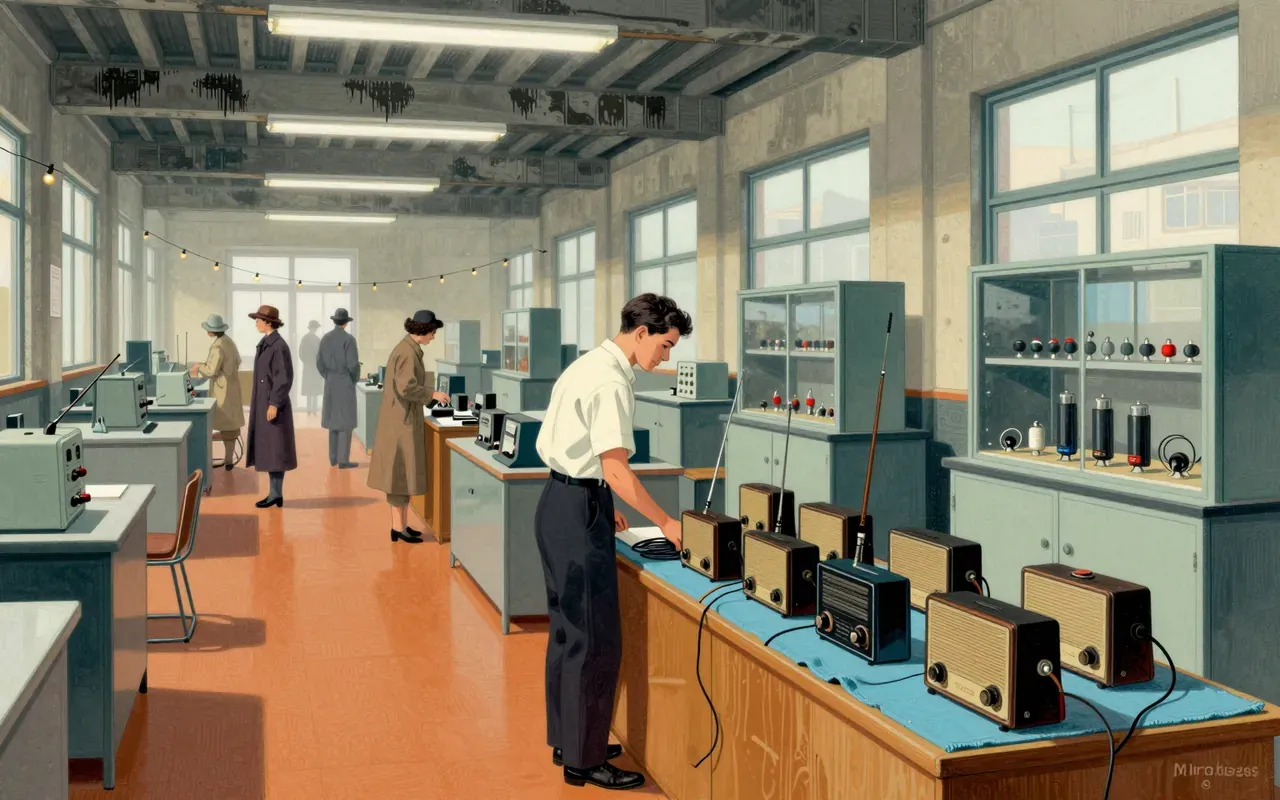
On 23 December 1947, John Bardeen and Walter Brattain, working at Bell Laboratories, demonstrated a small germanium device that could amplify an electrical signal using two closely spaced metal contacts pressed against the semiconductor’s surface. It was the first working transistor, and its purpose from the outset was explicit: to find a solid-state replacement for the vacuum tube, which amplified and switched signals well enough but was bulky, fragile, slow to warm up, and wasteful of power. The team’s laboratory notes from earlier that month recorded modest but real gain in both power and voltage, and the December demonstration itself was performed as a working speech amplifier in front of colleagues, proof that the effect was not a laboratory fluke but a usable circuit element.
The December demonstration
The device’s operating principle depended on controlling current through a semiconductor by applying a small signal at one point of contact and reading an amplified result at another, exploiting the peculiar behaviour of charge carriers at a semiconductor surface rather than the free electrons moving through a vacuum inside a tube. William Shockley, who headed the Bell Labs semiconductor group, had been pushing toward a different design based on a field effect and was not part of the specific breakthrough that Bardeen and Brattain achieved. When he learned how the successful device had come together without him directly involved, he took it as a slight, and Bell Labs’ own patent lawyers made things worse for him by finding his written ideas for a transistor too close to an existing 1925 patent to include his name safely on the application for the point-contact device.
A falling-out over credit
The physics behind the point-contact transistor held up: it amplified, it worked reliably enough to demonstrate publicly, and it established that a solid-state amplifier built from a semiconductor was genuinely possible, which is what the 1956 Nobel Prize in Physics ultimately recognised in all three men jointly, for their research into semiconductors and the transistor effect rather than for any single device. Shockley’s response to being sidelined was to develop his own, structurally different junction transistor within a few years, and that design turned out to be considerably easier to manufacture reliably at scale than the original point-contact geometry, which made it the version that Bell Labs licensed out and that spread through the electronics industry.
A second, better design
What does not hold up as cleanly is the idea of a single, unified team celebrating one invention together. The rivalry between Shockley and the pair he felt had gone around him was real and lasting, and it shaped Shockley’s subsequent career, including his decision to leave Bell Labs and start his own company, which in turn seeded much of what became Silicon Valley’s semiconductor industry. The point-contact transistor itself, moreover, was never the design that went on to dominate; it was superseded fairly quickly by junction transistors and later by entirely different structures, so the object first demonstrated in December 1947 is now mostly a museum piece rather than an ancestor of any transistor manufactured today.
One prize, two designs
The wider significance sits less in the specific germanium device than in what it proved was achievable at all: a small, solid, low-power component that could do a vacuum tube’s job. Bell Labs licensed the technology to other manufacturers, including Texas Instruments, and commercial production of transistors began in the early 1950s. The device’s leap into ordinary life came through radios rather than computers at first, with the Regency TR-1 launching a market that Sony’s TR-63 later took global, selling in the millions and putting a transistor in a shirt pocket well before it appeared in a home computer. That consumer success mattered because it funded and justified the manufacturing scale-up that later made transistors cheap and reliable enough to become the basic unit of every integrated circuit.
From lab bench to pocket radio
It is worth the time, partly because the science is approachable without an electronics background and partly because the human story, a boss upset at missing his own team’s breakthrough, adds a layer that most technology histories skip past. The demonstration itself is a satisfying, compact episode: a specific date, a specific device, a specific measured gain. Readers wanting the deeper engineering, why a junction transistor manufactures more reliably than a point-contact one, or how the later MOSFET eclipsed both, will need to look further, since this account stops close to where that story begins. But as an entry point into how a single Bell Labs demonstration in December 1947 became the basis of essentially all modern electronics, it earns its place.