A pattern across two dozen galaxies
Hubble’s 1929 paper claimed that galaxies recede from us at speeds that rise roughly in step with their distance: the farther away a galaxy sits, the faster it appears to be moving. This was an empirical pattern read off a small set of galaxies, not a claim about the universe’s origin. Paired with Georges Lemaître’s earlier theoretical derivation of the same relation, and with redshift measurements gathered years before by Vesto Slipher, it became the observational anchor for the idea that space itself stretches and carries galaxies apart as it does. Hubble’s paper did not itself declare the universe was expanding; that reading, and the value later called the Hubble constant, took decades of argument and correction to reach anything like its present form.
The Hooker telescope and the Cepheid trick
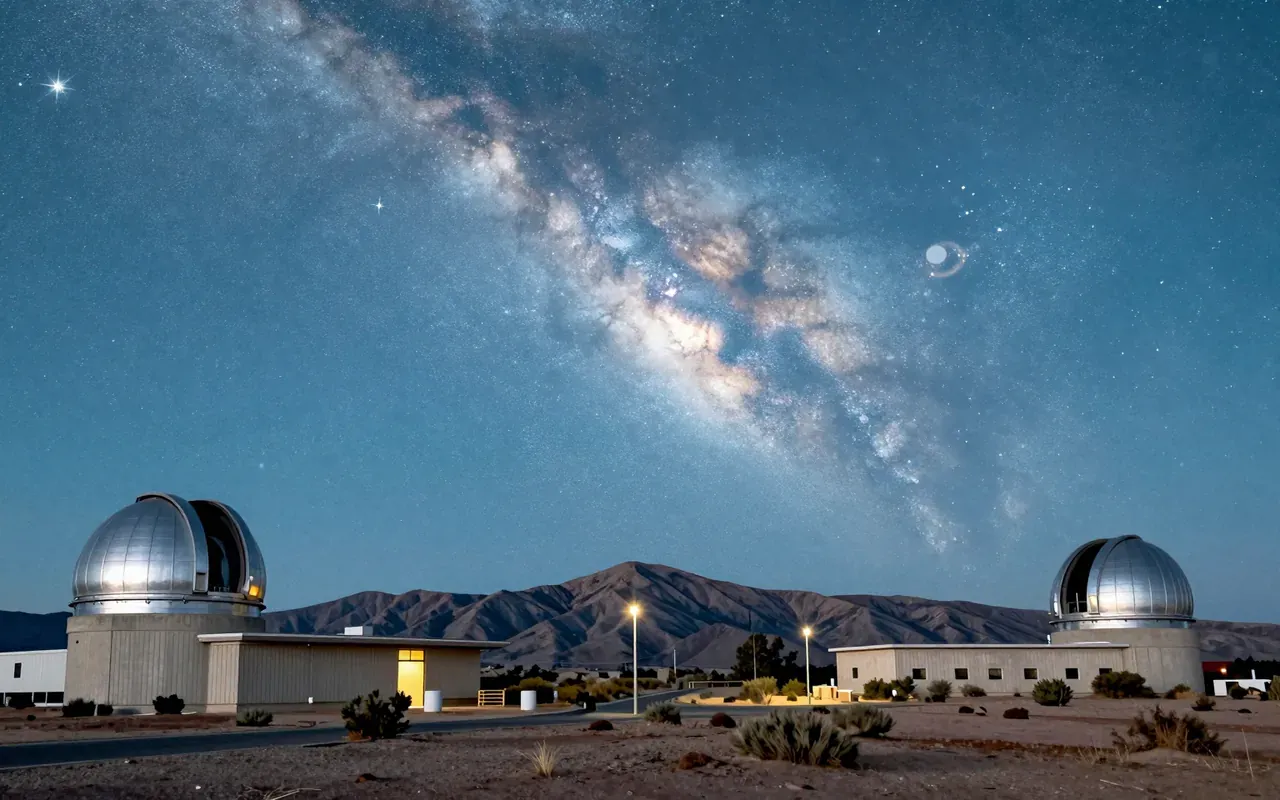
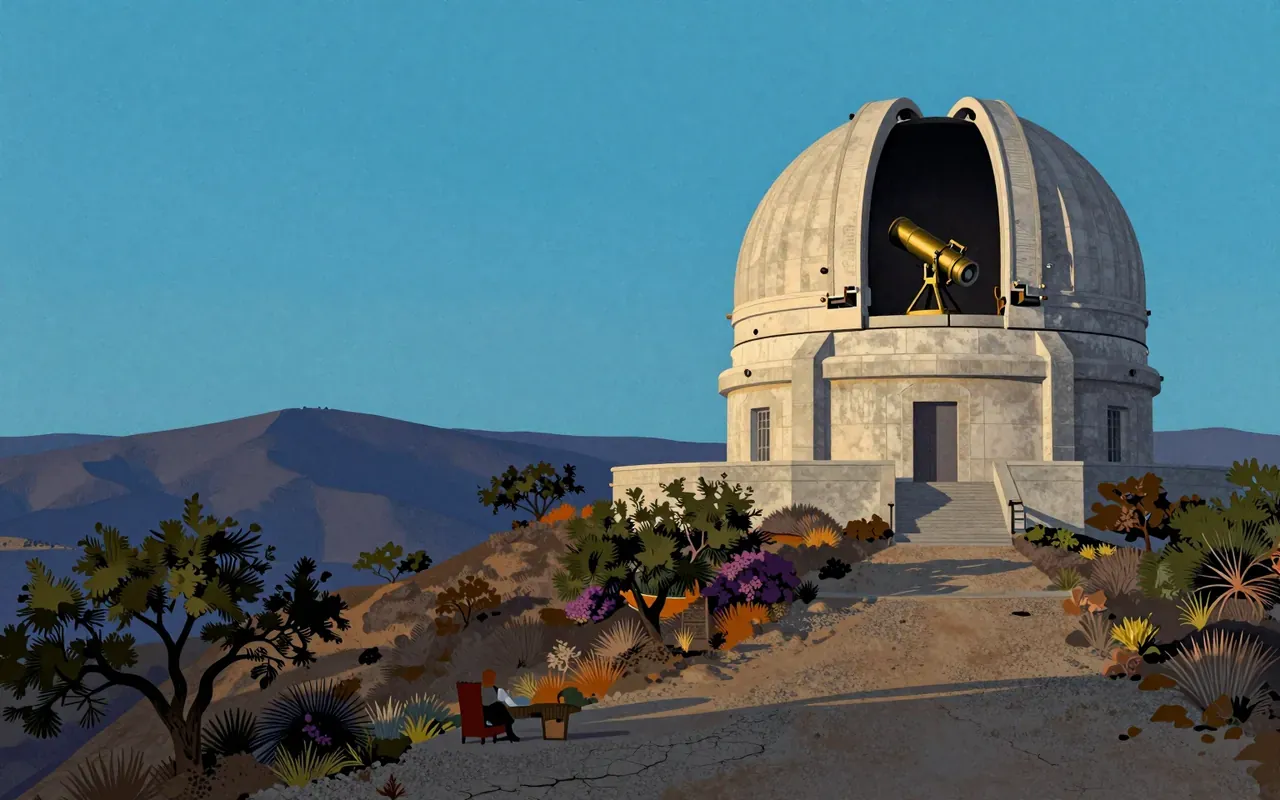
Hubble worked at Mount Wilson Observatory with the Hooker telescope, then the largest in the world, to find Cepheid variable stars in nearby spiral nebulae. A Cepheid brightens and dims on a rhythm tied to its true luminosity, so its apparent faintness gives a distance once that rhythm is measured. Hubble worked this out for roughly two dozen galaxies and set each distance against a recession velocity taken from redshift, a body of spectra built mostly by Vesto Slipher and, increasingly, by Hubble’s colleague Milton Humason. Plotted against each other, distance and velocity produced a rough but unmistakable upward trend. The sample was small and the Cepheid calibration was still crude, yet the correlation itself, that farther galaxies show larger redshifts, held.
Lemaître’s overlooked head start
The proportionality between distance and redshift has held since 1929, refined many times over but never overturned, and it remains the observational basis most often cited for cosmic expansion. Georges Lemaître had derived the same relation theoretically two years earlier, which is why the result is now formally called the Hubble–Lemaître law. The broad shape of the relationship, recession speed rising with distance, has survived a century of better telescopes, better distance indicators and vastly larger galaxy samples. What Hubble got right was the pattern; the numbers built on top of it kept moving. Independent evidence, from the cosmic microwave background to modern distance ladders, converges on the same qualitative picture: the universe is expanding, and this relation is how that expansion is read.
A constant on the move
Hubble’s own value for what is now the Hubble constant, about 500 kilometres per second per megaparsec, was wrong by close to a factor of seven, the result of miscalibrated Cepheid distances. Walter Baade found part of the error in 1952, after realising there were two distinct types of Cepheid, a correction that roughly doubled the accepted scale of the universe overnight. Even after that, the constant sat unresolved for the rest of the century, with rival astronomers defending values as far apart as fifty and one hundred for decades. Today’s version of the disagreement, called the Hubble tension, is narrower but still open: measurements anchored to the early universe and to the nearby distance ladder disagree by a margin large enough that chance is an unlikely explanation, and no consensus yet says why.
The tension that reappeared
The redshift-distance relation is the reason cosmology treats the universe as having a history rather than a fixed, static size. It gave Einstein grounds to abandon the term he had inserted into his equations purely to keep the universe from expanding on paper, a move he later called his greatest mistake, and it turned Lemaître’s mathematics into a claim about a real, changing cosmos. Every later estimate of the universe’s age, every model of galaxy formation, and every account of how dark energy affects the rate of expansion rests on some descendant of this relation. That the constant is still disputed is not a minor footnote to an otherwise settled subject; it is an active crack in the foundation of precision cosmology, and closing it is one of the field’s central open problems.
What the number still owes cosmology
This is worth the time if what draws you in is how an imprecise 1929 measurement became load-bearing for an entire field, mistakes included. The story earns its length in the gap between Hubble’s two results: he was roughly right about the pattern and badly wrong about the scale, and most of the interesting history sits in that gap, including Lemaître’s overlooked priority, Baade’s overnight doubling of the universe, and decades of astronomers defending rival numbers. Readers wanting a tidy triumph should look elsewhere. Readers curious about how provisional even a foundational result can remain, well into the era of space telescopes, will find the still-unresolved Hubble tension a genuinely live thread rather than a piece of settled history.