Two forty-minute talks
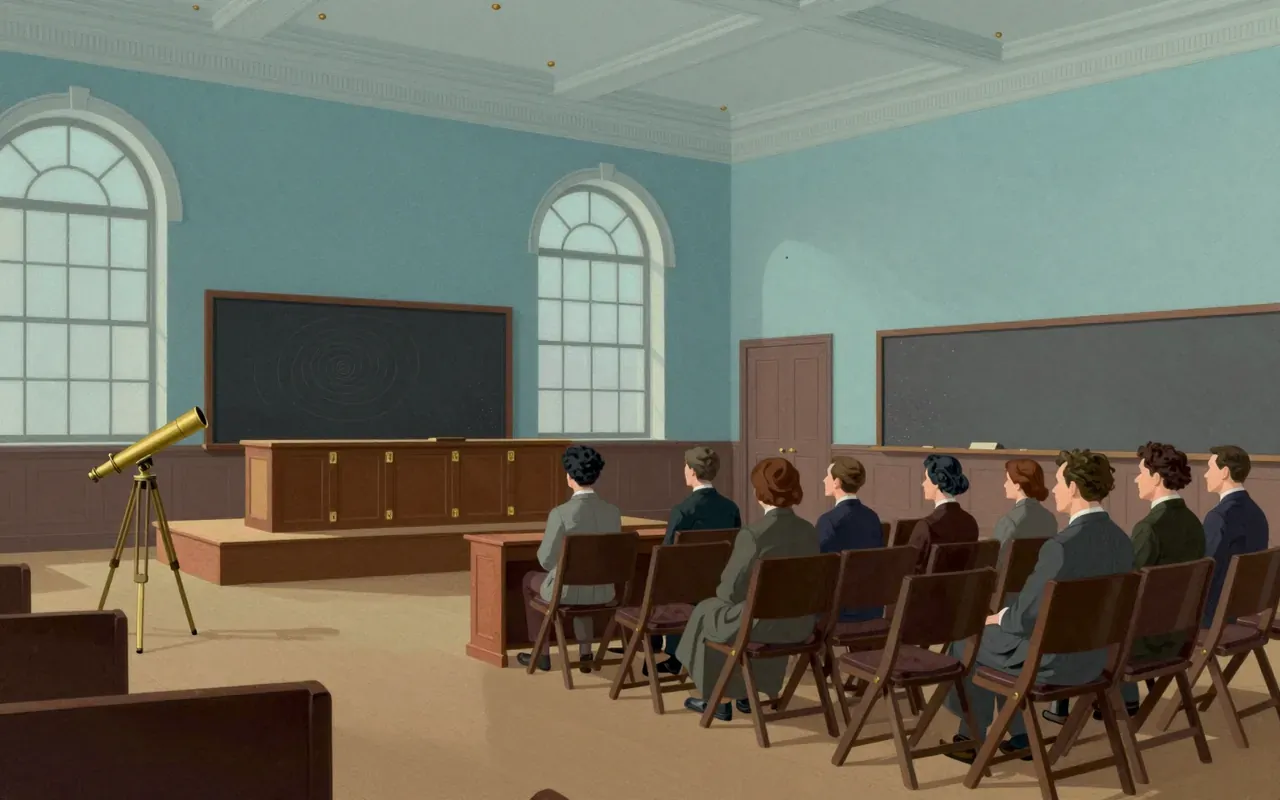
On 26 April 1920, at a meeting of the National Academy of Sciences held at the US National Museum in Washington, two astronomers, Harlow Shapley and Heber Curtis, each gave a forty-minute presentation on the scale of the universe. The question at stake was whether the Milky Way was the entirety of the cosmos or one galaxy among many. Shapley argued for a single, enormous Milky Way, roughly 300,000 light years across, with spiral nebulae such as Andromeda no more than features on its outer edge. Curtis argued the opposite: a considerably smaller Milky Way, around 30,000 light years across, coexisting with spiral nebulae that were themselves separate, distant galaxies comparable in scale to our own.
One galaxy or many
Shapley built his case on globular clusters and Cepheid variable stars, using the period-luminosity relation established by Henrietta Swan Leavitt to gauge distances and map how the clusters were distributed around the galaxy, from which he placed the Sun well away from the centre. He also cited a bright nova seen in Andromeda in 1885, which briefly outshone the entire nebula, and a claimed observation by Adriaan van Maanen that a spiral nebula was visibly rotating, a result that would be essentially impossible if the nebula were as large and distant as Curtis proposed. Curtis, in turn, pointed to the far greater number of novae recorded in Andromeda than in the Milky Way, to the unexpectedly large recession speeds measured for spiral nebulae, and to dust obscuration as a shared explanation for why few nebulae appeared along the Milky Way’s own plane.
The evidence each side brought
Parts of each man’s case have held up well. Shapley’s placement of the Sun away from the galactic centre, derived from the spread of globular clusters, remains accepted and reshaped where humanity sits within its own galaxy. Curtis’s central claim, that the spiral nebulae are independent galaxies rather than features of the Milky Way, was likewise vindicated. The debate itself is remembered less for either man being simply right than for how directly it set two testable pictures of the universe against each other in public, using the observational evidence each side actually had rather than appeals to authority or intuition, which is unusual enough in scientific history to be worth noting on its own.
Who was right about what
Neither man’s specific numbers survived. Shapley’s estimate that the Milky Way spanned some 300,000 light years proved too large, and Curtis’s estimate of roughly 30,000 light years proved too small; the true figure fell between the two. Shapley’s broader claim that the Milky Way constituted the entire universe turned out to be wrong, and one of his supporting data points, van Maanen’s claimed detection of a spiral nebula rotating, did not hold up either, since a real rotation of that kind was incompatible with the nebula being as distant as it in fact is. The 1885 nova that Shapley leaned on also had a different explanation than either debater assumed: it was later recognised as a supernova, extraordinarily bright for reasons unrelated to the nebula’s true size.
Hubble settles it
The central question was resolved within a few years, not by further debate but by better measurement. Edwin Hubble found Cepheid variable stars in the Andromeda nebula and used their known period-luminosity relation to calculate a distance far too great for Andromeda to be part of the Milky Way, confirming Curtis’s basic claim that spiral nebulae are separate galaxies. That single result reframed the Milky Way from the whole of creation into one galaxy among an enormous population, now estimated at somewhere between roughly 200 billion and 2 trillion galaxies in the observable universe. It marks the practical beginning of extragalactic astronomy as a field, and of cosmology as a science built on measured distances rather than assumed scale.
Is it worth your time
This is a good subject for anyone who likes watching an argument actually get settled rather than simply fade away. Both debaters were reasoning carefully from real evidence, and both were still substantially wrong about the numbers that mattered, which is a more honest picture of how science often proceeds than a story with a single clear winner from the outset. Shapley’s own graceful acceptance of Hubble’s later evidence against his position adds a human note to what could otherwise read as a purely technical dispute. It rewards an hour from anyone curious about the moment the universe stopped being one galaxy and became billions.