Species count as a balance, not a fixed total
Robert MacArthur and E.O. Wilson’s 1967 book The Theory of Island Biogeography proposed that the number of species living on an island is not a fixed or accidental total but the outcome of a dynamic balance between two ongoing processes: new species arriving from elsewhere, and species already present going locally extinct. Larger islands, the theory predicted, support more species than smaller ones because they offer more habitat and larger populations less vulnerable to dying out, while islands closer to a mainland source of colonists accumulate more species than distant ones because new arrivals reach them more easily. MacArthur built this into a graphical model, plotting a rising extinction curve against a falling immigration curve, with the point where the two curves crossed marking the equilibrium number of species an island of a given size and distance should settle around, not permanently fixed in composition but stable in overall count.
Wiping out islands to test the theory
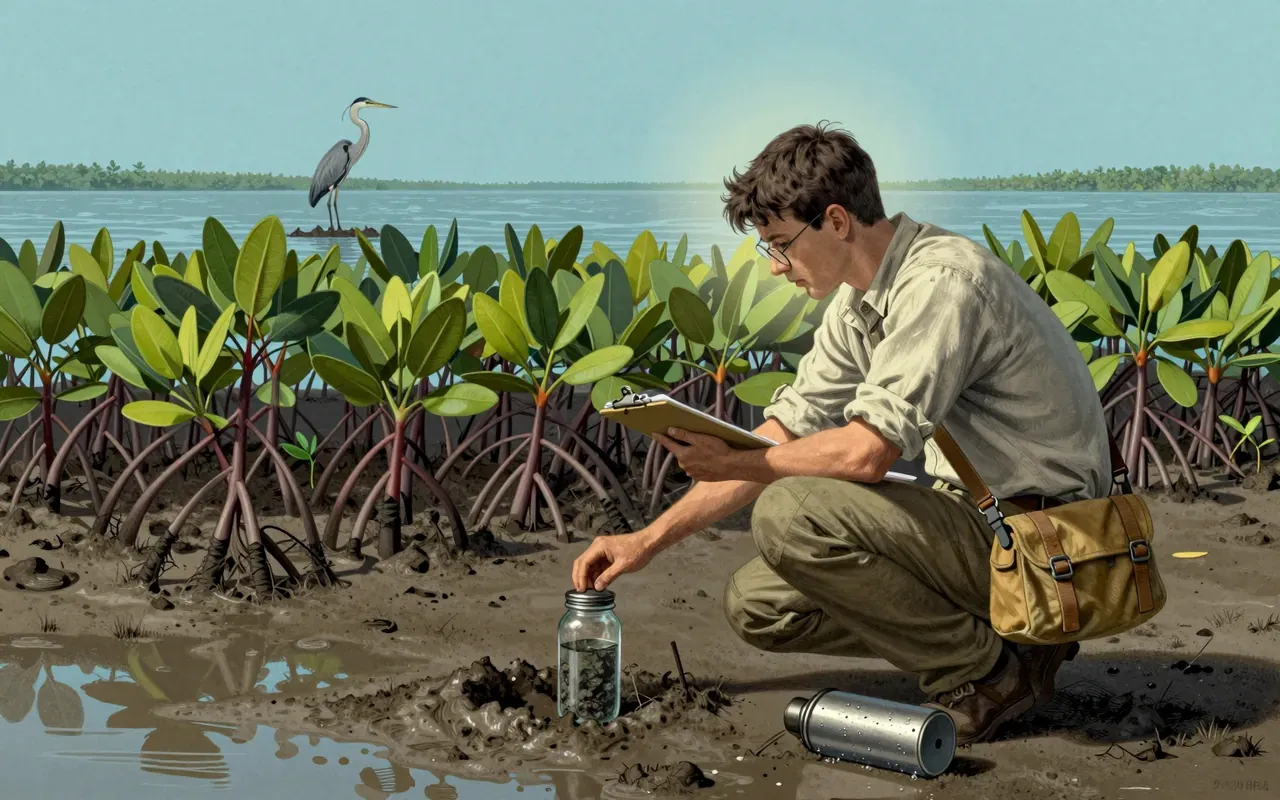
Wilson tested the theory directly rather than leaving it as a mathematical abstraction, working with graduate student Daniel Simberloff on six small mangrove islands in the Florida Keys in the late 1960s. They fumigated the islands with methyl bromide to wipe out the arthropod communities living on them, then tracked how quickly and how fully each island was recolonised over the following two years. The islands nearer to a source of colonising species recovered species numbers faster than more distant ones, and within roughly a year most islands had returned to something close to their pre-fumigation species totals, a result matching the theory’s core prediction about distance and immigration rate closely enough to count as genuine experimental confirmation rather than a plausible but untested mathematical story.
From ocean islands to national parks
The theory’s core predictions, that island size and isolation shape species counts through the interacting rates of immigration and extinction, have held up across a striking range of settings well beyond literal ocean islands. Researchers have applied the same framework to mountain peaks isolated by lowland habitat, lakes isolated by dry land, and even individual plants treated as islands for the insects living on them, finding the same basic species-area relationship, formally written as species number scaling with area raised to some fixed power, recurring across very different systems. William Newmark’s later research applying the theory to United States national parks found the same pattern between park size and the number of mammal species a park retained, extending a model originally built for oceanic islands directly into a practical question about how large a protected area needs to be.
An admitted oversimplification
Wilson himself, writing a new preface for the book’s 2001 reprint, acknowledged its flaws directly, describing them as oversimplification and incompleteness rather than defending the original model as complete. Critics have pointed out that the theory treats species as broadly interchangeable units competing for the same limited slots, largely ignoring differences in habitat quality and diversity that can matter as much as raw area, and that immigration and extinction are assumed to operate independently of each other in ways real ecosystems do not always respect. The theory also generally performs less well, with lower predictive values, when applied to fragmented, human-altered habitats that only loosely resemble true islands than it does on genuine oceanic islands, a gap that matters directly for conservation planning since most protected areas today are exactly this kind of imperfect, land-based island.
The single-large-or-several-small fight
The theory’s most consequential legacy is arguably the debate it triggered over how conservation reserves should actually be designed, known as the single large or several small debate, or SLOSS, which the writer David Quammen once described as ecology’s own genteel version of trench warfare. Researchers including Jared Diamond argued the theory implied a single large reserve would generally protect more species than several small reserves covering the same total area, since larger, less fragmented habitat reduces extinction rates more effectively; others, including Daniel Simberloff, pushed back that habitat diversity within a set of smaller reserves could matter just as much as sheer size. That disagreement, unresolved in any simple general rule, now shapes how conservation planners weigh trade-offs between protecting one large tract of land and protecting several smaller, more geographically varied ones.
A model that shaped how reserves are planned
This is worth the time both as ecology and as a case study in how a mathematically elegant model gets tested, extended and honestly qualified rather than either accepted wholesale or discarded once flaws appear. The mangrove island experiment in particular is worth understanding closely, since deliberately wiping out and then watching an ecosystem rebuild is a rare thing to be able to do at all, let alone do in a way that cleanly tests a specific numerical prediction. Readers should not expect the theory to function as a precise, universal formula for conservation decisions; its own co-author called it oversimplified, and the unresolved SLOSS debate it inspired shows the practical application remains genuinely contested. As an origin point for how ecologists think about fragmented habitat and reserve design, though, it remains close to indispensable.