What the work claims
That species arise in geographic relation to existing species and geological history—and that evolution by natural selection explains this pattern.
How it was done
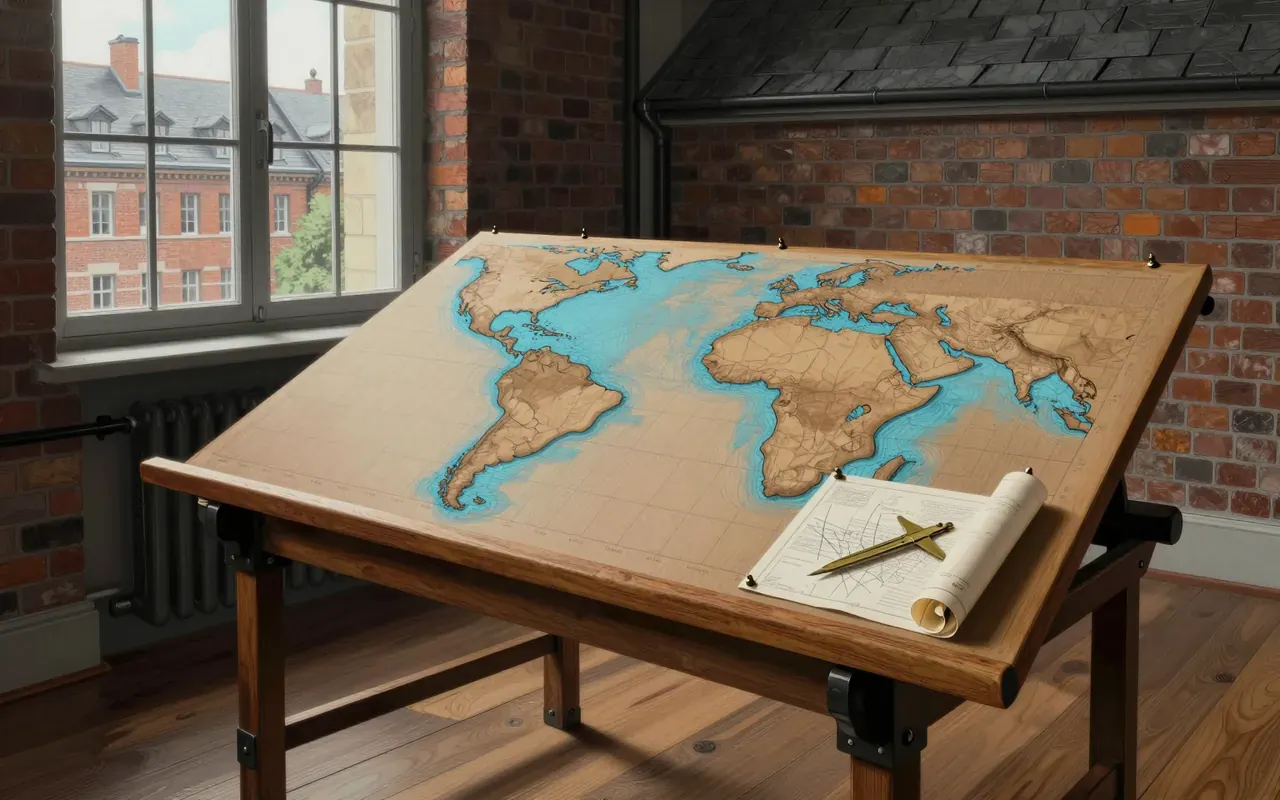
Wallace conducted fieldwork in the Amazon River basin and the Malay Archipelago. He observed species distributions across islands and mainland regions. He published his 1855 ‘Sarawak Law’ paper based on geographic and geologic distribution patterns of living and fossil species.
The question came first. In the Amazon basin Wallace realised that geographical barriers, such as the Amazon and its major tributaries, often separated the ranges of closely allied species. His 1853 paper “On the Monkeys of the Amazon” asked whether very closely allied species are ever separated by a wide interval of country. He also spent August 1850 to May 1852 on the Rio Negro, charting it and its tributary the Uaupés with sextant and compass. The ship taking him home in 1852 caught fire and all his specimens, mostly collected in the last two years of the trip, were lost; he saved a few notes and pencil sketches.
He wrote the Sarawak paper in February 1855 in Sarawak, on Borneo, after reading an 1854 paper by Edward Forbes that proposed an even more quasi-mystical form of progressive creationism. It appeared in the Annals and Magazine of Natural History in September 1855. Its central observation, that “Every species has come into existence coincident both in space and time with a closely allied species”, became known as the Sarawak Law.
What holds up
Wallace independently conceived natural selection. He identified the Wallace Line through direct faunal survey. He established biogeography as a discipline with the ‘Sarawak Law’ paper. He was recognised as the 19th century’s leading expert on animal species distribution.
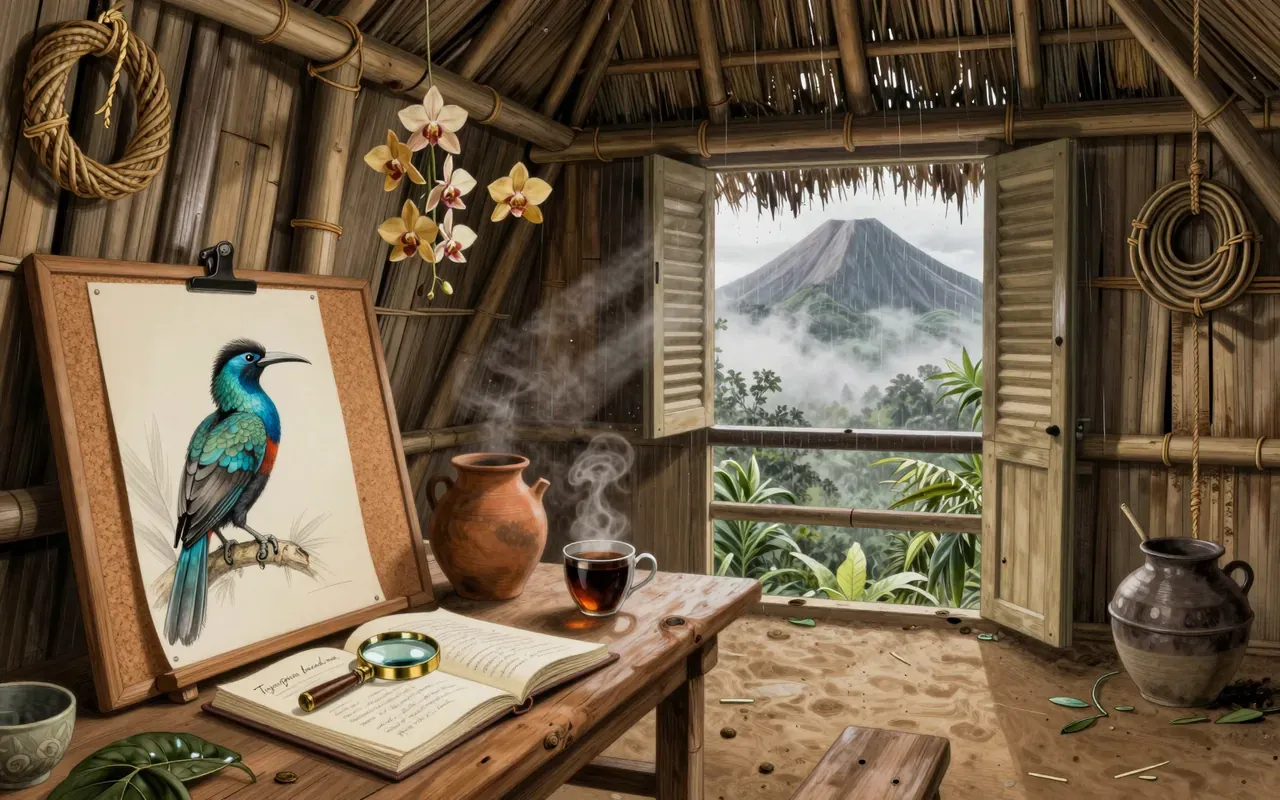
The line began with birds. In 1856 he wrote from Lombok that the birds of Bali and Lombok, divided by a narrow strait, belong to two quite distinct zoological provinces. Paragraphs from that letter were published in The Zoologist in January 1857, and after further investigation the boundary came to be called the Wallace Line. It separates a western part of the Indonesian archipelago, where the animals are largely of Asian origin, from an eastern part whose fauna reflects Australasia. Most of his birds were collected and prepared by his assistants, and Ali alone collected and prepared around 5,000.
What does not
The material does not establish that Wallace’s 1855 paper proposed natural selection. It does not claim he derived a mechanism for change—only that he identified a law governing species introduction based on geography and geology.
The paper does not mention possible mechanisms for evolution or even explicitly discuss transmutation. What it did say was that each new species was a small variation on an existing one, producing a branching tree of relationships that should be the basis of classification.
The mechanism came three years later. By February 1858 Wallace was convinced by his research in the Malay Archipelago that evolution was real, and he later recalled thinking of Malthus’s positive checks on human population while ill with a fever and asking why some animals die and some live. His 1858 paper was published that year alongside extracts from Darwin’s writings, which spurred Darwin to write the abstract that became On the Origin of Species in 1859. Darwin’s first reaction to the 1855 paper had been that it was “nothing very new”, since to him it seemed “all creation” with Wallace.
Why it matters beyond the lab
The Wallace Line remains a foundational boundary in ecology and conservation planning across Indonesia. His field-based, comparative method set the standard for observational biology in an era dominated by armchair taxonomy.
Is it worth your time
Yes. Wallace’s work anchors modern biogeography and evolutionary theory in empirical observation—not speculation. His methods remain legible and teachable today.