A heart that slowed on its own
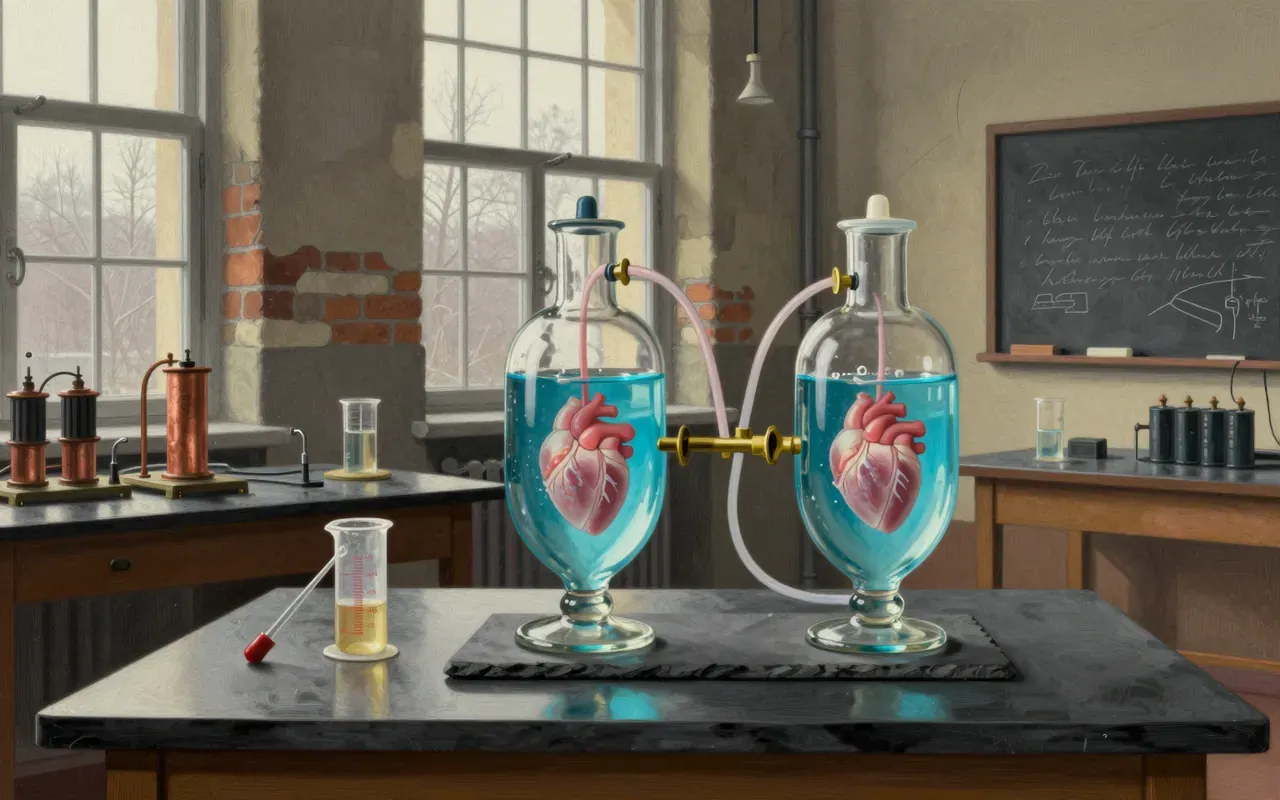
Otto Loewi’s claim was that a nerve influences its target organ by releasing a chemical into the space between them, rather than by direct electrical contact. Working with two frog hearts kept beating in saline outside the body, he showed that stimulating the vagus nerve on one heart slowed its rate, and that transferring the saline bathing that heart to a second, nerve-free heart slowed the second heart as well. Since the second heart had no nerve of its own attached, the only way the effect could have crossed over was in the fluid itself. Loewi named the substance responsible Vagusstoff, German for vagus substance, without yet knowing what it was. The identification of that substance as acetylcholine, and the general principle that neurons signal chemically, followed from this single transfer experiment.
Naming Vagusstoff
The method was simple by design: two isolated, still-beating frog hearts, submerged separately in a saline solution that kept them alive outside the animal. Loewi attached electrodes to the vagus nerve of the first heart and stimulated it, which is known to slow heart rate through the nervous system. He then drew the saline surrounding that first heart and applied it to the second, untouched heart, which had never been stimulated and had no nerve running to it. The second heart slowed in response to the borrowed fluid alone. Loewi later said the experimental design came to him in a dream on two consecutive nights, the first forgotten by morning, an anecdote that has followed the result ever since, though it says nothing about whether the underlying chemistry holds.
A shared Nobel
The core result has held for a century: synaptic transmission at the vagus nerve, and at most synapses generally, is chemical, not a matter of the nerve’s electrical impulse jumping the gap. Vagusstoff was subsequently identified as acetylcholine, the first substance confirmed to act as a neurotransmitter, and the criteria Loewi’s work implied — that a candidate chemical must be released by the neuron, act on the target, and then be cleared away — became the working test for identifying others. That test has since been applied to find more than a hundred neurotransmitters, spanning amino acids, monoamines, peptides and gases, each synthesised, stored, released, bound to a receptor and removed in broadly the same five-stage cycle Loewi’s heart experiment first implied without describing in that much detail.
From one substance to a hundred
What the frog-heart experiment does not establish is the completeness of the chemical picture. Some synapses in the nervous system are electrical, passing current directly through gap junctions rather than releasing a chemical messenger, so the finding describes a mechanism rather than the only one. The dream story, repeated in nearly every retelling of Loewi’s discovery, rests entirely on his own later account and cannot be checked against any contemporary record. And the tidy four-part test for what counts as a neurotransmitter — made, released, acting, cleared — has had to be loosened since to admit substances such as nitric oxide, which is not stored in vesicles and acts within seconds, meaning the category itself has grown less clean-edged than the original experiment suggested it might be.
The five-step relay
Once transmission was understood to be chemical, the nervous system became something drugs could act on with some precision, at each stage of that transmission cycle. Cocaine works by blocking the reabsorption of dopamine at the synapse; selective serotonin reuptake inhibitors work the same way on serotonin; antipsychotic medications work by blocking dopamine receptors rather than the transmitter itself. None of that pharmacology follows automatically from Loewi’s frog hearts, but the underlying premise, that a specific chemical carries the signal and can therefore be specifically intercepted, does. It is the reason a psychiatric drug can be designed to touch one signalling system without shutting down the nervous system altogether, and the reason the search for what else the brain releases, and what blocks it, continues.
A dream, or a tidy story
Yes, and not only for the anecdote. The experiment is a rare case in the history of science where the logic is available to check without specialised equipment: a heart slows, its bath water is moved, and a second heart slows too. That transparency is worth sitting with, because the version of the story usually told skips straight to the dream and the Nobel Prize and misses how little apparatus the original claim needed. It is a good hour for anyone who wants to understand where the idea that drugs act on specific brain chemicals comes from, and a useful corrective for anyone who assumes such foundational science must have been complicated to arrive at.