A problem named after air traffic control
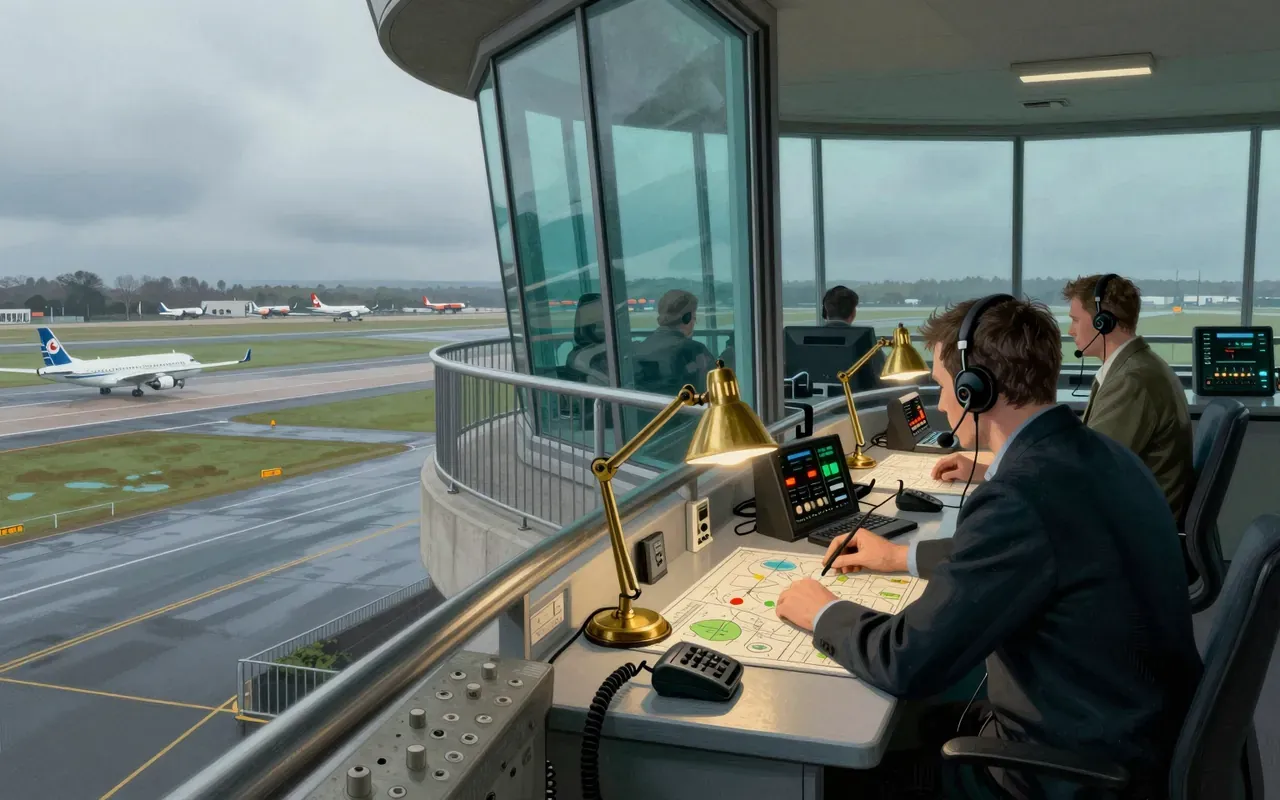
The claim under examination is that a listener’s brain can, and reliably does, select a single stream of speech out of several competing ones, tuning much of the rest out of conscious awareness rather than processing everything equally. Colin Cherry gave this phenomenon its name, the cocktail party problem, in 1953, motivated by a very practical version of it: air traffic controllers needed to pick out a specific pilot’s voice from multiple, simultaneous radio transmissions coming through the same loudspeaker. Cherry found that people’s ability to separate overlapping voices depended on several concrete features of the sound itself, including the speaker’s gender, the direction the sound came from, its pitch, and its speaking rate, suggesting that the brain uses identifiable acoustic cues, not just effort or focus, to accomplish the separation.
One message in each ear
Cherry’s method for studying this was the dichotic listening task, in which a participant wearing headphones received one message in the left ear and a different message in the right ear, and was asked to shadow one of them, repeating it aloud continuously while ignoring the other entirely. This design let researchers test precisely what information from the ignored channel, if any, actually registered. The critical finding was that participants who could report almost nothing about the content of the unattended message would nonetheless reliably notice if their own name appeared in it, breaking through into awareness despite supposedly being filtered out. That single, specific result carried more theoretical weight than it might first appear, because it directly contradicted the leading explanation of how selective attention was thought to work at the time.
A filter early in the chain
Donald Broadbent’s 1954 filter model had proposed that attention operates as an early filter, screening out unattended input based on simple physical characteristics, such as which ear it arrived in or its pitch, before the brain ever processes its meaning. Under a strict version of that model, a listener’s own name in the unattended channel should be just as invisible as any other word, since meaning is supposedly never reached. Anne Treisman revised the theory to account for the own-name finding, proposing instead that unattended information is attenuated, weakened rather than completely blocked, so that especially significant content, a person’s own name being the clearest example, can still surpass the threshold needed to reach awareness even while most of the unattended stream remains unprocessed.
The name that got through anyway
The theoretical picture did not settle cleanly even after Treisman’s revision. A rival late-selection model, associated with Deutsch and Deutsch, proposed the opposite structure entirely: that all incoming information receives full semantic processing regardless of attention, with selection happening only afterward, at the point where a response is chosen or something enters conscious awareness. Decades of argument between early- and late-selection accounts were eventually addressed, though not fully resolved, by Nilli Lavie’s perceptual load theory in the mid-1990s, which proposed that both can be right depending on circumstances: a demanding, high-load task exhausts attentional capacity and produces early-selection-like filtering, while a low-load task leaves spare capacity that spills over onto irrelevant information, producing behaviour that looks more like late selection. Neuroimaging from the 1990s onward has since tied selective attention to specific regions, including the left superior temporal gyrus and inferior frontal gyrus, without settling the early-versus-late debate definitively on its own.
Weakened, not blocked
The practical stakes of this research have grown well beyond air traffic control, its original motivation. Modern noise-cancelling headphones and emerging deep-learning systems capable of isolating a single target speaker’s voice from a noisy recording are direct engineering descendants of the same underlying problem Cherry first named, separating one meaningful stream of sound from a competing background. So-called semantic hearing headsets, which let a wearer filter sounds by describing in words what they want to hear or ignore, and programmable sound bubbles that suppress voices outside a defined acoustic zone, extend the idea further still, with clear benefit for people with hearing loss, misophonia, or sensory processing conditions who find ordinary noisy environments overwhelming. The psychological theory and the engineering problem have effectively converged on the same task from two different directions.
A load-dependent compromise
Yes, and the value is in watching a theory get corrected by a small, specific piece of evidence rather than a dramatic overturning. The own-name finding is exactly the kind of detail that is easy to skip past as a footnote but that actually forced a genuine revision, from a hard early filter to a softer, attenuating one, and eventually to a synthesis that depends on how demanding the surrounding task already is. It is also a satisfying case of psychological theory meeting real engineering payoff, since the same basic problem, extracting one voice from many, now sits directly behind consumer technology most readers already use. Anyone who wants to understand why attention feels selective but imperfectly so will find the mechanism laid out here in useful, checkable detail.