A tank of cleaning fluid underground
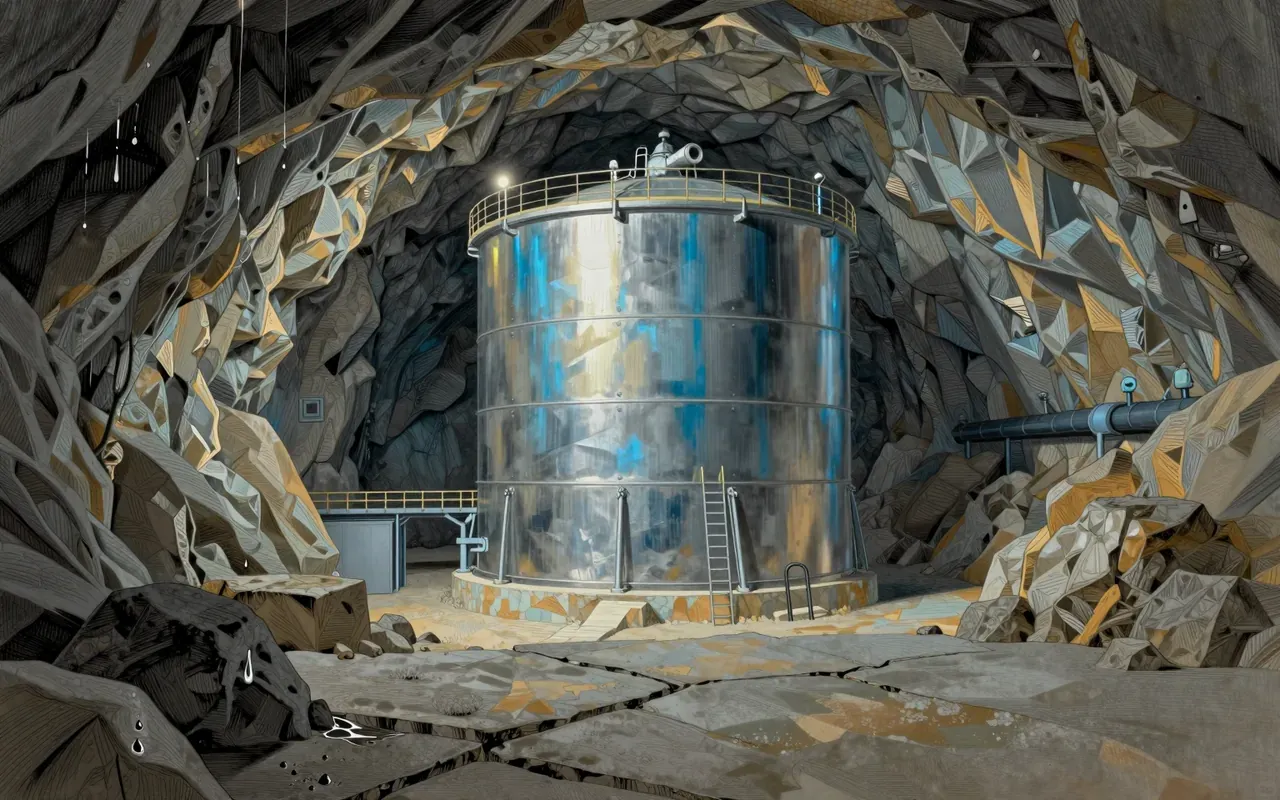
The experiment at the centre of this story was built to catch a famously hard-to-detect particle. Ray Davis constructed a detector consisting of a 380 cubic metre tank of perchloroethylene, an ordinary dry-cleaning fluid, placed nearly 1,500 metres underground in the Homestake Gold Mine in South Dakota, where the surrounding rock would shield it from interfering cosmic rays. The chlorine atoms in the fluid could occasionally capture an electron neutrino from the sun and convert into a radioactive form of argon, which Davis periodically extracted and counted, giving a direct measure of how many solar neutrinos of that type were reaching Earth.
A persistent shortfall
From when the experiment began operating in 1970, the count consistently fell short of what theory predicted. John Bahcall’s calculations, based on the standard model of how the sun generates energy through nuclear fusion, predicted a certain rate of neutrino captures, but Davis’s tank registered only roughly a third to two thirds of that expected number, and this shortfall persisted through repeated runs of the experiment over more than two decades of continuous operation, becoming known as the solar neutrino problem rather than a one-off anomaly that might resolve itself with better statistics or a longer run.
Blaming the wrong culprit
The gap between prediction and measurement was large and stable enough that it could not be waved away, and it was unclear at first which side of the comparison was at fault. Some researchers initially suspected an error in Davis’s experimental technique or equipment, while others considered whether the standard solar model itself needed revision, including proposals that the sun’s core might be cooler than assumed or that nuclear reactions inside it might occasionally pause. Repeated scrutiny of both the Homestake apparatus and the underlying theoretical calculations failed to identify a fault in either.
Ruling out a cooler sun
Independent evidence made proposed fixes to the solar model increasingly hard to sustain. Helioseismology, the study of vibrations propagating through the sun, produced measurements consistent with the standard solar model’s assumptions about the sun’s interior, and the detailed spectrum of neutrino energies detected did not fit a scenario in which the sun’s core was simply cooler than expected, since a cooler core is inconsistent with the specific pattern of energies measured. This left researchers with a genuine puzzle: neither obvious explanation, a flawed detector or a flawed sun, fit the accumulating evidence.
Neutrinos changing type in flight
The resolution came from a property of neutrinos themselves rather than from the sun or the detector. Neutrinos come in three types, and theoretical work dating back to a 1968 proposal by Bruno Pontecorvo suggested that if neutrinos have mass, they can oscillate, changing from one type to another as they travel. The Sudbury Neutrino Observatory in Canada, publishing results around 2001, confirmed this directly by measuring all three neutrino types together and finding that electron neutrinos made up only about a third of the total, in close agreement with the standard solar model’s overall prediction once oscillation is accounted for.
Both sides had been right
This meant Davis’s detector, sensitive only to electron neutrinos, had been counting accurately all along; the remaining two thirds of the predicted neutrinos were arriving at Earth having changed into the other two types along the way, invisible to his chlorine-based method. Ray Davis shared the 2002 Nobel Prize in Physics for the original detection work, and researchers who established neutrino oscillation, including Takaaki Kajita and Arthur McDonald, shared the 2015 prize for confirming the mechanism. The episode stands as a rare case where a persistent, decades-long discrepancy turned out to vindicate both sides of the original disagreement rather than exposing an error in either.