A barrier too high to climb classically
The puzzle this theory solves is a specific mismatch between energy and confinement. Inside certain atomic nuclei, an alpha particle, a tightly bound cluster of two protons and two neutrons, carries only around four to nine million electron volts of energy, yet it sits behind a confining energy barrier estimated at roughly twenty-five million electron volts high. Under classical physics, a particle simply does not have enough energy to climb over a barrier that much higher than its own energy, and yet alpha particles clearly do escape such nuclei on a regular and measurable basis, since alpha decay is a well-documented radioactive process.
Gamow’s tunnelling solution
George Gamow, working independently but at essentially the same time as Ronald Gurney and Edward Condon, resolved this in 1928 by applying quantum mechanics rather than classical mechanics to the problem. Because a particle in quantum theory is described by a wave function rather than a definite trajectory, and that wave function does not abruptly vanish at the edge of a barrier but instead decays gradually within it, there is a small but genuinely nonzero probability that the wave function extends out the other side, meaning the particle can, in effect, pass through the barrier rather than over it. Gurney and Condon described the effect vividly, noting that the alpha particle almost slips away unnoticed.
Turning an empirical rule into a derived one
What made this more than a plausible-sounding story was that Gamow’s mathematical treatment produced a specific, checkable prediction: a relationship between a radioactive nucleus’s half-life and the energy of the alpha particle it emits. This relationship had previously been known only as an empirical pattern, the Geiger-Nuttall law, observed in decay data without a theoretical derivation behind it. Gamow’s tunnelling theory derived that same relationship from first principles, showing that the empirical law was exactly what quantum tunnelling should produce, a strong form of confirmation because the theory was not fitted to the pattern after the fact but reproduced it from independent physical reasoning.
The same effect in stellar cores
The same underlying mechanism turned out to be essential far beyond alpha decay. Inside the core of a star, temperatures are high but still not high enough, by classical reasoning alone, to let positively charged nuclei overcome their mutual electrical repulsion and fuse together at the rate observed. Quantum tunnelling increases the probability that nuclei can penetrate this repulsive barrier despite lacking the classically required energy, and because a stellar core contains an enormous number of nuclei, even a very low tunnelling probability per attempt is enough to sustain the steady, ongoing fusion reactions that power stars including the sun.
From theory to the tunnel diode
The effect also proved technologically useful once physicists learned to engineer it deliberately in solid-state devices. Leo Esaki demonstrated in 1957 that electrons could tunnel across nanometre-scale barriers in semiconductor structures, leading to the development of the tunnel diode, an early practical electronic application of the effect. Related work by Ivar Giaever on tunnelling in superconductors and Brian Josephson’s prediction of tunnelling between superconductors joined Esaki’s work in earning the shared 1973 Nobel Prize in Physics, reflecting how significant controlled electron tunnelling had become for both fundamental physics and electronics.
Imaging individual atoms
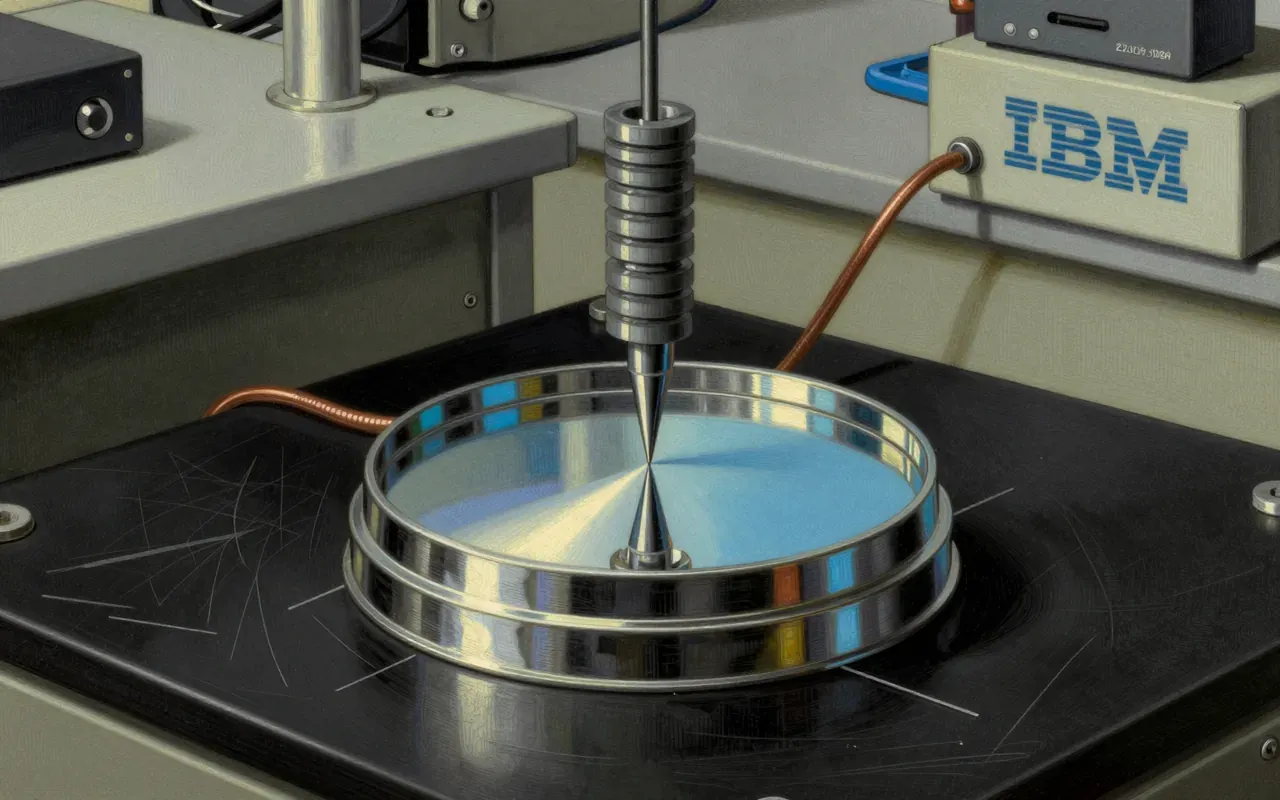
Perhaps the most visually striking application came in 1981, when Gerd Binnig and Heinrich Rohrer built the scanning tunnelling microscope, which measures the tiny electric current that tunnels between a very sharp conductive tip and a conductive surface as the tip is scanned across it at a near-atomic distance. Because this tunnelling current depends extremely sensitively on the tip’s distance from the surface, the instrument can resolve individual atoms, a capability that earned Binnig and Rohrer the 1986 Nobel Prize in Physics. From a nuclear physics puzzle in 1928 to imaging individual atoms decades later, this is a rare case of one abstract quantum idea doing genuinely load-bearing explanatory and technological work across entirely different fields.