10:15in productionCh. 1 · The Symmetry Trap/ 10:15 · ceiling 15 min
Physics · Astronomy & space
Roger Penrose
Penrose didn’t find black holes—he proved they’re unavoidable if Einstein was right.
Penrose’s 1964 singularity theorem showed black hole formation follows inevitably from general relativity—even without perfect symmetry. He did it by analysing spacetime topology, not geometry. The result holds mathematically under classical assumptions. It does not address quantum effects, observability, or internal physics. It matters because it turned black holes from curiosities into necessary consequences—changing how physicists frame cosmic collapse forever.
Before Penrose, relativity only worked in perfectly symmetric universes.
2:36
Lightcones Over Coordinates
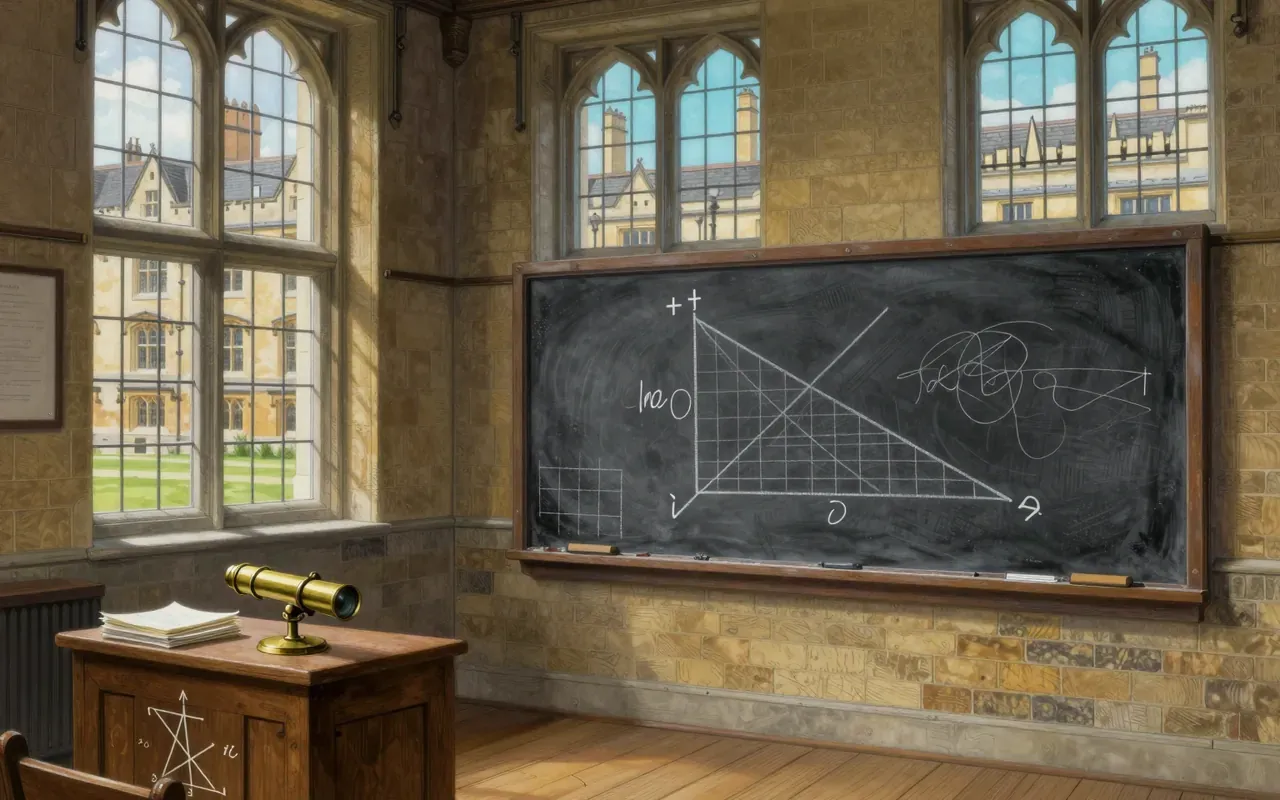
He replaced geometry with topology—lightcones, not coordinates, became the map.
4:22
No Escape Clause
Collapse past a point means singularity—no escape, no fine print.
6:02
Why the Nobel Said 'Robust'
This is why the 2020 Nobel Prize cited 'robust prediction', not discovery of black holes.
Worth your time?
Yes. Study the whole thing.
4.5/ 5
What works
establishes inevitability of singularities under generic collapse
introduces causal-topological tools still used today
breaks dependence on symmetry in GR analysis
What does not
proves existence of black holes
describes singularity physics
resolves quantum-gravity conflict
Study it if
physicists
astrophysicists
philosophers of science
Skip it if
general public seeking observational updates
quantum gravity researchers expecting new mechanisms
The written brief1 min read
What the work claims
That black hole formation is a robust prediction of general relativity—not dependent on idealised symmetry—and that spacetime singularities are unavoidable in generic gravitational collapse.
How it was done
Penrose used topology and conformal structure—ignoring detailed geometry—to analyse spacetime. He bypassed the need for high-symmetry solutions by focusing on lightcone structure and causal relationships.
What holds up
The conclusion that gravitational collapse beyond a critical point leads inevitably to a spacetime singularity holds within classical general relativity. The topological method remains foundational for causal analysis.
What does not
It does not prove black holes exist in nature. It does not describe what happens at the singularity. It does not resolve quantum-gravity conflicts.
Why it matters beyond the lab
It shifted astrophysics from speculative symmetry-based models to rigorous, model-independent predictions—enabling later work on event horizons, information loss, and observational signatures.
Is it worth your time
Yes. It redefined how we treat singularities in general relativity—not as artefacts of symmetry, but as inevitable outcomes under generic conditions.
Franklin didn’t discover the double helix — she discovered that DNA’s shape changes with humidity, and that its backbone faces outward. Everything else was interpretation.