A machine that learns by trial and error
Frank Rosenblatt, a psychologist working at Cornell Aeronautical Laboratory, designed the perceptron as a way for a machine to learn a classification task from examples rather than from an explicit program. He first ran the idea as a simulation on an IBM 704 computer in 1957, then built it as dedicated hardware, the Mark I Perceptron, over 1959, unveiling it publicly in June 1960. The project drew funding from several sources, including an Institute for Defense Analysis contract and later a larger Office of Naval Research award, and the CIA’s photo division studied the machine in the early 1960s for possible use in recognising targets in aerial photographs, giving an early indication of how seriously the underlying idea was taken.
Photocells, potentiometers and motors
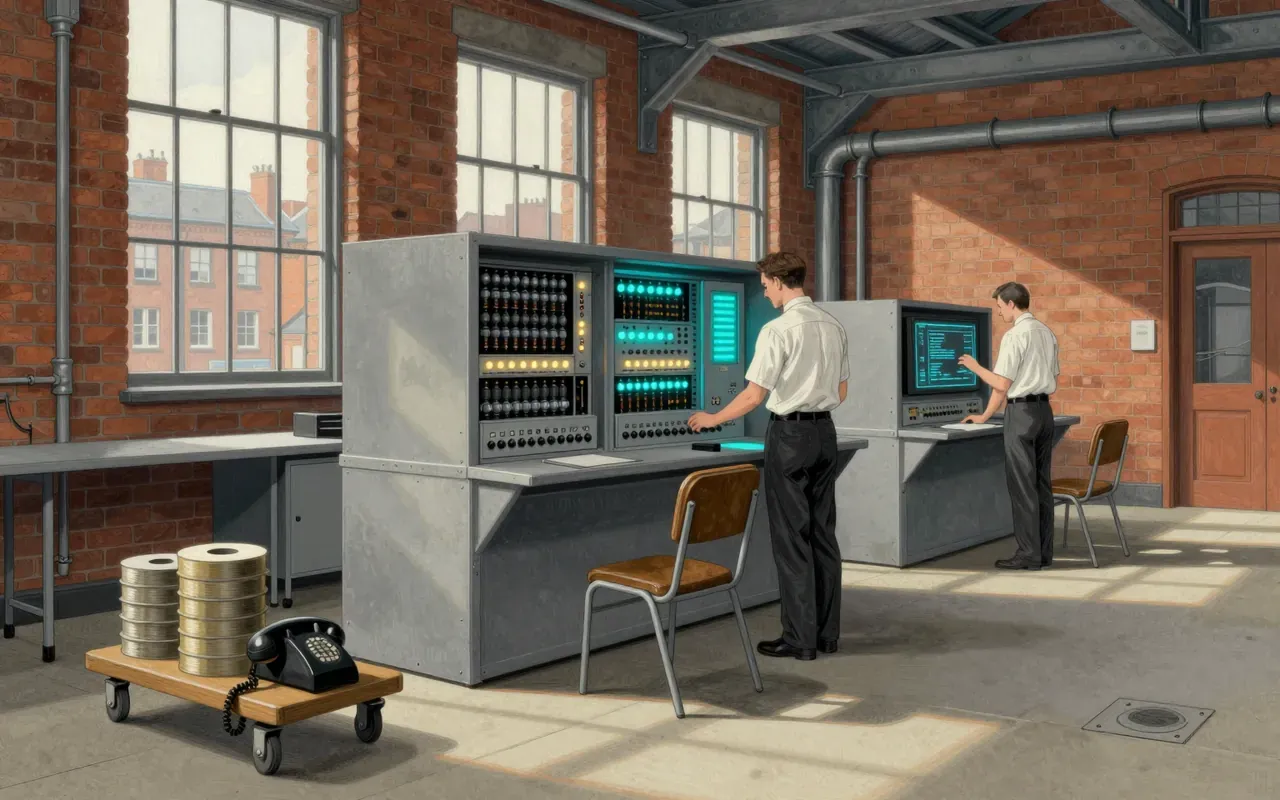
The Mark I Perceptron translated the learning rule into physical components. A 20-by-20 grid of 400 photocells served as sensory input, feeding into 512 intermediate units whose connections were wired randomly and left fixed, which in turn fed forward to eight output units. The connections between the intermediate and output layers were the ones that actually learned: they ran through adjustable potentiometers, physically turned by small electric motors during training as the machine compared its output to the correct answer and nudged its weights closer to reducing the error. It was, in effect, a linear classifier built out of photocells and motors rather than software, sorting inputs into categories by whether a weighted sum crossed a threshold.
A press conference gets ahead of the science
A Navy press conference in 1958 led to newspaper coverage describing the perceptron as heading toward a machine that would walk, talk, see, reproduce itself and be aware of its own existence, an extraordinary leap from what a single trainable layer of photocells and potentiometers could actually do. The gap between that coverage and the machine’s real capabilities set up the field for a harder fall a decade later. In 1969, Marvin Minsky and Seymour Papert published a book proving that elementary perceptrons of the kind Rosenblatt had built could not learn certain patterns, most notably the exclusive-or function, because those patterns are not linearly separable and a single layer has no way to represent them.
The exclusive-or problem
Minsky and Papert’s mathematics was correct and has held up: a single layer without hidden units genuinely cannot solve problems like exclusive-or, and this remains a standard, uncontroversial result in the theory of neural networks. What did not hold up was the broader reading their book received. The authors themselves noted that networks with additional layers could overcome the limitation, but that nuance was largely lost, and the book was widely cited as evidence that the entire approach of learning from adjustable weights was fundamentally limited. Funding and research interest in neural networks declined sharply afterward, a slowdown that took roughly a decade to reverse, a pattern later researchers came to call an AI winter.
A decade in the cold
The episode matters beyond the specific machine because it shows how a narrow, correct technical result can be flattened into a broad, incorrect verdict once it leaves the paper it was proven in. Minsky and Papert’s proof concerned a specific, restricted architecture, not the idea of trainable networks in general, yet its popular interpretation shaped funding decisions and research priorities across an entire field for years. When multilayer perceptrons paired with the backpropagation algorithm demonstrated in the 1980s that additional layers could indeed solve the problems Minsky and Papert had flagged, it confirmed that the original limitation had always been about depth rather than about the underlying learning approach, a distinction that had been available from the start but went largely unheeded.
The comeback
Rosenblatt did not live to see this vindication; he died in a boating accident in 1971, on his forty-third birthday, having spent his last years building a room-sized speech-recognition system that digital computer simulation had already begun to outpace. The Mark I Perceptron itself now sits in the Smithsonian, a physical artefact of an idea that outlasted both the hype that surrounded it and the winter that followed. The story is worth an hour for how directly its two halves, the overpromising press coverage and the underappreciated fine print of a mathematical proof, still describe the way new computing technologies get oversold and then unfairly written off before the truer, slower science catches up.