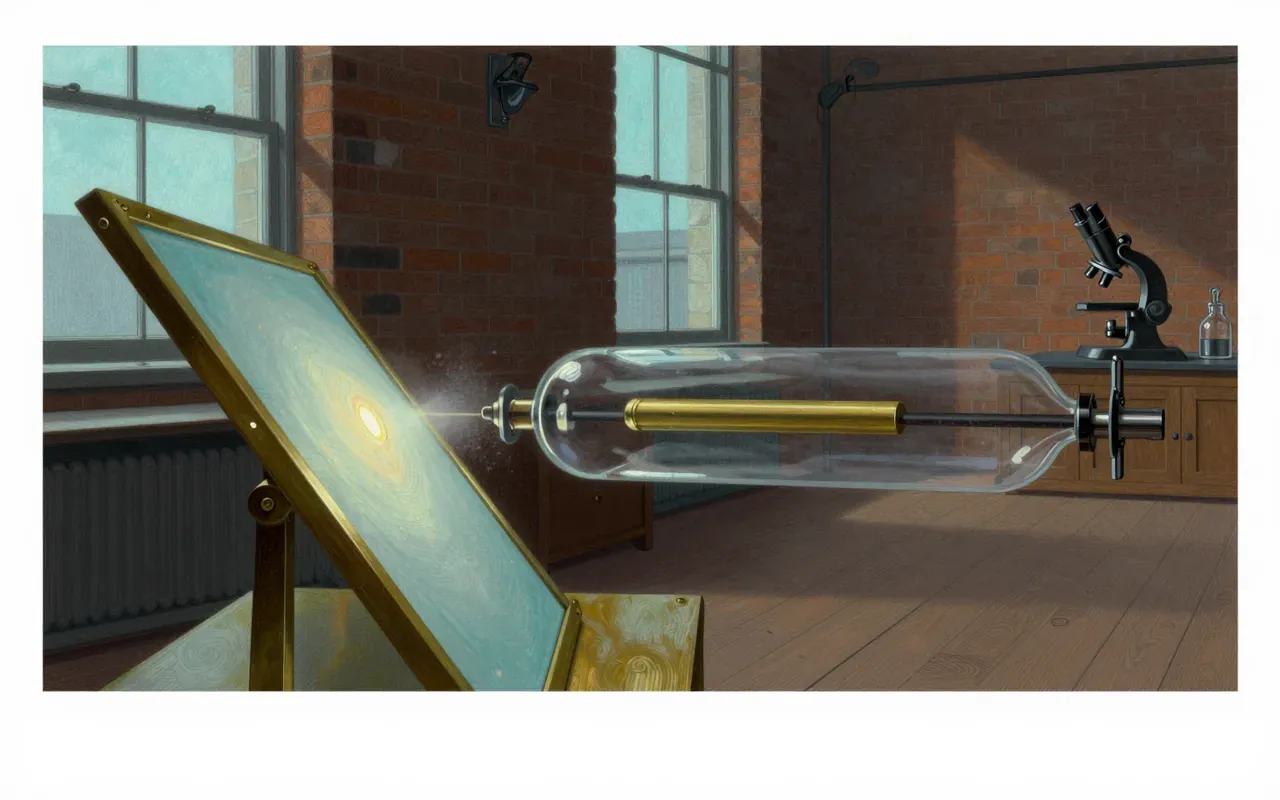
A beam of particles at a sheet of gold
Between 1906 and 1913, working at the Victoria University of Manchester under Ernest Rutherford’s direction, Hans Geiger, a German physicist who had joined the laboratory in 1906, and Ernest Marsden, an undergraduate working under Geiger, ran a series of experiments in which a beam of positively charged alpha particles was fired at extremely thin gold foil. A screen coated to flash briefly when struck let them record, particle by particle, the angle at which each one emerged after passing near or through the foil. Rutherford specifically asked the pair to check for particles deflected at unusually large angles, even though nothing in the atomic theory of the day gave a reason to expect that any would be found.
What the plum pudding model predicted
The prevailing picture of the atom at the time, associated with J.J. Thomson, held that positive charge was spread diffusely throughout the whole volume of the atom, with electrons distributed within it, an arrangement often described by the shorthand plum pudding. That model made a clear, quantitative prediction: a fast alpha particle passing through such a diffuse charge distribution should be deflected only slightly, by less than one degree, since no part of the atom concentrated enough charge in one place to exert a strong localised force. Geiger and Marsden’s task was simply to measure the actual distribution of deflection angles and see whether it matched that expectation.
One in eight thousand
It did not. In the 1909 results, roughly one alpha particle in every eight thousand was scattered through an angle greater than ninety degrees, with some rebounding almost directly back toward the source, a pattern the diffuse plum pudding model offered no way to explain. From the frequency and angle of these large deflections, Rutherford worked out that the positive charge and most of the mass of the atom had to be concentrated in a region far smaller than the atom as a whole, by his estimate at least ten thousand times smaller, an object that came to be called the nucleus. Later calculations from head-on collisions put the radius of a gold nucleus at no more than about 2.7 times ten to the minus fourteen metres.
A model that did not survive the data
The plum pudding model itself did not survive the encounter with this data in any form; there was no way to adjust it to accommodate particles bouncing almost straight back, since a diffuse charge simply cannot produce that kind of reversal. Rutherford himself described the result as one of the most startling of his career, comparing the effect to firing a heavy artillery shell at a sheet of tissue paper and having it rebound, a comparison that conveys how completely the outcome sat outside what the accepted theory allowed for. Part of what makes the episode notable is that the discovery came from deliberately testing an assumption nobody expected to fail, rather than from a result stumbled upon by accident.
A nucleus ten thousand times smaller than the atom
Rutherford set out the nuclear interpretation in a 1911 paper, “The Scattering of α and β Particles by Matter and the Structure of the Atom,” proposing that an atom’s positive charge and nearly all of its mass sit in a tiny, dense central nucleus, with electrons occupying the much larger volume surrounding it. Geiger and Marsden followed with a more complete confirmation of the scattering pattern in 1913, published as “The Laws of Deflexion of α Particles through Large Angles.” Together the two papers displaced the plum pudding model entirely, fed directly into the later Rutherford-Bohr model of the atom, and established particle scattering, firing a known projectile at a target and reading the pattern of what comes back, as a standing method that particle physics still relies on.
Confirmed, and still in use
This is a compact, satisfying case of an experiment doing exactly what an experiment is supposed to do: testing an assumption nobody had thought to question and finding it false in a way too clear to argue with. The timeline is unusually tight for physics of this importance, from the 1909 measurement to a settled model in 1911 and independent confirmation in 1913. Rutherford’s later identification of the proton in 1919, and his own students’ first splitting of the atom in 1932 at Cambridge’s Cavendish Laboratory, both trace back to the nuclear picture this one foil and this one beam of particles first forced into view.