10:48in productionCh. 1 · The First Reasoning Robot/ 10:48 · ceiling 15 min
Computing & AI · Engineering
Shakey the robot
Shakey didn’t think like us—but it proved machines could plan like us.
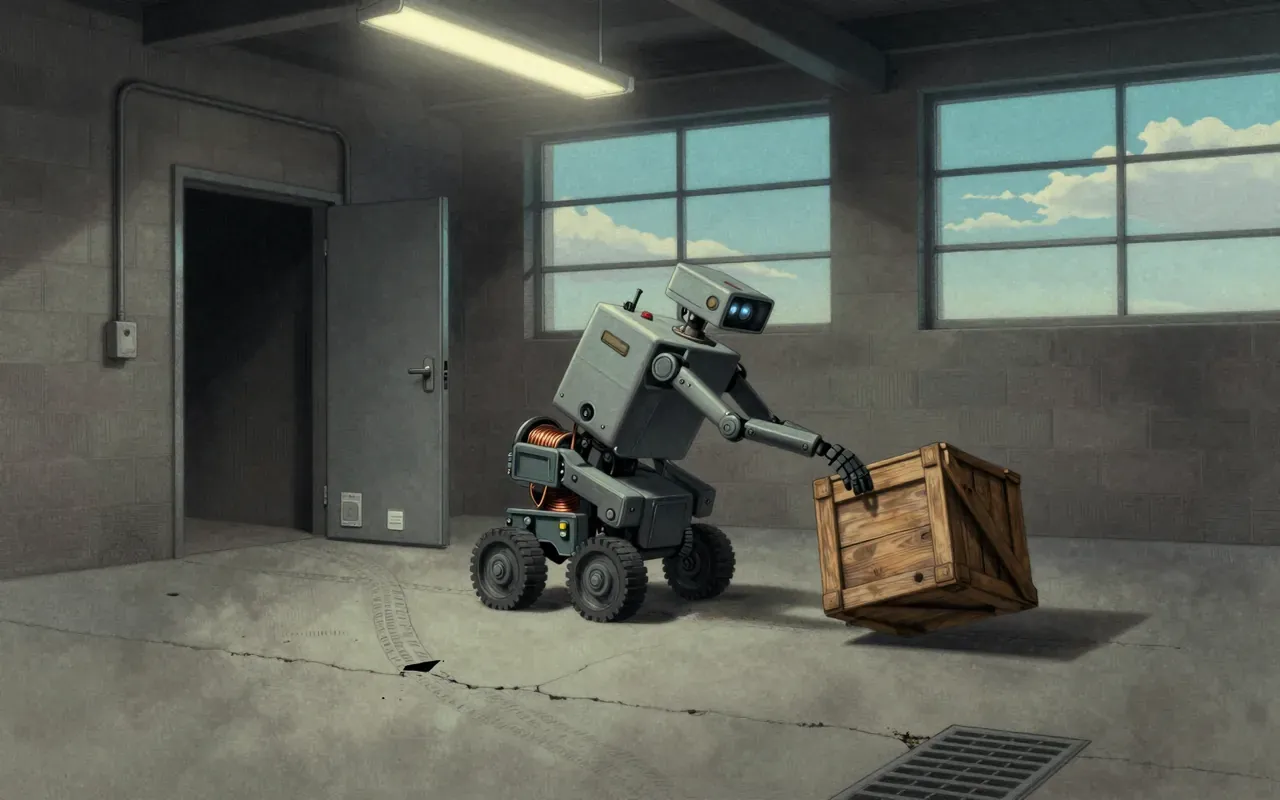
Shakey the robot was the first general-purpose mobile robot capable of reasoning about its own actions. Developed at Stanford Research Institute’s Artificial Intelligence Center, it used LISP and the STRIPS planner to break high-level commands into physical actions—travelling, flipping switches, opening doors, climbing, pushing objects. It produced A*, the Hough transform, and the visibility graph method. It did not learn, adapt, or operate in real time. Its significance lies not in performance but in proving that logical planning could drive physical action—a conceptual foundation for AI and robotics.
Shakey was the first mobile robot that reasoned about its own actions.
2:55
From Command to Action
It decomposed commands into actions—travel, flip switches, open doors, push objects—without manual scripting.
4:47
Where Logic Met Wheels
STRIPS planning linked logic to physics—the first system to merge reasoning and motion.
6:30
Algorithms That Outlived the Robot
Its LISP-based software produced A*, the Hough transform, and the visibility graph method.
Worth your time?
Yes. Study the whole thing.
4.5/ 5
What works
reasoning about action
command decomposition
integration of planning and actuation
foundational algorithm derivation
What does not
real-time operation
learning
robust perception
generalisation beyond fixed action set
Study it if
AI historians
robotics students
software engineers studying search and planning
Skip it if
practitioners building modern autonomous vehicles or LLM agents
The written brief1 min read
What the work claims
That machines could autonomously translate abstract goals into sequences of physical actions in a real-world environment. That planning, perception, and action could be integrated within a single computational framework.
How it was done
Shakey was built at the Artificial Intelligence Center of Stanford Research Institute. Its software ran primarily in LISP. It used the STRIPS planner to generate sequences of physical actions. Its perception relied on early computer vision; its reasoning linked goals to executable steps.
What holds up
Shakey was the first general-purpose mobile robot able to reason about its own actions. It broke high-level commands into executable steps without step-by-step scripting. It fused logical planning with physical actuation—proving the concept was implementable.
What does not
Shakey did not operate in real time. It did not learn from experience. It did not handle uncertainty or sensor noise robustly. It did not generalise beyond its narrow action set: travel, toggle lights, open doors, climb, push objects.
Why it matters beyond the lab
It established foundational algorithms still in use: A*, the Hough transform, and the visibility graph method. It defined the architecture—perception → representation → planning → action—that underlies decades of robotics and AI research.
Is it worth your time
Yes—if you want to understand where AI planning, search, and robot autonomy began. It is not a prototype for modern autonomous systems, but the first working demonstration that logical reasoning could drive physical action in an unstructured environment.