A heartbeat with an electrical signature
By the late nineteenth century, physiologists had already established that each heartbeat is accompanied by a small electrical signal spreading through the heart muscle as it contracts, a signal that could in principle be detected from outside the body if an instrument sensitive enough existed to register it through skin, fat and bone. Early attempts to record this signal used existing galvanometers, instruments designed to measure electrical current, but these devices moved too slowly and were disturbed too easily by other bodily movement to produce a clean, reliable trace of something as fast and faint as a heartbeat.
A string sensitive enough to catch it
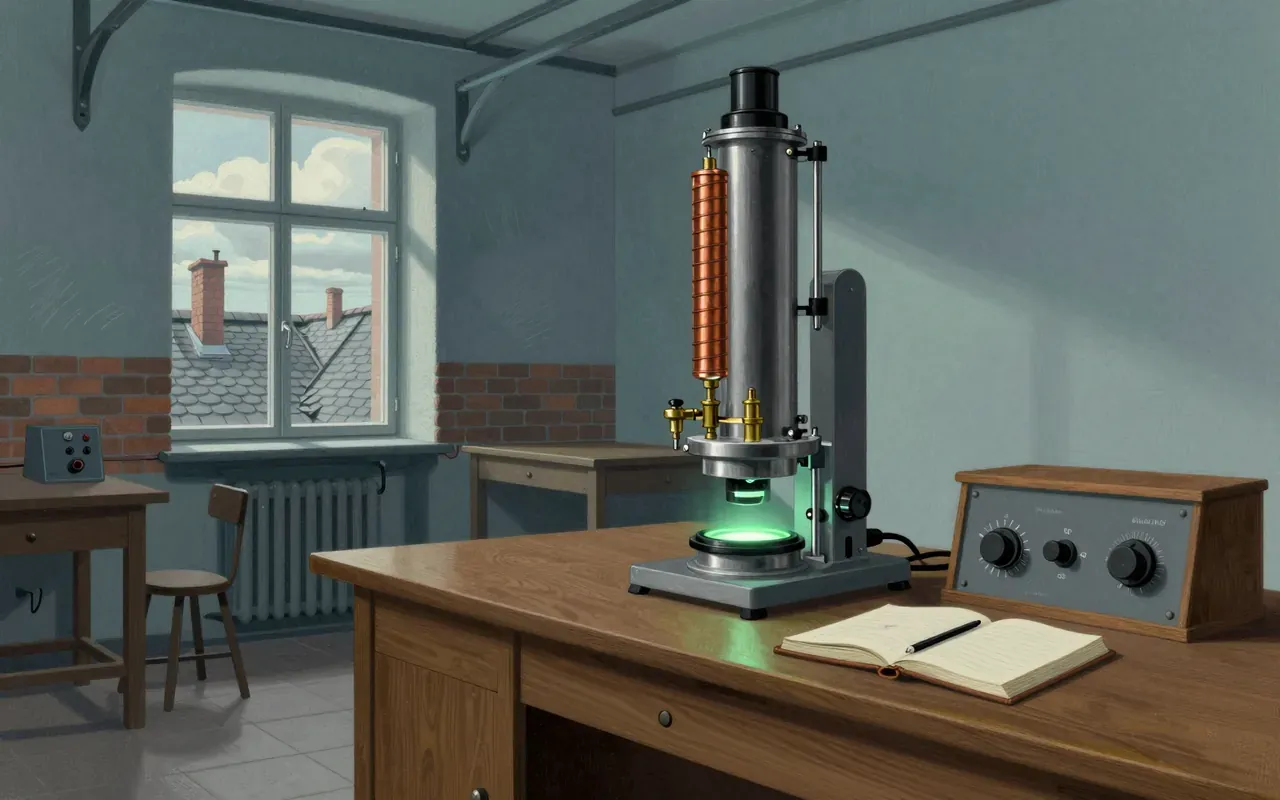
Willem Einthoven, a physiology professor at the University of Leiden, set out from 1901 to build an instrument precise enough for the task. His string galvanometer worked by suspending an extremely thin, current-carrying filament between two powerful electromagnets; as the heart’s electrical signal passed through the filament, the surrounding magnetic field caused it to deflect, and a light source cast the moving shadow of the filament onto a roll of photographic paper, tracing a continuous curve as the paper advanced. This design was sensitive enough to register the heart’s signal clearly, at a level of detail earlier instruments could not match.
Five people and 270 kilograms
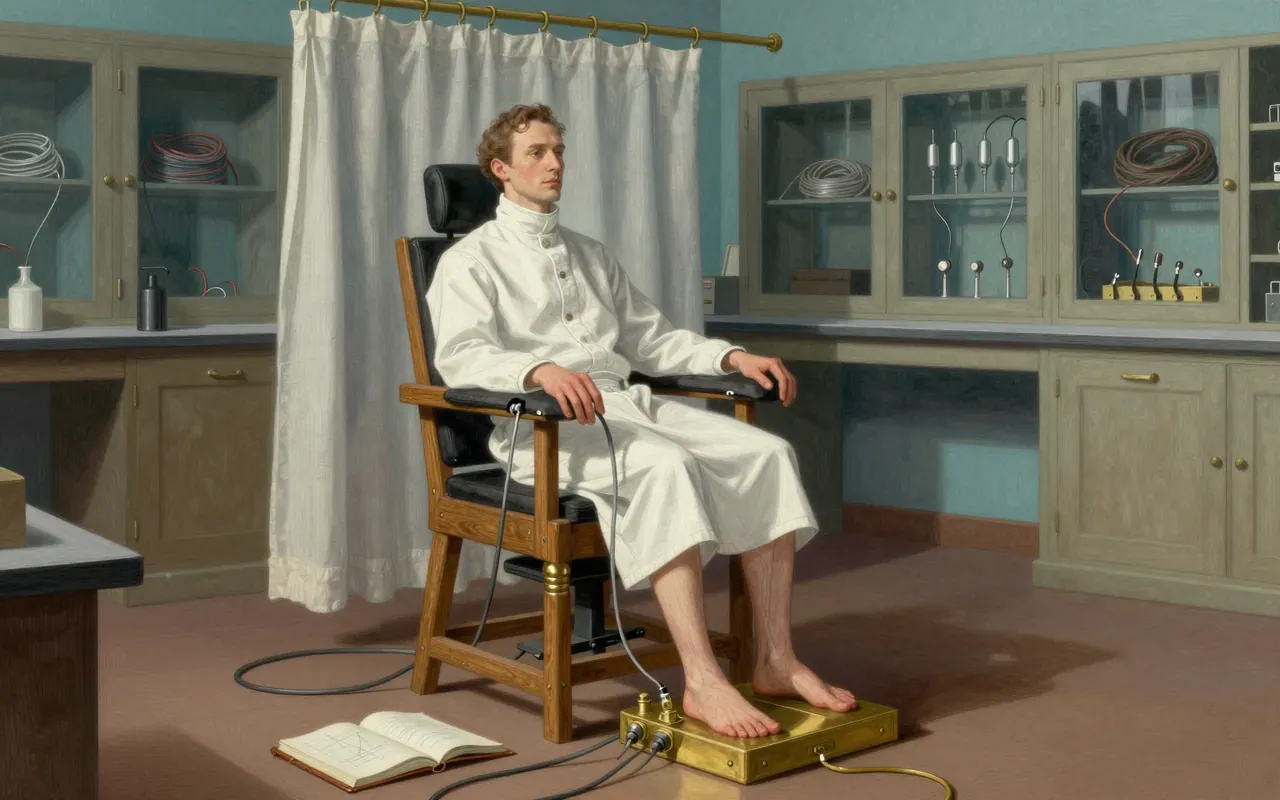
The device that made this possible, completed in 1903, was far from a compact instrument: it required water cooling to manage its powerful electromagnets, weighed around 270 kilograms, and needed five people to operate. Its impracticality did not undermine the underlying result: the trace it produced showed the heart’s electrical activity with enough clarity and consistency to be genuinely useful for identifying particular kinds of cardiac irregularity, and Einthoven established a standard arrangement of electrodes on the limbs, since known as Einthoven’s triangle, that let recordings from different patients and different machines be compared on the same terms.
Naming the waves
What the original 1903 machine could not do was serve as a practical clinical tool; a 270-kilogram, five-operator apparatus with water-cooled electromagnets was never going to sit beside a hospital bed. Turning the string galvanometer’s underlying principle into the compact, portable electrocardiograph used in clinics and hospitals today required decades of separate engineering work by many hands, refining the electronics and the recording mechanism well beyond anything Einthoven’s original design addressed. The basic naming scheme he introduced for the trace’s component waves, however, labelling the deflections P, Q, R, S and T, survived that entire process of miniaturisation essentially unchanged.
From a lab curiosity to a routine test
Once engineered into a practical form, the electrocardiogram became one of medicine’s most frequently used diagnostic tests, applied to detect irregular heart rhythms, signs of inadequate blood flow to the heart muscle, and a range of other cardiac and metabolic problems, as well as for routine monitoring during surgery and for testing the heart’s response to physical stress. Its value rests directly on Einthoven’s original insight and his standardised lead placement, since a modern ECG trace is still read using the same P, Q, R, S and T labels he assigned to a signal picked up by a machine that would today look more like laboratory apparatus than medical equipment.
Why a 270-kilogram machine still matters
This is worth understanding because it is a clean example of how far an instrument can travel from its first working version to its everyday form, and of how much of that first version’s intellectual content, the naming of the waves, the standard electrode geometry, survives the physical redesign that makes a device actually usable. Einthoven’s 1924 Nobel Prize recognised the underlying discovery of how the electrocardiogram’s mechanism works, not the specific bulky machine that first recorded it, and that distinction, between a scientific insight and the engineering needed to make it practical, is worth carrying into how any early scientific instrument’s later, more convenient descendants are understood.