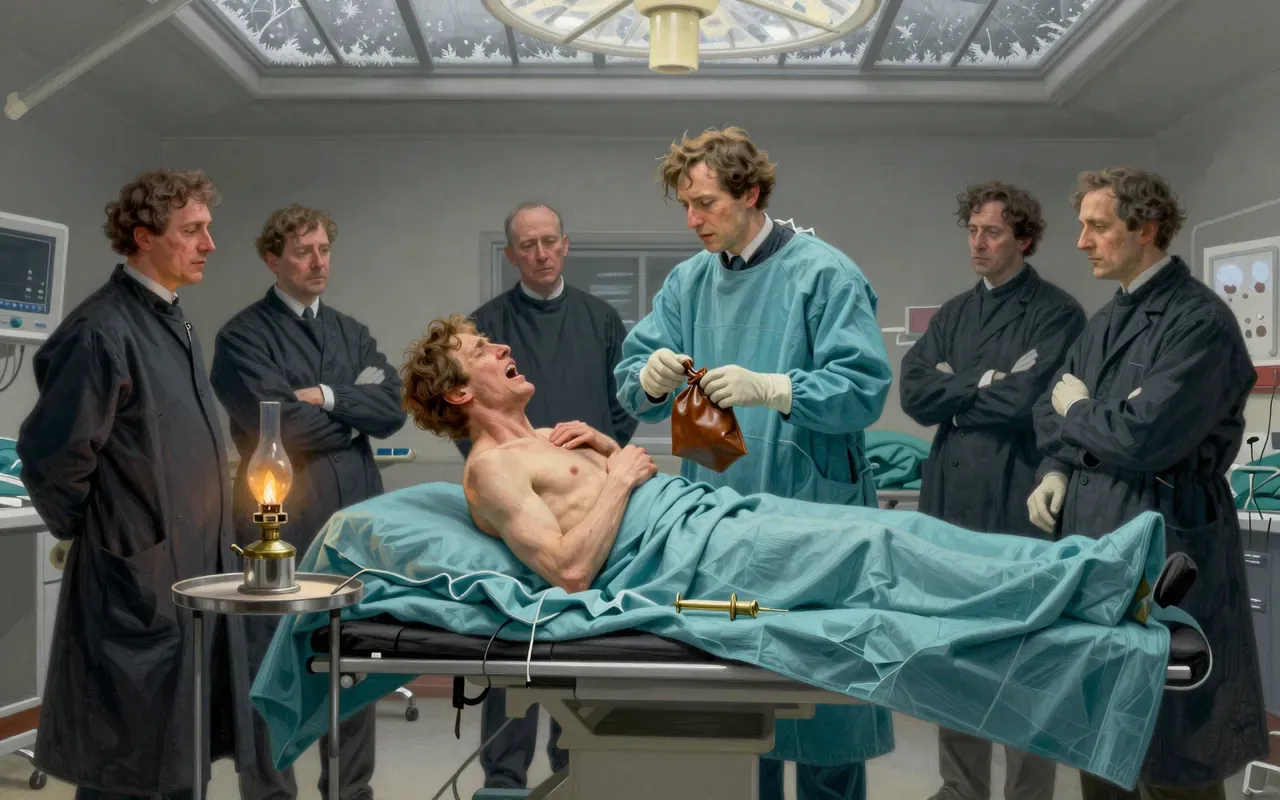
A failed demonstration the year before
On 20 January 1845, a dentist named Horace Wells attempted to demonstrate nitrous oxide as a surgical anaesthetic in the same Massachusetts General Hospital operating theatre that would later host the successful ether demonstration. The attempt failed: the patient cried out during the procedure, and the assembled audience of physicians and medical students left unconvinced that the gas had actually blocked any pain at all. That public failure meant any later demonstration of surgical anaesthesia would have to overcome real, freshly reinforced scepticism, since the most recent public attempt at exactly this claim had visibly and memorably not worked.
A private success, then a public one
William Morton, another dentist, had been experimenting with ether, a substance already known socially through recreational ether frolics he had attended years earlier, and tested it privately on a patient named Eben Frost on 30 September 1846 with promising results. Building on that private success, Morton arranged a public demonstration at the same hospital theatre for 16 October 1846, working with surgeon John Collins Warren, the first dean of Harvard Medical School, who agreed to operate on a patient while Morton administered the gas using an apparatus he had built for the purpose.
No pain, and no humbug
During the operation, Morton held the delivery apparatus to the mouth of the patient, a young printer named Edward Gilbert Abbott, and had him breathe until he lost consciousness within three to four minutes. Warren then removed part of a tumour from the left side of Abbott’s neck; Abbott later reported feeling only a scratching sensation rather than pain, and Warren addressed the assembled physicians afterward with the remark that this was no humbug, a direct reference to the credibility problem left by Wells’s failed attempt the year before. News of the successful demonstration spread to Europe and across America within weeks, carried in part by an account published almost immediately by Henry Jacob Bigelow.
A discovery already made, and unpublished
Morton’s claim to have introduced surgical anaesthesia was contested almost immediately and on more than one front. Charles Jackson, a chemist who had discussed ether’s properties with Morton beforehand, argued that Morton had taken the underlying idea from him rather than developing it independently, beginning a dispute over credit that continued for years afterward. Separately, and more decisively for the historical record, Crawford Long had already administered ether to remove a tumour from a patient’s neck back on 30 March 1842, four years before Morton’s demonstration, but he did not publish an account of the operation until 1849, well after Morton’s public success had already been widely reported and credited.
A dispute that outlasted the demonstration
What actually followed from Morton’s demonstration was rapid and consequential regardless of the priority dispute: Robert Liston performed the first amputation under ether within two months, in December 1846, and within a year the Scottish obstetrician James Young Simpson had introduced chloroform as an alternative anaesthetic. Ether’s use spread widely enough that by 1853 the physician John Snow was administering an anaesthetic, chloroform, to Queen Victoria during childbirth, a moment credited with helping legitimise anaesthesia specifically in obstetric practice. Ether itself remained a standard surgical anaesthetic for many decades before safer alternatives, including halothane from 1956 and later isoflurane, sevoflurane and desflurane, gradually replaced it.
Why the public moment mattered more than the private one
This is worth understanding because it separates two things that get blurred together in popular retellings: who first did something, and whose demonstration of it actually changed practice. Crawford Long administered ether for surgery years before Morton did, yet it is Morton’s public, witnessed, and immediately publicised demonstration at Massachusetts General Hospital that is credited with launching the era of surgical anaesthesia, precisely because an unpublished private success could not do the work of persuading the wider medical community the way a documented public one could. An hour spent on the full sequence, the failed 1845 attempt, Morton’s private test, the public demonstration, and the priority dispute that followed, gives a clearer sense of how medical practice actually changes than the single-inventor version usually told.