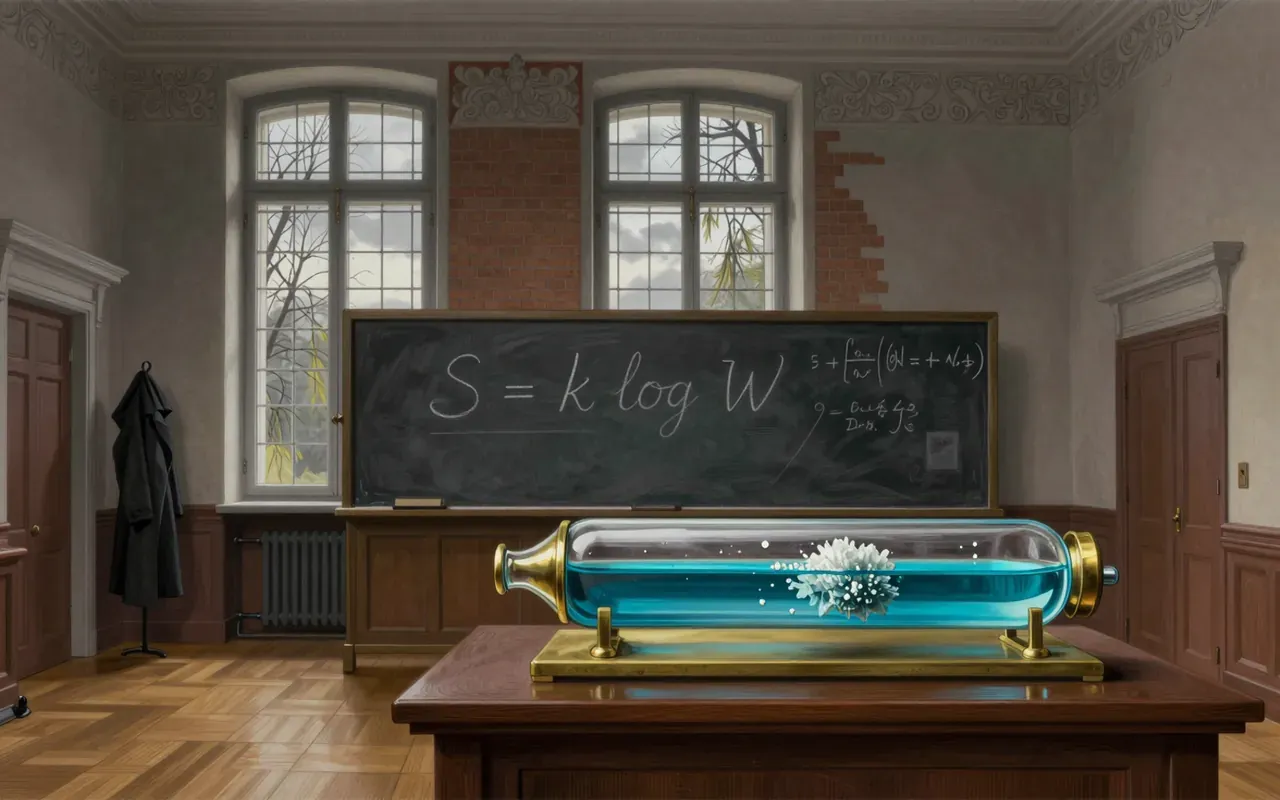
Entropy as a count of possibilities
Ludwig Boltzmann’s entropy formula, S equals the Boltzmann constant times the natural logarithm of W, claims that the entropy physicists had already been measuring as a quantity of heat divided by temperature is, underneath, a count of possibilities: W is the number of distinct microscopic arrangements of atoms or molecules that all produce the same observable, macroscopic state. A gas spread evenly through a room has far more ways to arrange its molecules and still look like an evenly spread gas than it would have ways to arrange itself while clumped in one corner, and Boltzmann’s claim is that this difference in the sheer number of arrangements is what entropy actually measures. It reframed a law about heat engines as a statement about probability: high-entropy states are common not because of some special force pushing systems toward them, but because there are overwhelmingly more ways to be in one.
From an 1877 paper to Planck’s notation
Boltzmann worked out the underlying logarithmic relationship between entropy and the number of possible molecular arrangements in a paper published in 1877, building on his earlier kinetic theory of gases and the distribution of molecular speeds he had developed with James Clerk Maxwell. Max Planck later put the relationship into the compact form now used, S equals k times the natural log of W, around 1900, and named the constant k after Boltzmann even though Boltzmann himself had not written the formula in quite that shape. The reasoning rested on treating a gas as an enormous number of individual particles whose exact positions and speeds, a microstate, could not be tracked directly, while the pressure, temperature and volume an experimenter actually measures, a macrostate, correspond to a huge number of different possible microstates consistent with it.
Why the second law holds statistically
The formula has become one of the most secure results in physics, treated as a bridge between mechanics and thermodynamics rather than a hypothesis still under test. It explains, in probabilistic terms, why the second law of thermodynamics holds: entropy tends to increase not because it must in every conceivable case, but because disordered, high-entropy arrangements vastly outnumber ordered ones, so any system left alone is overwhelmingly likely to drift toward them. The formula is carved on Boltzmann’s own gravestone in Vienna, a mark of how central it became to his legacy. His broader statistical framework, developed initially just to explain gas behaviour, went on to become foundational to quantum mechanics and to nearly every branch of physics that deals with large numbers of particles.
A fight over whether atoms were real
What the formula could not do, in Boltzmann’s own lifetime, was settle the argument he was actually having, which was about whether atoms existed at all rather than about the mathematics of entropy. Influential physicists and philosophers of the period, including Ernst Mach and Wilhelm Ostwald, argued for a view called energetics, treating energy rather than matter as the fundamental reality, and dismissed atoms as a convenient mathematical fiction rather than physically real objects. Boltzmann’s statistical mechanics only made sense if atoms were real, countable things whose arrangements could be tallied, and he spent much of his career defending that assumption against colleagues who considered it unproven and, in some cases, refused to let him reference atoms as anything more than a calculating device in print.
Vindication that came too late
The dispute over atoms was not merely academic; it shaped what kind of physics counted as respectable for decades and contributed to genuine professional isolation for Boltzmann. Vindication came only after his death: between 1908 and 1909, Jean Perrin’s experiments on tiny particles suspended in liquid, building directly on Albert Einstein’s 1905 theoretical treatment of Brownian motion, gave a physical measurement of the same constants Boltzmann’s statistical mechanics required, convincing most remaining sceptics that atoms were real rather than a useful fiction. That the confirmation depended on Einstein and Perrin’s separate, later work rather than on Boltzmann’s own formula being independently checked says something about how theoretical results in physics sometimes wait for an unrelated experimental method to catch up before they can be settled.
A formula on a gravestone
This is worth the time as a study in how a correct idea can outlast the argument surrounding it. Boltzmann hanged himself in 1906, exhausted by depression and by years of resistance to work that turned out, within a few years, to be exactly right, which gives the story a genuinely difficult edge rather than a triumphant one. Readers should come to this expecting a formula that is now uncontroversial, foundational even, paired with a biography that was anything but settled at the time. The material rewards attention to the timing: the confirmation through Brownian motion experiments arrived only two or three years after Boltzmann’s death, close enough to make the delay feel almost unbearable rather than merely historical. It is a short read with real weight to it.