A pattern in three oxides of nitrogen
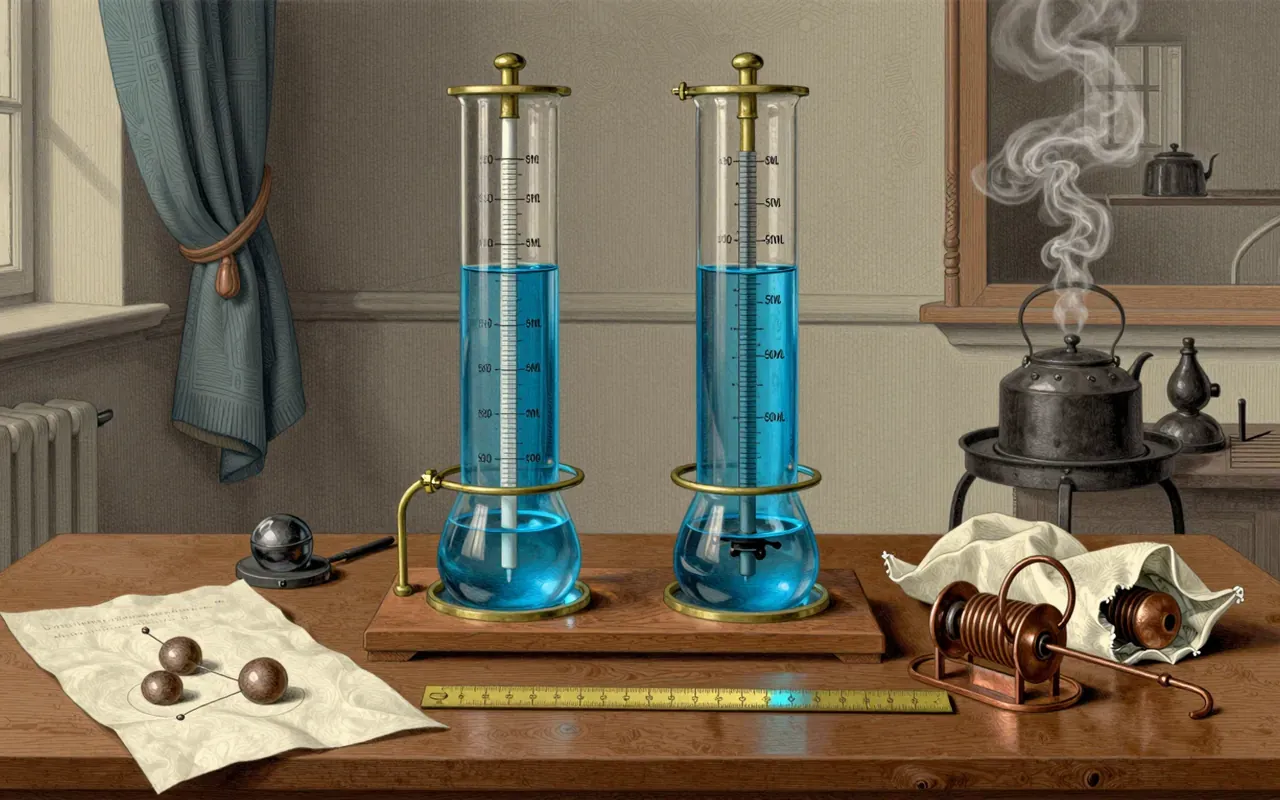
The claim starts from a specific numerical pattern rather than a philosophical position on what matter is made of. In 1804 Dalton examined three compounds of nitrogen and oxygen and found their oxygen-to-nitrogen mass ratios came out as 80 to 140, 160 to 140, and 320 to 140 — a sequence reducible to the simple ratio 1 to 2 to 4. Generalising from this, he proposed the law of multiple proportions: when two elements form more than one compound together, the ratios of one element combining with a fixed mass of the other fall into small whole numbers, which he took as evidence that elements combine in fixed, countable units.
Five postulates in one book
Dalton built a full theory on top of that observation, setting it out completely in his 1808 book A New System of Chemical Philosophy after early indications had appeared in a paper published in 1805. Its core postulates held that every atom of a given element is identical and shares one characteristic weight, that atoms of different elements differ from each other, that atoms cannot be split, created or destroyed, and that compounds form when atoms combine in simple, fixed whole-number ratios. Chemical reactions, in this framework, only ever combine, separate or rearrange atoms that already exist, never create or destroy them.
A weighing method that assumed its own answer
Turning this into a usable table of atomic weights is where the method broke down. Dalton assigned hydrogen a weight of 1 and treated water as a binary compound of one oxygen atom to one hydrogen atom, which led him to calculate oxygen’s weight as 7; his first published table of relative atomic weights, in 1805, covered six elements on this basis. The problem was the underlying assumption, not the arithmetic — had he happened to study hydrogen peroxide instead of water as his reference compound, the same method would have assigned oxygen a weight of 16, which shows the ratio-guessing approach could not fix an atom’s true combining ratio without outside information Dalton did not yet have.
Avogadro’s fix and the real formula for water
That outside information came from Amedeo Avogadro, whose 1811 hypothesis proposed that equal volumes of gas at the same temperature and pressure contain equal numbers of molecules. Applied to oxygen and hydrogen gas, this revealed that elemental gases often exist as paired atoms rather than single ones, correcting the picture Dalton had assumed. Avogadro’s approach yielded an atomic weight for oxygen of about 15.074 and the correct formula for water, two hydrogen atoms to one oxygen, rather than Dalton’s one-to-one binary compound — a direct repair of the specific error built into Dalton’s original weighing method.
The atom stops being indivisible
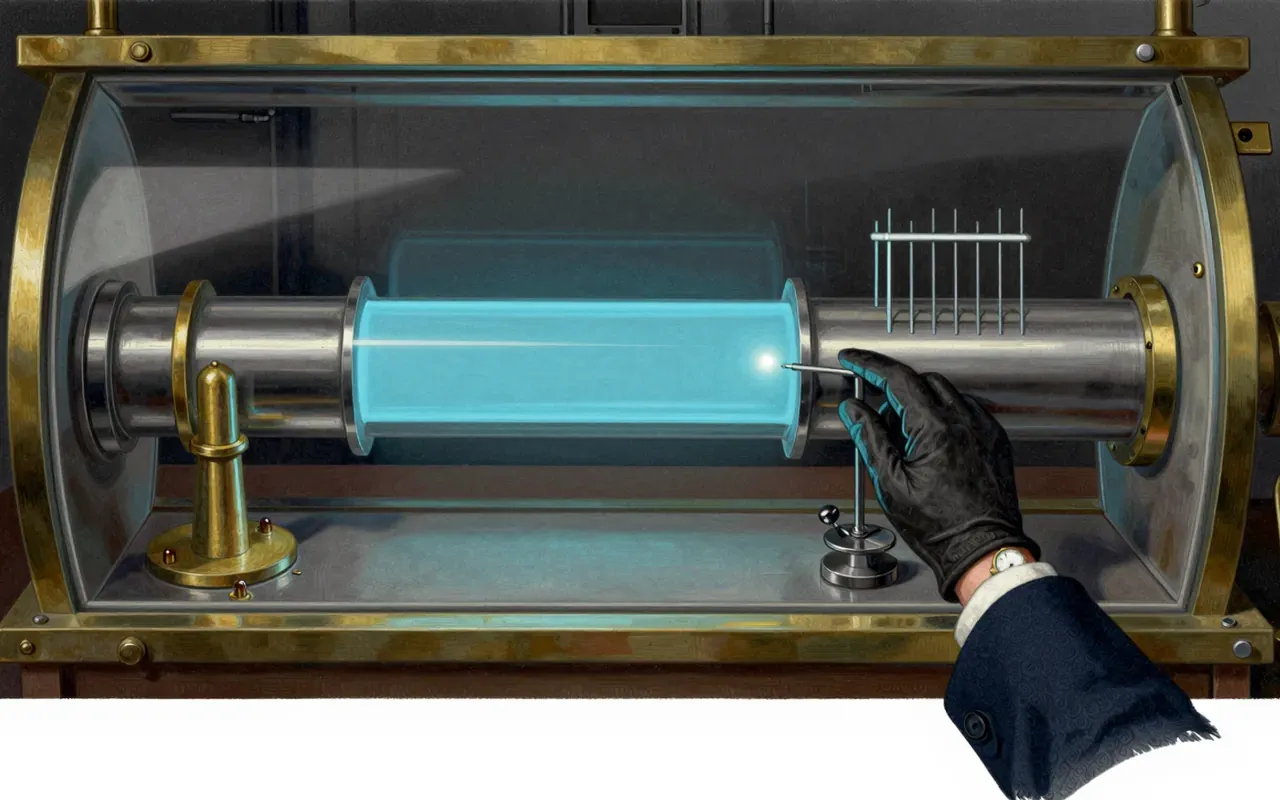
The larger claim, that atoms are indivisible, lasted rather longer before it was dismantled piece by piece. J.J. Thomson’s discovery of the electron in 1899, through his work on cathode rays, first showed atoms have internal structure and can be broken apart. Ernest Rutherford’s foil-bombardment experiments between 1908 and 1913 then revealed a small, concentrated nucleus rather than matter spread evenly through the atom, and Niels Bohr’s 1913 model placed electrons in defined states around that nucleus. James Chadwick’s 1932 identification of the neutron, inferred from measuring the energy of particles recoiling from a mysterious radiation, completed the modern picture of protons, neutrons and electrons that has nothing in common with Dalton’s solid, uncuttable sphere.
The pattern survived even though the model didn’t
What makes this worth following through to the end is which part of Dalton’s work actually survived. His specific model of the atom, and his method for weighing it, were both superseded within a century by better evidence and better instruments. But the whole-number regularity he first noticed in those three nitrogen oxides was never overturned — it turned out to reflect something real about how atoms combine, even though explaining why required physics Dalton had no access to. That is a useful shape for a science story to take: the observation holds, the explanation gets replaced, and neither fact makes the other less interesting.