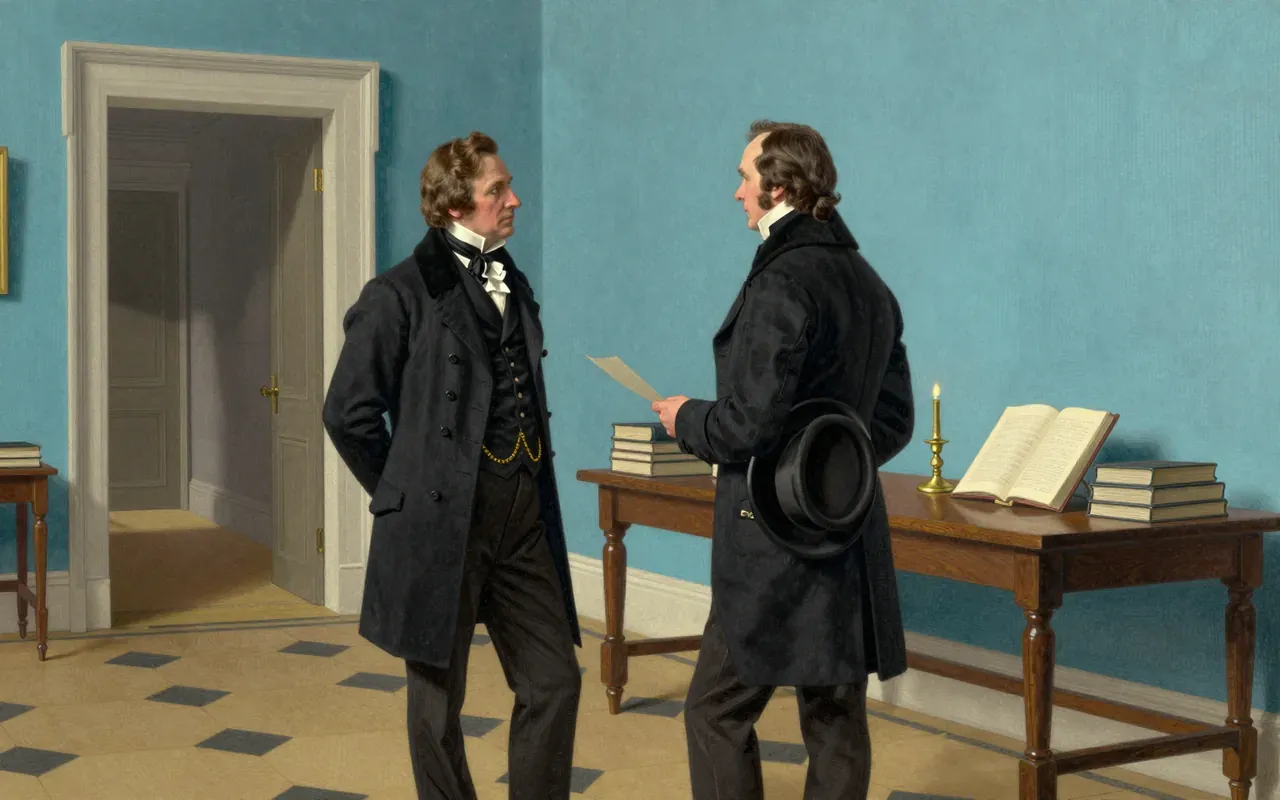
Two men, one theory
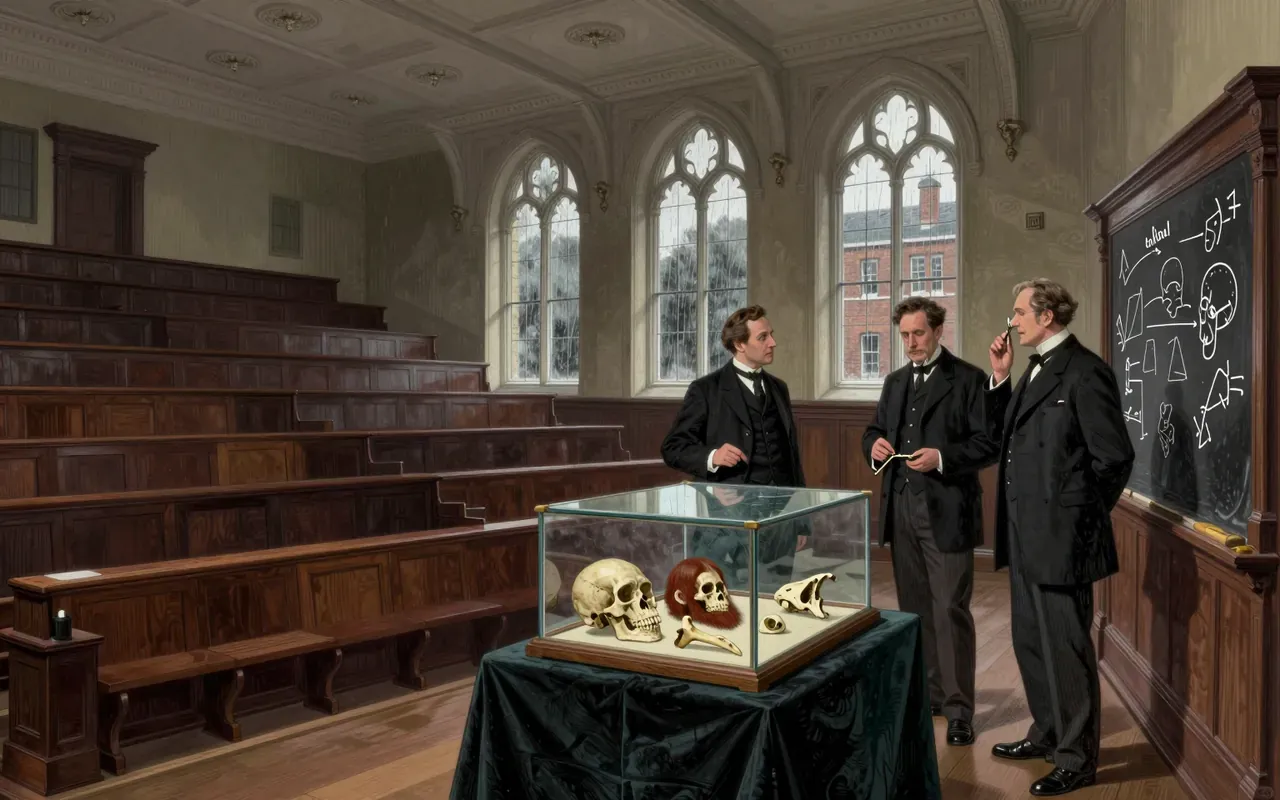
On 1 July 1858, the Linnean Society of London heard a joint paper crediting two men, not one, with the theory of evolution by natural selection: Charles Darwin, who had been developing the idea privately for two decades without publishing it, and Alfred Russel Wallace, who had independently arrived at essentially the same mechanism while recovering from malaria in the Malay Archipelago and had just sent Darwin a short essay laying it out. The paper combined extracts from unpublished writing Darwin had drafted years earlier with Wallace’s new essay, presented together as a single reading rather than as two competing claims. The event’s core claim, in other words, is not simply that natural selection was proposed, but that it was proposed twice, independently, by two men who ended up sharing a stage neither had specifically asked to share.
A letter that forced Darwin’s hand
Darwin had sketched the theory in a private 1842 outline and a fuller 1844 essay, but kept delaying publication while gathering further evidence. On 18 June 1858 he received roughly twenty pages from Wallace describing a mechanism close enough to his own that Darwin wrote he could not have summarised his own 1842 sketch better. Rather than let Wallace publish first or suppress his own priority, Darwin turned the dilemma over to his friends Charles Lyell and Joseph Hooker, who arranged the joint reading at the Linnean Society, combining Wallace’s essay with extracts from Darwin’s earlier writing and a letter Darwin had sent to the botanist Asa Gray in 1857. Neither man attended the reading in person; Darwin was at home dealing with a family illness, and Wallace was still in the East Indies, unaware the arrangement had even been made.
A reading neither man attended
The arrangement achieved what it was designed to achieve: it established a joint, dated public record of the theory before either man published a full account, and it did so without either party appearing to have stolen from the other, since the material presented came from writing that predated Wallace’s letter on Darwin’s side and from Wallace’s own hand on his. Darwin followed up quickly, compressing years of unfinished research into an abstract that became On the Origin of Species, published on 24 November 1859 and sold out on its first day of general sale. Wallace, for his part, never contested the arrangement or Darwin’s subsequent primacy in the public mind, and the two remained on cordial terms, corresponding for years afterward about sexual selection, warning coloration and other extensions of the theory.
An event that made little impression
What the joint paper did not do was make much of an immediate impression. The Linnean Society’s president, reviewing the year afterward, remarked that it had produced no discoveries that would revolutionise the field, a judgement that reads, in hindsight, as one of the more mistaken assessments in the history of science. The theory’s actual reception took shape only after Origin of Species appeared the following year, meaning the Linnean Society reading is better understood as a quiet procedural fix to a delicate priority problem than as the moment natural selection became famous. It also did not resolve, and was arguably designed to sidestep, the underlying awkwardness of one man’s twenty years of unpublished work being placed alongside another man’s few weeks of urgent composition as though the two were equivalent contributions.
From reading to Origin of Species
The episode matters beyond the biology because it set a template for how scientific priority disputes get managed when two people converge on the same idea independently: not through public argument over who thought of it first, but through a negotiated joint presentation engineered by senior colleagues acting, in this case, mostly on Darwin’s behalf. Wallace went on to a long, independently distinguished career, founding much of modern biogeography through his identification of the faunal boundary now called the Wallace Line, and later took up causes, including opposition to eugenics and advocacy for land reform, that put him at odds with some of his fellow evolutionary thinkers. That his name still trails Darwin’s in most popular accounts of natural selection, despite the acknowledged independence of his discovery, says as much about publication timing and public memory as about the underlying science.
A template for shared credit
This is worth the time precisely because it complicates a story most people think they already know. Readers arrive expecting Darwin to be the sole author of natural selection and instead find a negotiated arrangement between two independent discoverers, brokered by intermediaries, that neither man attended in person. It rewards attention to Wallace’s own account of events, since his later career, as a biogeographer, social reformer and, more controversially, an investigator of spiritualism, is easy to lose entirely inside the Darwin-centred version of the story. The material is less useful for anyone wanting a detailed account of the science of natural selection itself; its focus is squarely on the human and institutional mechanics of how credit for a major idea gets settled between two people who reached it separately and almost simultaneously.