What the work claims
That the Andromeda and Triangulum nebulae are external galaxies, not Milky Way components. That galaxy radial velocities increase roughly linearly with distance — meaning greater separation speeds for more distant pairs.
How it was done
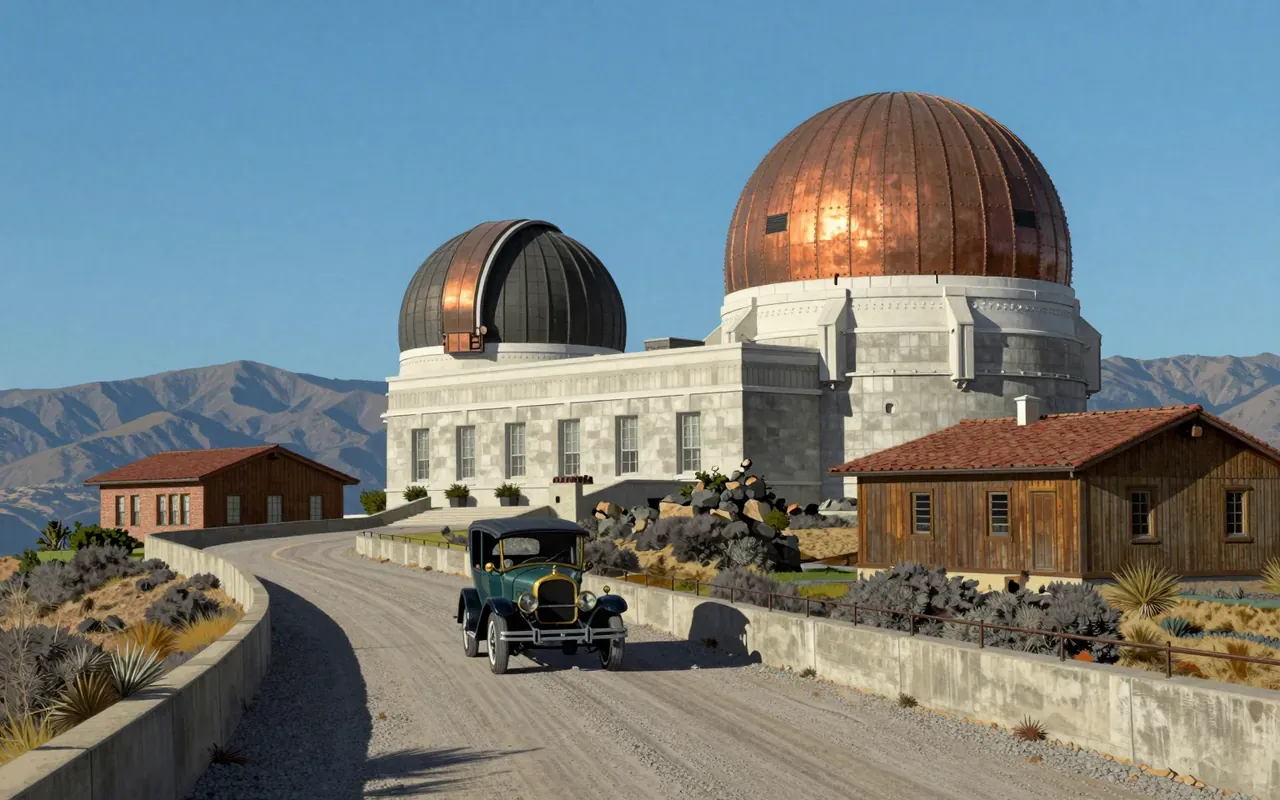
Hubble used the Hooker Telescope at Mount Wilson Observatory to identify Cepheid variable stars in the Andromeda and Triangulum nebulae. He measured their distances by comparing apparent luminosity to intrinsic luminosity — a method enabled by Henrietta Swan Leavitt’s calibration of Cepheids as standard candles. In 1929, he examined redshift-derived radial velocities of galaxies and compared them with those distances.
What holds up
The identification of Cepheids in Andromeda and Triangulum proved those objects lie far beyond the Milky Way’s stellar halo — establishing them as separate galaxies. The 1929 velocity–distance relation holds as an empirical trend across modern surveys, though its slope (the Hubble constant) remains contested due to measurement discrepancies.
What does not
Hubble did not discover the expansion of the universe. His 1929 paper reported a linear velocity–distance relation, not an expanding space-time model. He did not claim or interpret the result as evidence for a beginning, a Big Bang, or metric expansion — those interpretations came later from others.
Why it matters beyond the lab
It ended the ‘Great Debate’ over the nature of nebulae and forced a radical revision of cosmic scale. The velocity–distance relation became the primary empirical basis for models of cosmic evolution — but only after theoretical reinterpretation by others, notably Lemaître and Friedmann.
Is it worth your time
Yes. It redefined cosmic scale and motion in two distinct, empirically grounded steps — galaxy classification and velocity–distance correlation — both still foundational to observational cosmology.