Light in, electrons out
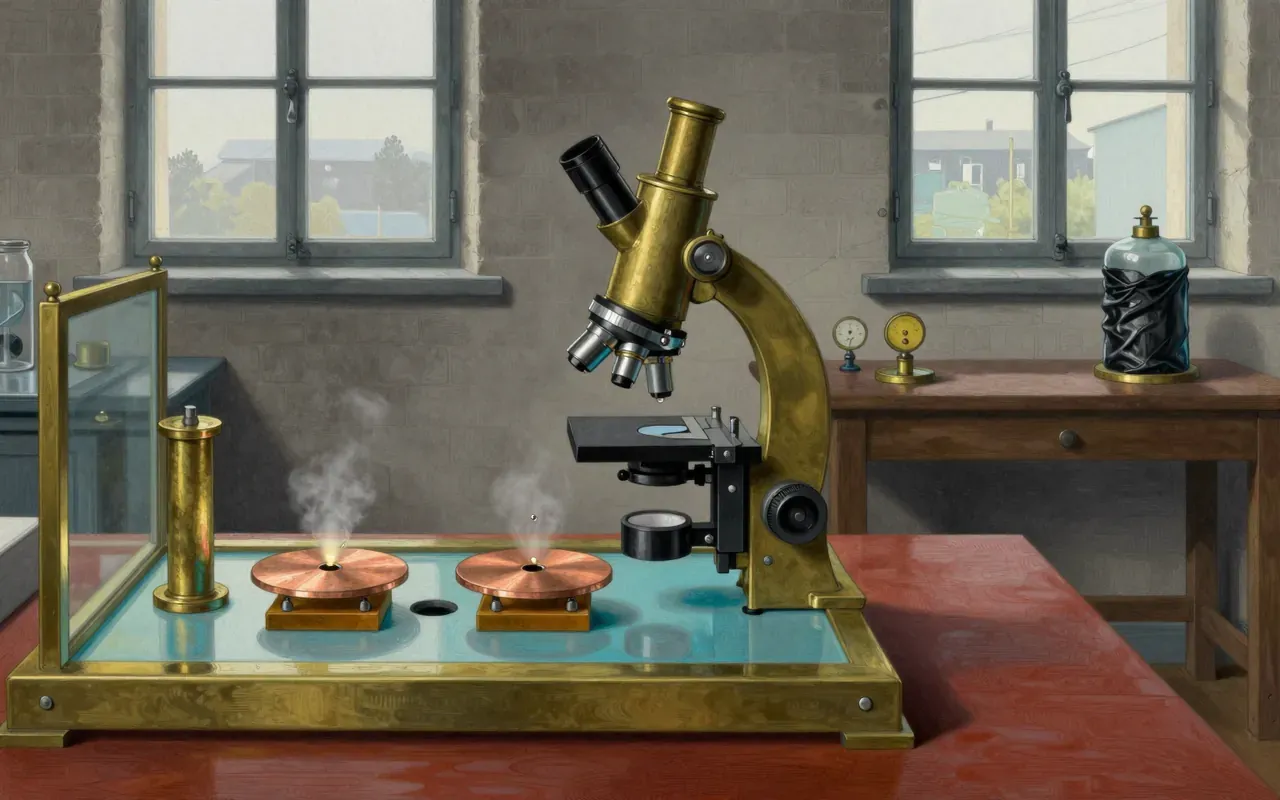
Photoemission spectroscopy claims something fairly narrow but very useful: that firing light of a known, precisely tuned energy at a solid, gas or liquid, and measuring the kinetic energy of the electrons that light knocks loose, tells you how tightly those electrons were bound inside their atoms before they left. That binding energy is a fingerprint. Different elements bind their electrons at different, well-defined energies, and the same element bound to different neighbours shifts that energy slightly again. Kai Siegbahn’s version of the technique, developed from 1957 using X-rays, extended this from a laboratory curiosity into a method sensitive enough to identify not just which elements sit at a surface but which chemical compounds they belong to, which is why he called it electron spectroscopy for chemical analysis.
Siegbahn’s ESCA
The method rests directly on Einstein’s photoelectric equation, which states that the kinetic energy of an ejected electron equals the energy of the absorbing photon minus the electron’s binding energy. Since the photon energy is fixed and known, measuring the outgoing electron’s kinetic energy in an electron analyser lets the binding energy be calculated by subtraction. Siegbahn’s X-ray photoelectron spectroscopy probes deeply bound core electrons and requires ultra-high vacuum so the ejected electrons are not scattered before detection. A related but distinct technique, ultraviolet photoelectron spectroscopy, was developed separately for gas-phase molecules from 1961 by Feodor Vilesov and extended in 1962 by David Turner, using lower-energy ultraviolet light to probe the outer, valence electrons involved in chemical bonding rather than the core.
A family of techniques
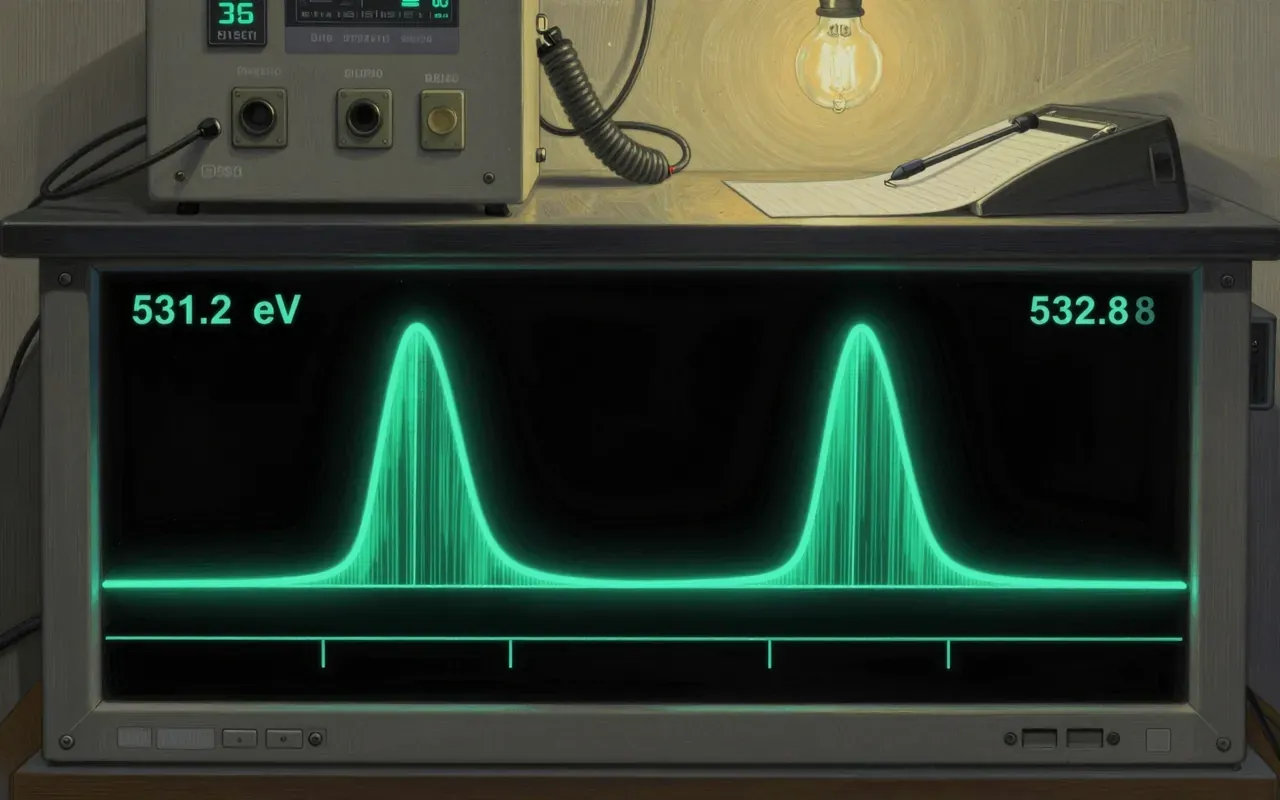
What holds up is the basic identification power of the method. Core-electron binding energies are characteristic enough of each element, and shift predictably enough with chemical environment, that XPS spectra reliably tell researchers what elements are present at a surface and roughly what they are bonded to, with peak widths as narrow as five to eight millielectronvolts achievable with a good monochromator and analyser. Because photoelectrons escape only from within a few nanometres of the surface in a solid, the technique is genuinely surface-specific rather than sampling the bulk material, which is exactly what makes it useful for studying coatings, catalysts and thin films. Siegbahn’s 1981 Nobel Prize in Physics recognised this as a mature, reliable analytical method rather than a speculative one.
What the peaks actually show
The limitations are practical rather than conceptual. Because the technique depends on electrons escaping into vacuum without being absorbed on the way, it only works on samples that can tolerate ultra-high vacuum conditions, which rules out many biological or liquid samples in their natural state and complicates in-situ studies of chemistry happening under normal atmospheric pressure. Distinguishing a genuine signal from background noise also demands care, particularly for trace elements at low concentration. And while angle-resolved photoemission spectroscopy, or ARPES, has become central to mapping the electronic band structure of solids, doing so with the resolution needed to see fine details of quasiparticle behaviour depends on synchrotron light sources that are not available in an ordinary laboratory, which concentrates the most advanced work at a handful of large facilities.
The vacuum problem
Outside the physics literature, this family of techniques is quietly load-bearing across materials science and chemistry. XPS is a standard tool for checking what is actually on the surface of a manufactured material, whether a catalyst’s active sites have degraded, or whether a semiconductor coating has the composition it was supposed to have, because it answers a question optical methods cannot: not just what a surface looks like, but what atoms and bonds are actually there. ARPES, meanwhile, has become the primary way physicists directly observe the electronic structure predicted by theories of exotic materials, from superconductors to topological insulators, turning abstract band diagrams into measured curves. Neither result makes headlines, but both function as everyday verification tools other, flashier discoveries depend on.
A workhorse, not a headline
This is a good read for anyone who wants to see how an abstract quantum-mechanical idea, the photoelectric effect, becomes a piece of laboratory equipment that answers concrete questions about what a material is made of. It rewards patience rather than delivering a dramatic reveal: the interest lies in watching one simple equation, kinetic energy equals photon energy minus binding energy, get refined over decades into several distinct instruments with different reach, from Siegbahn’s core-electron ESCA to modern ARPES mapping whole electronic bands. Readers wanting a single breakthrough narrative should look elsewhere; readers curious about how the everyday business of chemical and materials analysis actually works, and how a Nobel Prize can go to sustained instrumental refinement, will find it a solid, if technical, hour.