What the work claims
Laplace claimed that planetary systems are mutually equilibrated under Newtonian gravity. He claimed that tidal motion obeys linear partial differential equations incorporating real-world effects like friction and resonance. He claimed that the gravitational field of a spheroid can be fully calculated for external points. He claimed the Solar System originated from a rotating nebula and suggested an object so massive light cannot escape — a precursor idea to black holes.
How it was done
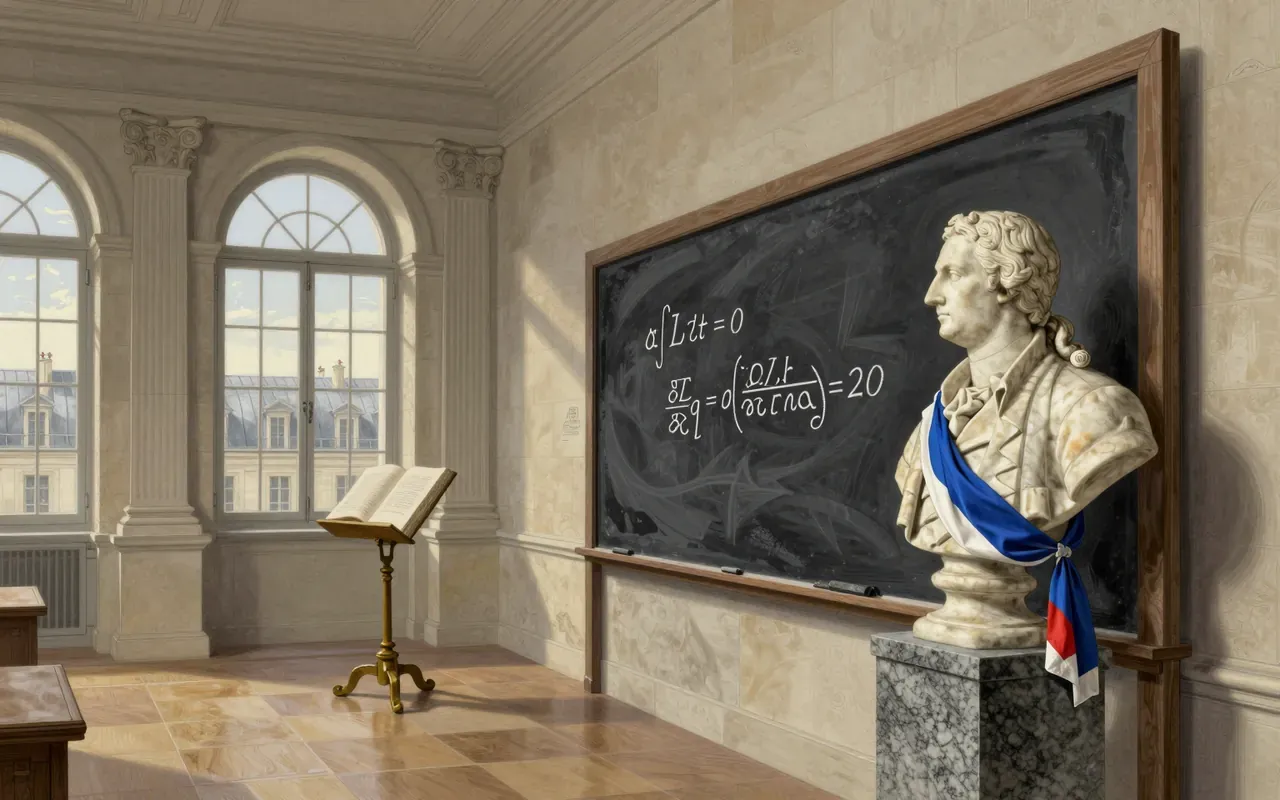
Laplace used higher-order perturbation analysis to model planetary motion. He formulated Laplace’s equation and the Laplace transform. In 1775, he developed the dynamic theory of tides. In 1776, he published a memoir exploring non-instantaneous gravitation and luminiferous ether before returning to Newtonian gravity. That same year, he formulated linear partial differential equations for barotropic tidal flow. He also determined gravitational attraction of a spheroid using mathematical analysis.
What holds up
Laplace’s formulation of Laplace’s equation and the Laplace transform holds up as foundational tools. His dynamic tidal theory — accounting for friction, resonance, and basin periods — remains conceptually central. His conclusion that any two planets and the Sun must be in mutual equilibrium follows from his perturbation analysis. His complete determination of spheroidal gravitational attraction is mathematically sound and verified.
What does not
The material does not support claims that Laplace proved planetary stability, confirmed black holes, or established consensus on the nebular hypothesis. It does not say he measured anything experimentally, nor that his tidal equations were validated against oceanic data at the time.
Why it matters beyond the lab
Laplace’s mathematics structures how we model everything from satellite orbits to storm surges. His tidal equations remain the conceptual basis for modern ocean models. His spheroid solution informs geodesy and planetary science. His nebular hypothesis and black hole suggestion shaped cosmological thinking — not as predictions confirmed in his lifetime, but as generative constraints on later theory.
Is it worth your time
Yes — Laplace’s methods underpin modern mathematical physics, celestial mechanics, and geophysical fluid dynamics. His work is not historical ornament; it is operational infrastructure.