12:59in productionCh. 1 · First neutrino astronomy/ 12:59 · ceiling 15 min
Astronomy & space · Physics
IceCube Neutrino Observatory
2010
Neutrinos don’t lie — and IceCube just made them point back at their makers.
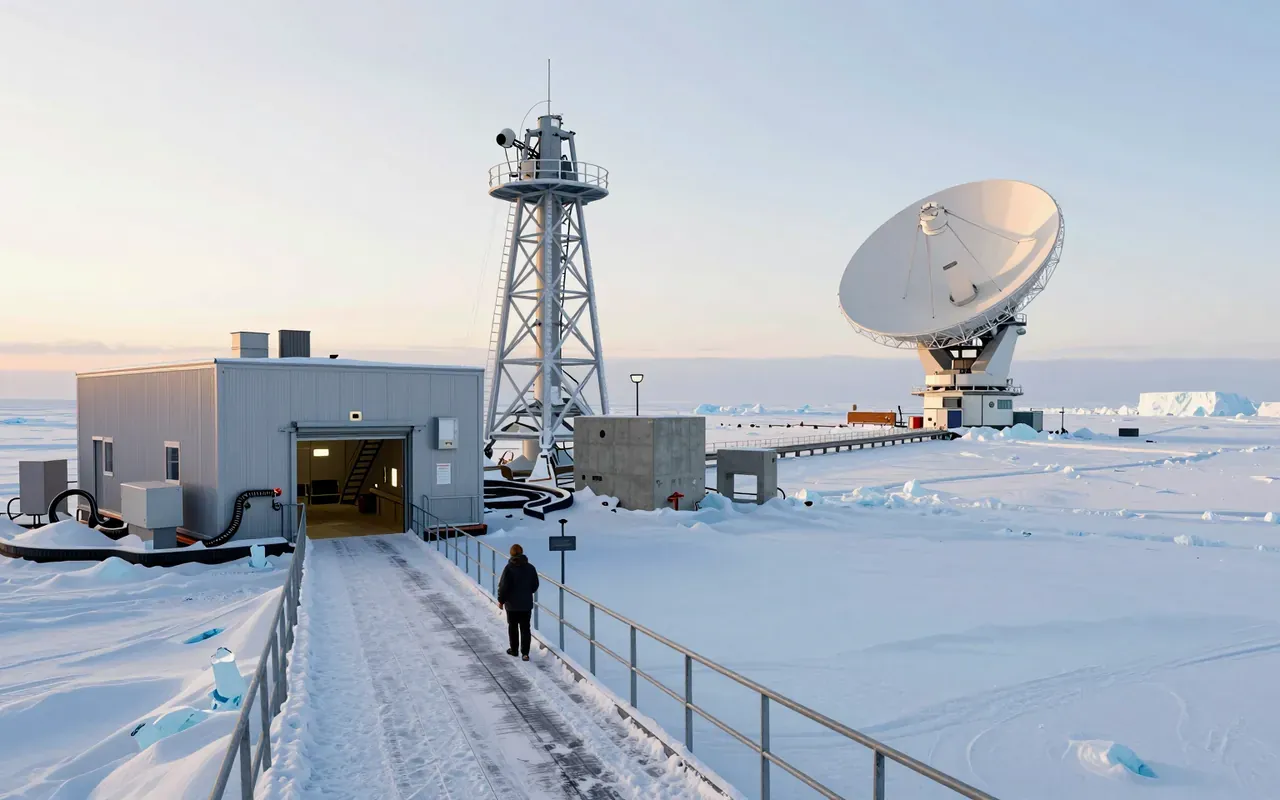
IceCube Neutrino Observatory (2010) is a neutrino telescope at the South Pole. It detected the first astrophysical neutrino point source (TXS 0506+056), the highest-energy neutrinos (PeV), diffuse Galactic neutrino emission, a second AGN source (Messier 77), astrophysical tau neutrino candidates, and found no evidence for sterile neutrinos.
For the first time, a neutrino detector located an object in space — a blazar 3.7 billion light-years away.
2:40
PeV neutrinos
IceCube detected the highest-energy neutrinos ever seen — two at the peta-electron volt scale.
4:07
Galactic neutrino glow
It mapped diffuse neutrino emission from the Milky Way’s plane — the first galactic neutrino map.
5:48
Second source confirmed
Messier 77 became only the second confirmed astrophysical neutrino point source — after TXS 0506+056.
7:22
Tau neutrinos found
Seven tau neutrino candidates were identified using machine learning — the first such astrophysical sample.
8:27
Sterile neutrino ruled out
No evidence for sterile neutrinos was found — closing one major extension of the Standard Model.
Worth your time?
Yes. Study the whole thing.
4.5/ 5
What works
spatial source localisation
energy measurement up to PeV
diffuse emission mapping at 4.5σ
tau neutrino candidate identification
What does not
proves cosmic-ray acceleration
confirms sterile neutrinos
identifies more than two point sources
detects solar or supernova neutrinos beyond SN1987A
Study it if
astrophysicists
particle physicists
cosmic-ray researchers
Skip it if
general public without physics background
climate scientists
biologists
The written brief1 min read
What the work claims
IceCube claims to have identified astrophysical neutrino point sources, measured the highest-energy neutrinos to date, mapped diffuse Galactic neutrino emission, detected astrophysical tau neutrinos, and ruled out sterile neutrino oscillations in its 2016 analysis.
How it was done
IceCube is a neutrino observatory built at the South Pole by the University of Wisconsin–Madison. It detects high-energy astrophysical neutrinos via Cherenkov radiation from charged leptons produced in neutrino–ice interactions.
What holds up
The 2017 neutrino traced to TXS 0506+056 at 3.7 billion light-years (3–3.5σ). The 2013 detection of 28 astrophysical neutrinos, including two at PeV scale. The 2023 Galactic-plane diffuse emission at 4.5σ. The 2022 identification of Messier 77 as a second AGN source. The 2024 identification of seven tau neutrino candidates using machine learning.
What does not
It does not prove cosmic-ray acceleration mechanisms. It does not confirm sterile neutrinos exist — it found no evidence for them in 2016. It does not identify more than two astrophysical point sources (TXS 0506+056 and Messier 77). It does not claim detection of solar or supernova neutrinos beyond SN1987A.
Why it matters beyond the lab
Neutrinos travel unimpeded across cosmic distances. Pinpointing their origins constrains models of cosmic-ray production. Detecting them from the Galactic plane confirms hadronic processes in our own galaxy. Ruling out sterile neutrinos shapes particle physics beyond the Standard Model.
Is it worth your time
Yes. It delivers spatially resolved astrophysical neutrino sources, measures PeV-scale energies, and maps diffuse Galactic emission — all with quantified significance. Its limitations are explicit and testable.