Forty substances, eleven slots
The problem Soddy was solving in 1913 was a specific arithmetic mismatch. Radiochemists studying the decay chains that run from uranium down to lead had identified roughly forty distinct radioactive species along the way, each with its own decay behaviour, yet the periodic table only had eleven element positions available across that same stretch. Something had to give: either the periodic table was missing dozens of elements nobody could otherwise place, or several of these supposedly distinct species were actually the same element showing up more than once in a form chemistry could not yet distinguish.
A name born from a conversation
Soddy’s resolution was that the second explanation was correct: a given element could exist as atoms sharing identical chemical behaviour but differing in atomic mass, occupying the same position on the periodic table despite that difference. He needed a word for this and got one from an unlikely source — Margaret Todd, a Scottish physician, suggested isotope, from Greek roots meaning equal place, during a conversation in which Soddy was explaining the idea to her. Working alongside Kazimierz Fajans, he also worked out the radioactive displacement law, showing that alpha decay shifts an element two places to the left on the periodic table and beta decay shifts it one place to the right, which helped make sense of how so many distinct decay products could still collapse into so few actual elements.
Two independent confirmations
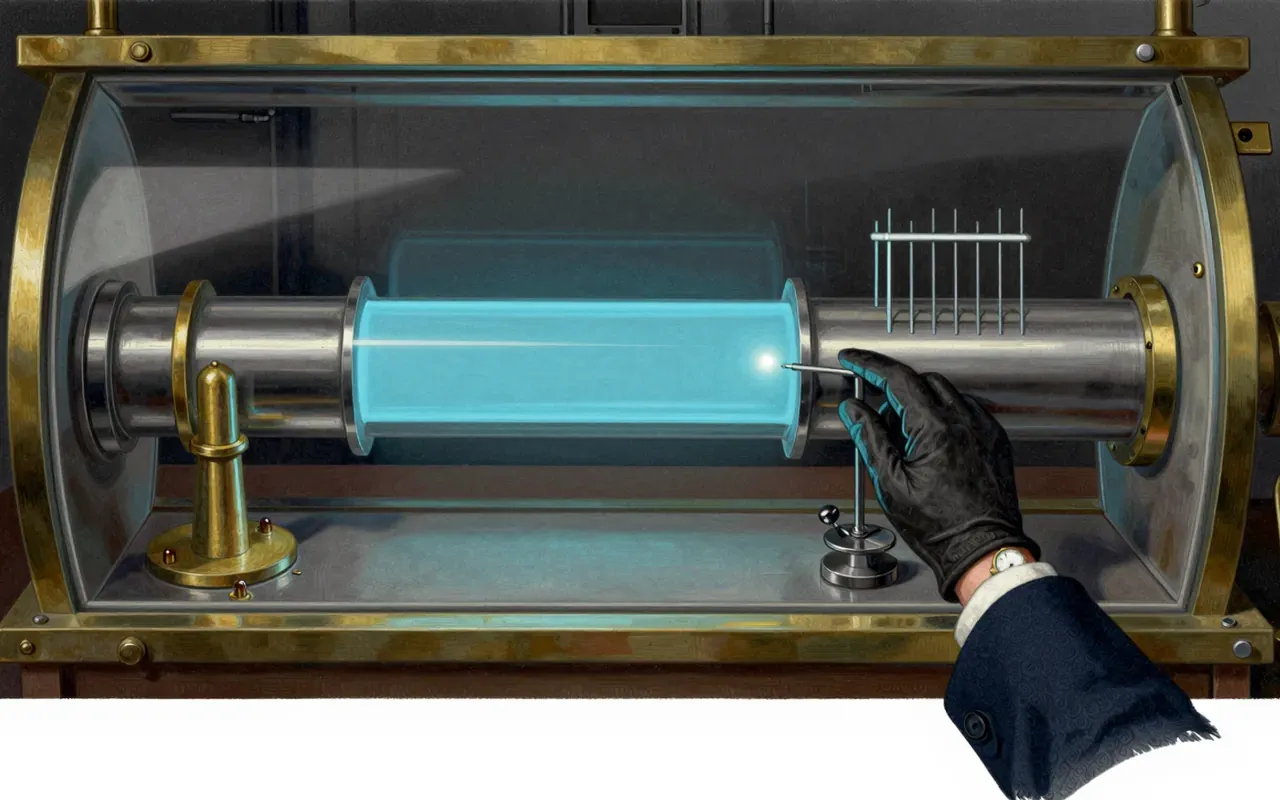
The idea did not rest on Soddy’s proposal alone for long. T.W. Richards found in 1914 that lead extracted from different minerals had measurably different atomic weights, consistent with different radioactive origins producing different isotopic mixtures. More directly, J.J. Thomson’s canal-ray experiments around 1912 and 1913 produced photographic plates showing two distinct impact positions for neon, later identified as neon-20 and neon-22, and Francis Aston’s mass spectrograph, built with better resolution by 1919 and 1920, confirmed the pattern precisely, showing that chlorine’s familiar atomic weight of 35.45 was in fact a weighted average of chlorine-35 and chlorine-37 rather than a single true value.
The neutron makes the picture make sense
What had been an inference from chemistry and mass measurement only became a structural explanation once James Chadwick identified the neutron in 1932. That discovery clarified exactly what varies between isotopes of the same element: identical numbers of protons, which fix the chemical identity, alongside differing numbers of neutrons, which change the mass without changing the chemistry. This is also where the limits of the concept show up — Earth’s naturally occurring nuclides number in the low hundreds, and their distribution is uneven, with one element, tin, having ten stable isotopes while twenty-six elements have only a single stable form, a pattern isotope theory describes without on its own explaining why some combinations of protons and neutrons are stable and others are not.
From dating rocks to tracing food fraud
The practical reach of the isotope concept extends well past nuclear physics. Radiocarbon dating uses the known decay rate of carbon-14 to estimate the age of organic material, nuclear medicine relies on radioisotopes for both diagnosis and treatment, and isotope separation techniques — gas diffusion for lighter elements, chemical exchange processes for hydrogen and deuterium, and centrifugation or laser methods for uranium — are central to both energy production and research. Stable, non-radioactive isotopes do just as much quiet work, serving as tracers in chemical and biological experiments, underpinning nuclear magnetic resonance spectroscopy, and letting geochemists trace the origin of food products or identify meteorites from their isotopic signatures.
A Nobel-winning idea, and a less reliable second act
The isotope concept holds up as cleanly as any idea from this period of chemistry: it solved a real numerical problem, was independently confirmed by two different physical methods within a decade, and was given a structural explanation within two more. Soddy himself is a more complicated figure to sum up, since after his 1921 Nobel Prize he spent over a decade publishing unconventional monetary theories built on thermodynamic analogies, some of which anticipated later mainstream economic tools while his central critique of banking practice never gained comparable acceptance. That later chapter is worth knowing about, but it says nothing for or against the isotope work itself, which stands on its own confirmed evidence.