
10:20in productionCh. 1 · Heat is made, not moved/ 10:20 · ceiling 15 min
Physics · Energy
James Prescott Joule
Heat is not a substance — it is work in disguise.
Joule showed heat is generated, not transferred — and that mechanical work converts to heat at a fixed ratio. His three experimental methods converged on consistent values. This refuted caloric theory’s central claim. It did not prove universal energy conservation — only demonstrated equivalence in specific, controlled mechanical and electrical systems. The result remains foundational for thermodynamics and energy engineering.
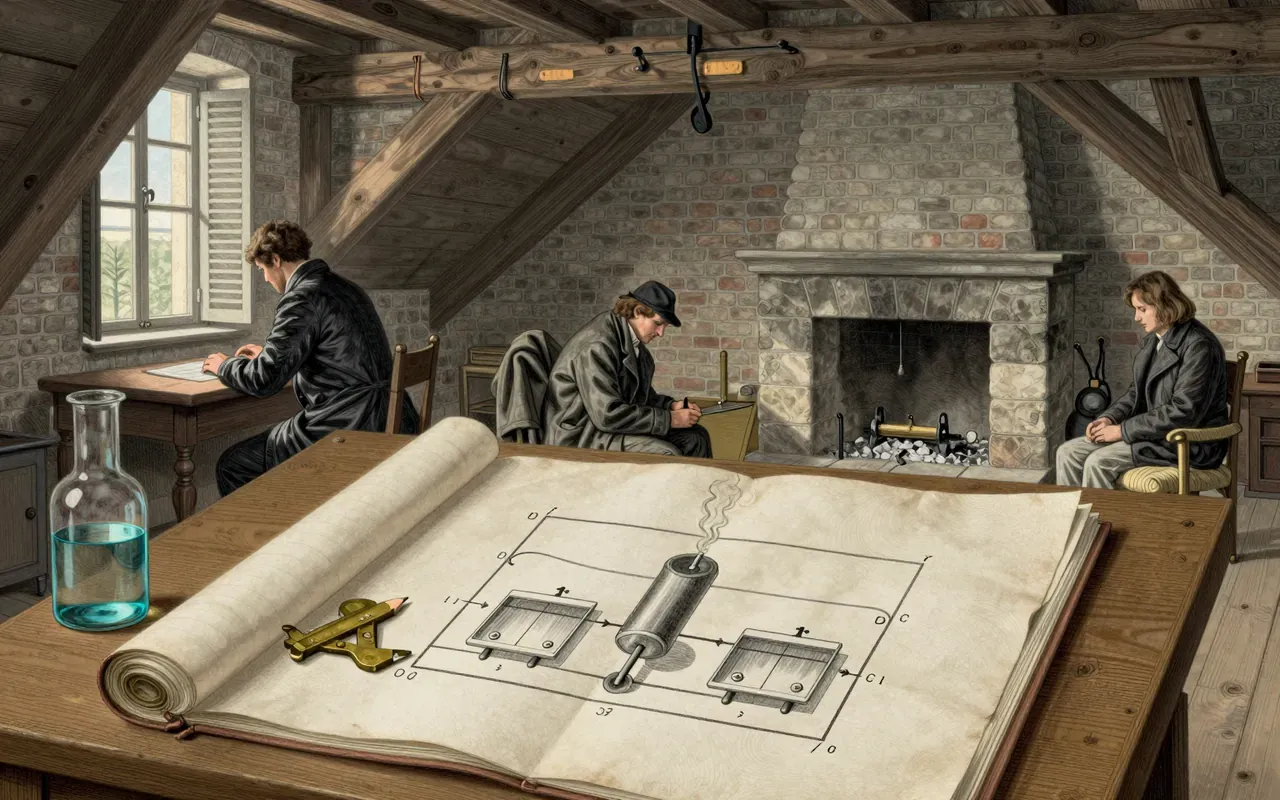
Electric current generates heat inside conductors — it does not move heat from elsewhere.
2:42
A blow to caloric
Joule’s experiments directly contradicted the caloric theory’s claim that heat cannot be created.
4:17
Three ways to make heat
He measured heat generation using fluid friction and gas compression — two non-electrical methods.
6:01
Same number, three times
His mechanical equivalent values — 770 and 819 ft·lbf/BTU — were consistent across methods.
Worth your time?
Yes. Study the whole thing.
4.5/ 5
What works
quantitative equivalence of work and heat
in-situ heat generation in conductors
consistency across three distinct methods
What does not
proves conservation of energy
applies to chemical or nuclear processes
refutes caloric theory in full
establishes entropy or irreversibility
Study it if
physicists
engineers
historians of science
Skip it if
general readers seeking modern applications
students without mechanics background
The written brief1 min read
What the work claims
That heat is generated in situ by electric current and mechanical work; that heat and work are quantitatively interchangeable; and that the mechanical equivalent of heat is a fixed, measurable quantity.
How it was done
Joule used three methods: electrical resistance heating (measuring heat from current in wires), viscous fluid heating (forcing water through a perforated cylinder), and gas compression (measuring heat generated versus work done). His most famous setup used a falling weight to spin a paddle wheel in insulated water.
What holds up
Joule’s three independent methods gave consistent mechanical equivalents of heat (770 and 819 ft·lbf/BTU). His conclusion — that mechanical work always yields an exact equivalent of heat — holds for the systems he tested under his conditions.
What does not
The work does not prove conservation of energy as a universal law. It does not address radiation, chemical reactions, or electromagnetic fields. It does not refute caloric theory by itself — only shows heat can be generated, not that caloric is impossible in all forms.
Why it matters beyond the lab
It dismantled the caloric theory’s core axiom — that heat cannot be created — and enabled the first precise energy accounting in engines, power systems, and later, all physical sciences.
Is it worth your time
Yes. It established the first quantitative, experimentally reproducible equivalence between mechanical work and heat — foundational for thermodynamics and energy engineering.