A draper who saw the invisible
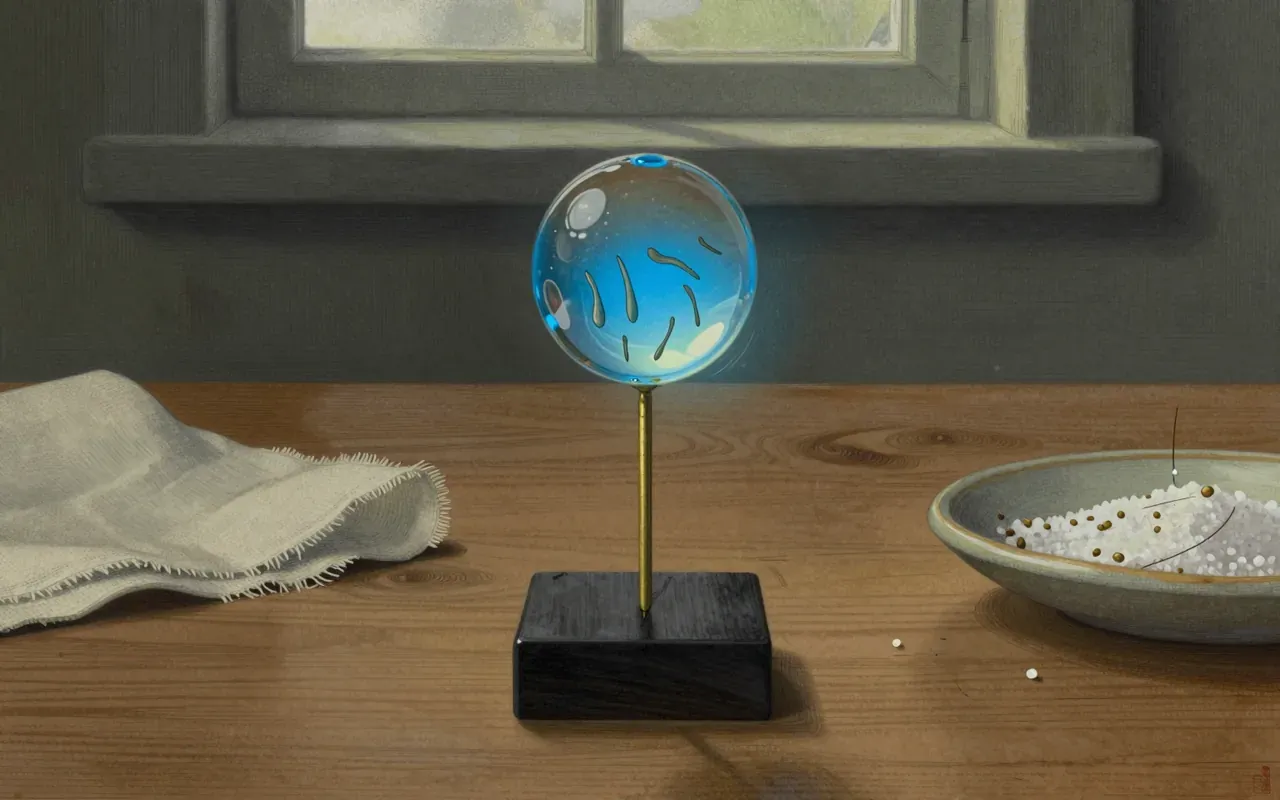
Antonie van Leeuwenhoek, a draper in Delft with no university training, ground his own lenses well enough to build simple microscopes reaching magnifications of up to 275 times, and in 1674 turned one on a drop of water and saw creatures no one had described before: tiny, moving organisms he called animalcules. Over the following decade he extended the same technique across an extraordinary range of material, identifying spermatozoa in 1677, red blood cells moving through the vessels of a tadpole’s tail, the banded structure of muscle fibre in 1682, and, in 1683, bacteria scraped from human teeth, becoming the first person to see and describe what would later be recognised as an entire kingdom of microscopic life. His claim, in each case, was simply that these things existed and could be seen, a modest-sounding assertion that nonetheless described organisms nobody else had any means of detecting.
From mould and lice to a startling claim
Leeuwenhoek built more than five hundred lenses and around twenty-five microscopes over his lifetime, most of them small enough to hold in one hand and each ground individually rather than mass-produced, using a lens-making method he kept secret and that was only worked out by researchers in 1953. He described his observations in letters to the Royal Society in London, which had already published an earlier letter of his in 1673 describing mould, bees and lice, giving him a channel to a scientific audience despite having no formal academic standing of his own. It was his letter of 9 October 1676, describing single-celled organisms living in water, that pushed his claims past what his correspondents could simply take on trust, since nothing resembling life on that scale had previously been reported by anyone.
Verification before acceptance
The Royal Society responded to the 1676 claim not by dismissing it outright but by organising a formal verification process, sending credible witnesses, including clergymen and members of the nobility, to look through Leeuwenhoek’s own instruments and confirm what he had reported. That process, completed by 1677, vindicated his observations rather than his instruments’ reputation alone, and the Society elected him a fellow in February 1680, on the nomination of the physician William Croone, despite his never once travelling to London to attend in person. Over the rest of his life he sent the Society roughly five hundred and sixty letters describing his observations, and every major category of organism he first reported, protozoa, spermatozoa, red blood cells, bacteria, has since been independently confirmed and become foundational to biology, none overturned by later, more powerful instruments.
Observation without explanation
What Leeuwenhoek could not do, working alone with simple hand-ground lenses, was explain what these organisms were, where they came from, or what larger role they played in health and disease. He observed and accurately described bacteria from the human mouth in 1683, for instance, without any means of connecting that observation to illness, since the germ theory of disease would not be developed for another two centuries. His famous, blunt assertion that a man comes not from an egg but from an animalcule found in male sperm also reflects the limits of interpretation available to him at the time, a claim about reproduction that his observation of moving sperm cells could not, on its own, fully settle. He supplied the observations; making sense of their significance was left to later generations of scientists working with theoretical frameworks that did not yet exist in his lifetime.
A new scale of the natural world
Leeuwenhoek’s observations opened an entirely new scale of the natural world to scientific study, one that had simply been invisible before his lenses existed, and the field that grew out of that opening, microbiology, eventually explained infectious disease, fermentation, and much of cellular biology itself. The verification process the Royal Society used to confirm his claims, sending independent observers to check an extraordinary result before accepting it, also set an early template for how scientific institutions handle claims that sound implausible on first hearing but come from a source with a demonstrated track record of careful observation. That combination, a genuinely novel observation paired with a formal, institutional process of independent verification, is part of why his findings held up rather than being dismissed as the eccentric claims of an untrained tradesman.
A template for handling implausible claims
This is a satisfying story precisely because it is small in scope and completely solid in outcome: a single self-taught craftsman, using instruments he built and refused to fully explain, reported things that turned out to be exactly as real as he said. It rewards attention to the verification episode in particular, since the Royal Society’s response to an extraordinary claim, checking it directly rather than either accepting or rejecting it on reputation alone, is a genuinely useful model for how unfamiliar results should be handled. Readers should not expect Leeuwenhoek’s own writing to explain what animalcules meant for medicine or biology more broadly; that interpretation came later, from other scientists building on observations he could describe precisely but not yet fully understand. As a founding moment in microbiology, it holds up remarkably well.