An organelle with its own address
The material describes mitochondria as double-membraned organelles present in most eukaryotic cells, responsible for turning nutrients into adenosine triphosphate, the molecule a cell spends on nearly everything it does. The claim underneath that description is bigger than plumbing: mitochondria were not assembled from scratch by the eukaryotic cell but originated as free-living bacteria, taken up by an ancestral host and never fully let go. That is the endosymbiotic theory, and it rests on the organelle carrying its own circular chromosome, its own ribosomes, and a double membrane consistent with one cell having engulfed another. Alongside this sits the respiration story proper: glycolysis, the citric acid cycle and oxidative phosphorylation as the sequence by which glucose is broken down and its energy captured as ATP rather than simply released as heat.
The case for a bacterial past
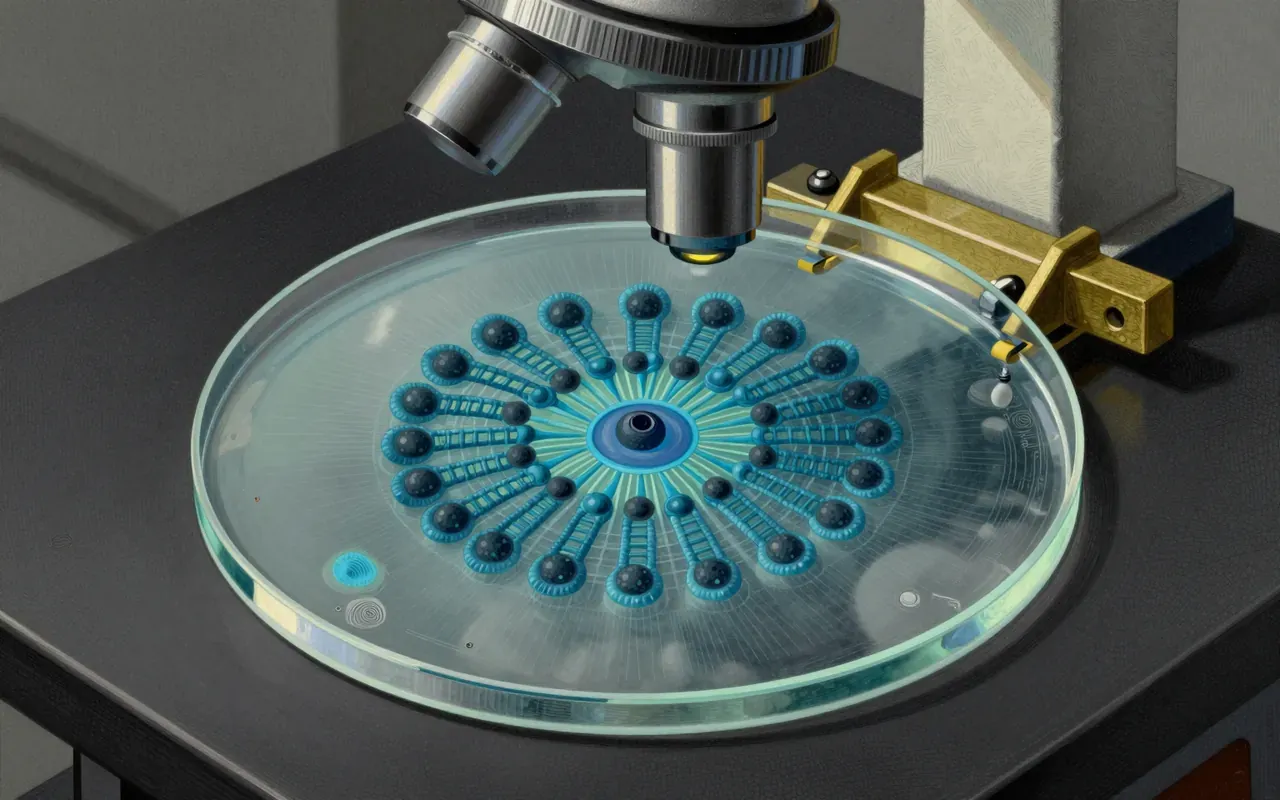
The structural evidence is described in some detail. Mitochondria have an outer membrane studded with pore-forming proteins that let small molecules pass freely, and an inner membrane that is far more selective, folded into cristae to increase its surface area, and packed with the machinery of the electron transport chain. The matrix inside holds its own ribosomes, transfer RNAs and multiple copies of a circular chromosome, the same basic layout bacteria use rather than the linear chromosomes housed in the eukaryotic nucleus. The favoured account traces the ancestral bacterium to the alphaproteobacteria, a group related to present-day Rickettsiales. This lineage argument is treated as the best-supported reading of the phylogenetic evidence rather than a settled fact, and the material notes that the precise relationship and timing relative to the nucleus’s own origin remain contested.
From glucose to ATP
The respiration pathway is laid out stage by stage and location by location. Glycolysis runs in the cytosol, splitting glucose into pyruvate and yielding a small amount of ATP directly. Pyruvate then crosses into the mitochondrial matrix, where it is converted to acetyl-CoA and fed into the citric acid cycle, which strips off carbon dioxide and hands electrons to carrier molecules. Those electrons pass along the electron transport chain embedded in the inner membrane, and the energy released pumps protons across that membrane, building a gradient. ATP synthase then lets protons flow back down that gradient, using the resulting force to attach phosphate to ADP. Peter Mitchell’s chemiosmotic hypothesis is credited as the explanation that tied this proton gradient to ATP production, work recognised with a Nobel Prize.
Where the textbook number softens
One place the material is careful is ATP yield. Older textbooks stated a fixed total of thirty-eight ATP molecules per glucose, and that figure is described as too high. Transporting pyruvate, phosphate and ADP into the mitochondrion itself draws on the same proton gradient that would otherwise make ATP, and the shuttle system a cell uses to move electrons from cytosolic NADH into the mitochondrion changes the final count. The result is a lower and somewhat variable yield rather than one clean number, and the material treats this as an area where structural detail is still being refined rather than as a closed question. It also distinguishes aerobic respiration from fermentation, which skips the mitochondrion entirely and yields far less ATP but does so quickly, without needing oxygen.
Beyond the powerhouse label
Mitochondria’s remit extends well past energy conversion, and the material treats these other roles as equally load-bearing rather than footnotes. They act as a buffer for cytosolic calcium, taking it up and releasing it as part of cell signalling. In brown fat, a protein called thermogenin lets protons leak back across the inner membrane without passing through ATP synthase, converting that potential energy directly into heat rather than ATP, which is how some mammals generate warmth without shivering. Mitochondria also sit at the centre of programmed cell death: releasing cytochrome c from the intermembrane space is the trigger that assembles the apoptosome and commits a cell to dying in an orderly way, rather than rupturing and spilling its contents.
What is still unsettled
For a reader who only knows mitochondria as the powerhouse of the cell, this material earns the hour by showing what that phrase is standing in for and where the underlying evidence gets thinner. The structural case for endosymbiosis is concrete and well laid out; the exact bacterial ancestor and the timing of the merger are not settled, and the material says so plainly rather than picking a side. The ATP yield section is a useful corrective for anyone who memorised thirty-eight as a fixed number. It is not a dramatic read, and it will not change how anyone thinks about biology, but it replaces a slogan with the actual chain of reasoning behind it, which is exactly what a brief like this should do.