
Henry Gee
Henry Gee is a British palaeontologist and evolutionary biologist, a senior editor at Nature, and the author of books on deep time, the origin of vertebrates and human evolution.

Bacteria can pick up genes from other cells by transformation, transduction or conjugation, not only by inheriting them. Lederberg and Zinder showed in 1951 that a virus could carry genes from one strain of Salmonella to another, and Lederberg's earlier work with Edward Tatum showed that E. coli can exchange genes by conjugation. The material treats the process as the main route by which antibiotic resistance spreads among bacteria.





















Evolutionary game theory is a precise, minimal framework that explains how genetically fixed behaviours persist without cognition. Its strength lies in its constraints — no rationality, no learning, no flexibility — and its explanatory reach is limited to frequency-dependent contests where inheritance and replication are well defined.
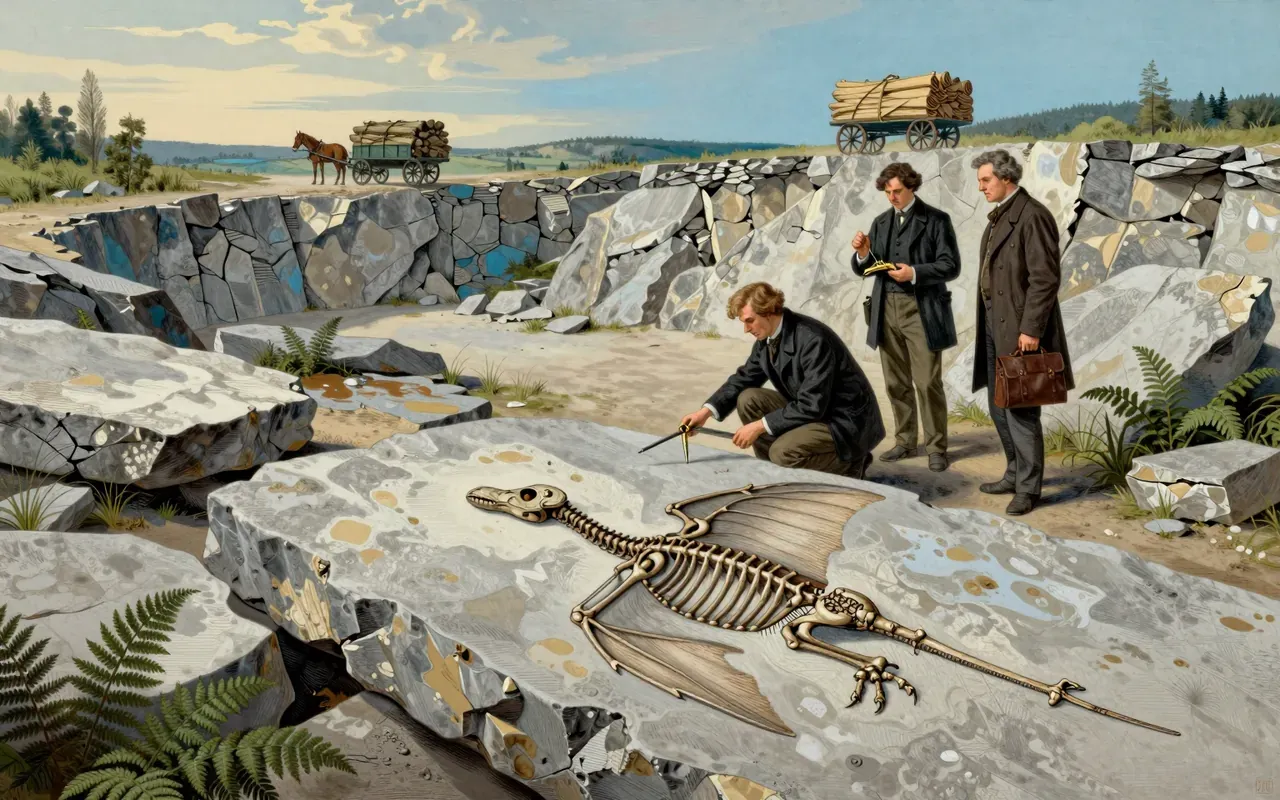
























Punctuated equilibrium is a descriptive claim about fossil patterns — not a mechanism, not a refutation, not a universal law. It says what is seen (stasis), what is rare (gradualism), and where change appears (cladogenesis). Its power lies in its restraint.











The Neanderthal genome project did not discover interbreeding as a hypothesis — it confirmed it with genomic data. It replaced speculation with measurement: four billion base pairs, three Croatian specimens, one decisive conclusion. Its legacy is methodological rigour and a rewritten human family tree.

The neutral theory reframed molecular evolution around stochasticity—not adaptation—as the dominant force shaping DNA change. It offered precise, falsifiable predictions about rates and variation, grounded in population genetics. It did not disprove selection; it defined its null model. Its endurance lies not in universality, but in utility: every test for selection begins here.









On the Origin of Species (1859) introduced natural selection as the mechanism for evolutionary descent with modification. It presented evidence for common descent via a branching pattern, drawn from Darwin’s Beagle expedition, research, correspondence, and experimentation. It established descent with modification as the dominant scientific explanation of natural diversification. Its proposition of universal common ancestry is now accepted—but that acceptance postdates the book and is not itself what the book established.