What the work claims
Tesla claimed to have conceived the rotating magnetic field principle in 1882. He described his radio-controlled boat as a ‘telautomaton’. He investigated ‘radiant energy’ after observing film damage, later identified as X-rays. He linked his high-voltage discharge experiments to invisible radiation following Hertz’s proof of electromagnetic waves.
How it was done
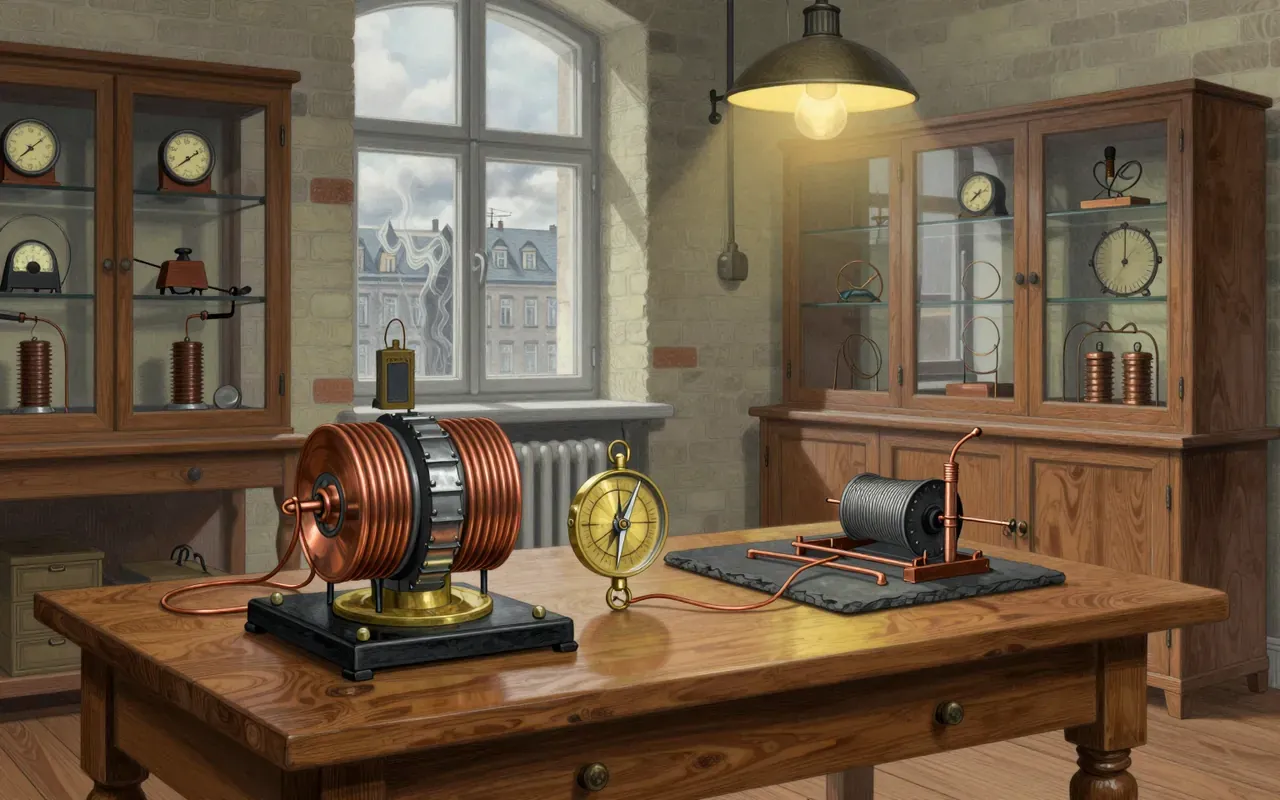
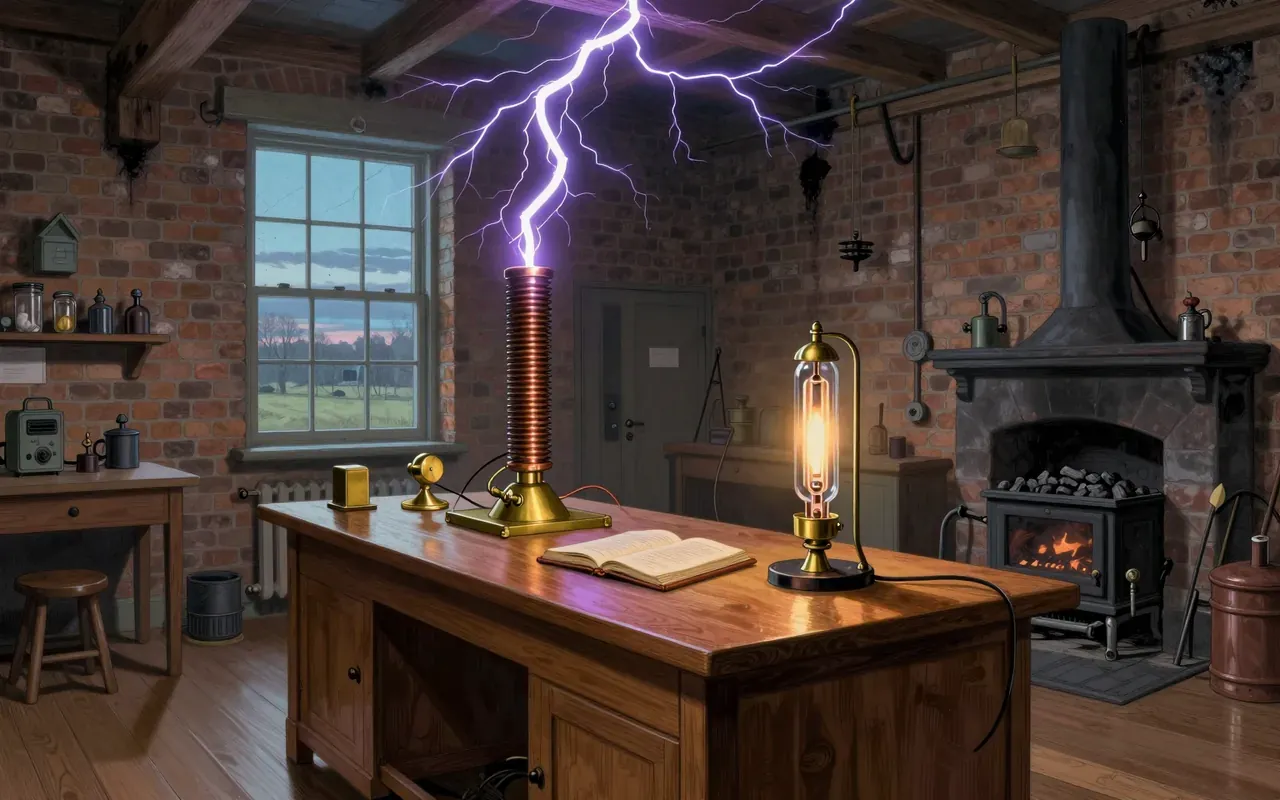
Tesla built an AC induction motor in 1887 using polyphase current to generate a rotating magnetic field. He conducted X-ray imaging experiments from March 1896 using a single-terminal vacuum tube powered by his Tesla coil. In 1898, he demonstrated a radio-controlled boat at Madison Square Garden using a coherer-based system. He studied electromagnetic radiation after learning of Hertz’s 1886–1888 experiments during the 1889 Paris Exposition Universelle.
What holds up
The AC induction motor was self-starting, commutator-free, and patented in May 1888. His X-ray tube produced bremsstrahlung radiation. His 1898 boat demonstration used a coherer-based receiver and was publicly exhibited. His engagement with Hertzian waves was direct and documented.
What does not
The sources do not establish that Tesla invented radio, discovered cosmic rays, transmitted power without wires, or built functional ‘world systems’. They do not mention Wardenclyffe Tower, Niagara Falls, or any commercial deployment of his radio-control or X-ray devices beyond demonstration.
Why it matters beyond the lab
His motor enabled scalable AC power infrastructure. His coherer-based control prefigured remote operation in robotics and drones. His X-ray tube design contributed to early radiographic methods — though not clinical adoption. These were engineering milestones, not theoretical breakthroughs.
Is it worth your time
Yes — Tesla’s work established foundational engineering principles for AC power systems and early wireless control, but it does not support claims about wireless energy transmission, death rays, or suppressed inventions.