Chains, not clusters
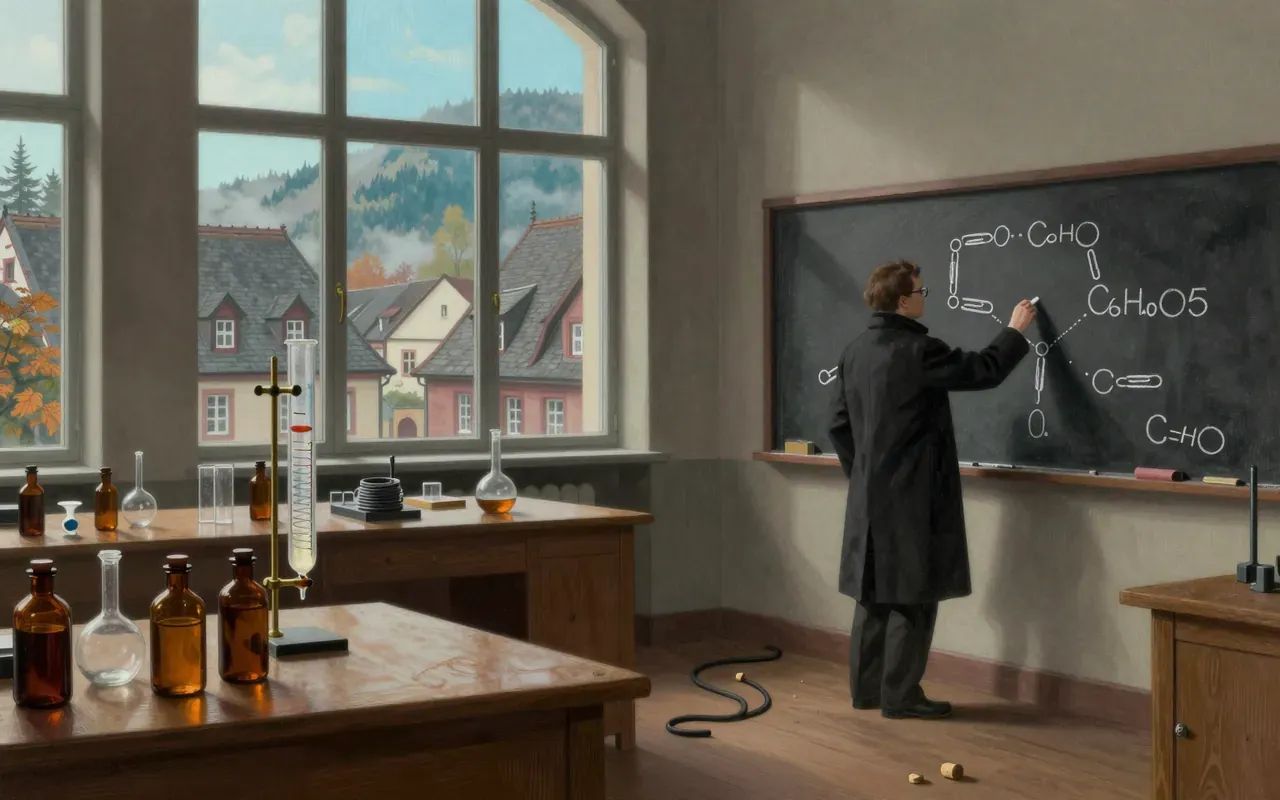
Hermann Staudinger’s claim, set out in a 1920 paper, was that substances such as rubber, starch, cellulose and proteins are not colloidal aggregates of small molecules held together loosely, as most chemists of the time assumed, but long chains of repeating units joined end to end by ordinary covalent bonds — the same kind of bond that holds any small molecule together. He described the arrangement as comparable to a chain of paper clips linked one after another. The distinction mattered because it reframed what a polymer is: not a cluster behaving oddly because of its size, but a single molecule of unusual length, built through a definable chemical process — polymerisation — that could in principle be controlled, reproduced and eventually designed rather than only observed in natural materials.
Two ways to build a chain
Polymerisation itself works by one of two routes. In chain-growth polymerisation, an active site — a free radical, a cation or an anion — is generated on a monomer and then adds further monomers one after another in rapid succession, so long chains appear almost as soon as the reaction starts; this is how polyethylene and polyvinyl chloride are made from small molecules carrying a carbon-carbon double bond. In step-growth polymerisation, any two reactive molecules present, whether monomers or already-formed short chains, can join together, so molecular weight rises slowly across the whole reaction and only late in the process do genuinely long chains appear; this route, often releasing a small molecule such as water as it proceeds, produces materials including nylons and polyesters. Staudinger’s own evidence for covalent chains came from measurements of solution viscosity and osmotic pressure consistent with genuinely large single molecules rather than aggregates.
A decade of vindicating evidence
The chain hypothesis itself is no longer contested; it is the basis of modern polymer chemistry. Independent lines of evidence converged on it during the 1930s: X-ray diffraction studies by Herman Mark showed regular, chain-like structural repeats inconsistent with loose aggregation, membrane osmometry gave molecular weights far too high for small-molecule clusters, and Wallace Carothers’s synthetic work at DuPont, building nylon deliberately from Staudinger’s chain-growth logic, showed that macromolecules could be constructed to order rather than only isolated from nature. The distinction between chain-growth and step-growth mechanisms described above has likewise held up as a genuinely useful way of predicting how a given monomer will behave and what kind of material will result, which is why it still organises how polymer chemistry is taught and practised today.
A rejected idea and a complicated man
What has not held up, and what the material makes no attempt to defend, is the assumption Staudinger was arguing against: that colloidal aggregation, rather than covalent chain formation, explained the size and behaviour of these substances. That view was the scientific mainstream when he proposed his alternative, championed by chemists as senior as Emil Fischer and Heinrich Wieland, and it took roughly a decade of accumulating physical evidence to displace it. It is also worth separating Staudinger’s chemistry from Staudinger the man: his later support for the SS sits uncomfortably against his earlier public refusal, alongside figures such as Einstein, to endorse a wartime manifesto — a biographical complication the material records without resolving, and one that has no bearing on whether the chain hypothesis itself is correct.
From natural curiosity to designed material
Once polymers were understood as chains built by a controllable reaction rather than as natural curiosities, making new ones deliberately became a realistic goal rather than a matter of luck. Carothers’s nylon is the clearest early example, but the same logic underlies the entire synthetic materials industry that followed — plastics, synthetic rubbers, and fibres engineered by choosing a monomer and a polymerisation route to get a particular chain length, branching pattern or mechanical property. The chain-growth versus step-growth distinction is not an academic footnote either: it is a practical design choice, since a manufacturer needs to know whether a reaction will need to run to near-completion before useful material forms, or whether long chains and useful properties appear from early in the process, and that choice shapes how the material is actually produced at scale.
An idea that outlasted its critics
This is worth following if the interest is in how a scientific mainstream gets overturned rather than in polymers for their own sake — a respected researcher proposing something correct that his most senior colleagues rejected for the better part of a decade, until instrumentation caught up with the claim. Staudinger’s 1953 Nobel Prize came only after that vindication was complete, which is itself instructive about how long a genuinely sound idea can sit unaccepted. Anyone wanting chemical detail on modern polymerisation methods, additives or specific commercial materials will find the mechanism summarised here rather than surveyed in depth; the value of this material is the history of an idea being resisted and then confirmed, not a manual for practising polymer chemistry.