A bit of scruff on the chart paper
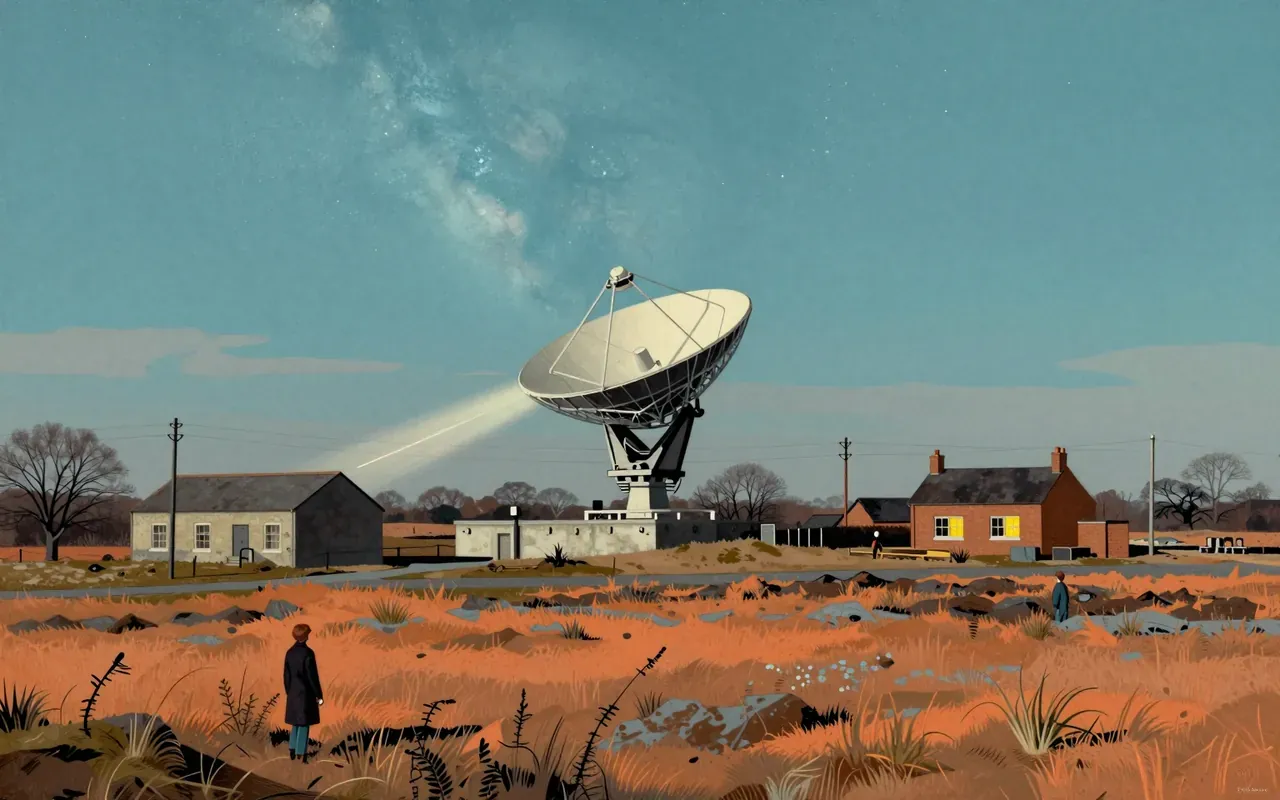
In 1967, Jocelyn Bell Burnell was a PhD student at Cambridge, working under the supervision of Antony Hewish and reviewing the paper output of a radio telescope she had helped construct as part of a survey of interplanetary scintillation. Sifting through roughly ninety-six feet of chart-recorder paper produced each night, she noticed an unusual signal, a small, recurring irregularity she described as a bit of scruff, distinct from the interference and noise she had learned to recognise and dismiss over months of careful review. Hewish initially treated the signal as likely interference as well, but Bell Burnell kept tracking it, and by 28 November 1967 the two had confirmed it repeated with striking regularity, roughly every 1.33 seconds, a precision difficult to attribute to any ordinary terrestrial or instrumental source.
1.33 seconds, too regular to ignore
That regularity briefly raised a genuinely serious possibility: that the signal might be artificial, a deliberate transmission from an intelligent source elsewhere in the galaxy, and the object was informally nicknamed Little Green Man 1 while the team worked out what it actually was. The hypothesis did not last long. When a second, similarly precise pulsing signal turned up in December 1967 coming from an entirely different part of the sky, the idea of a single artificial beacon aimed at Earth became implausible, since it would require multiple, independent alien transmitters rather than one, and the team turned instead toward a natural astrophysical explanation, ultimately identifying the source as a rapidly rotating neutron star, an object so dense that a beam of radiation from its magnetic poles sweeps past Earth once per rotation like a lighthouse, producing the regular pulses observed.
From little green men to a natural explanation
The discovery itself has held up completely: pulsars are now a well-established and extensively studied class of astronomical object, and the specific source Bell Burnell first identified, now catalogued as PSR B1919+21, remains recognised as the first pulsar ever found. What has remained genuinely contested, rather than settled, is the question of credit. The 1974 Nobel Prize in Physics recognised pulsar research and went to Antony Hewish and Martin Ryle, even though Bell Burnell had built the specific telescope equipment involved, personally identified the anomalous signal, and pushed past her own supervisor’s initial scepticism to establish that it was a genuine astrophysical discovery rather than noise, despite appearing as the second author on the five-author paper announcing the find.
A lighthouse made of collapsed matter
Bell Burnell’s own public response to the Nobel decision changed over time in a way that resists a simple resolution. In 1977 she suggested it would demean the Nobel Prize to award it to research students except in very exceptional cases, a graceful, if perhaps diplomatically shaped, acceptance of the outcome. Decades later, however, she reflected that being both a graduate student and a woman had likely reduced her standing for consideration, a markedly different framing of the same episode. Neither position fully closes the question of what a fair accounting of credit should have looked like, and the case remains one of the most discussed instances in twentieth-century physics of a student researcher’s central role in a major discovery not translating into the field’s highest recognition.
A Nobel Prize that skipped the discoverer
Pulsars themselves went on to matter well beyond the circumstances of their discovery. The binary pulsar system found by Joseph Taylor and Russell Hulse in 1974 provided the first evidence for gravitational waves, since the pair’s orbit was observed decaying at a rate matching what general relativity predicted for energy carried away by gravitational radiation, decades before gravitational waves were directly detected by other means. Millisecond pulsars, rotating with extraordinary regularity, have since been used as natural clocks precise enough to rival atomic clocks, and pulsar signals have even been proposed and tested as a navigation reference for spacecraft, extending a discovery that began as an unexplained scrap of chart-recorder noise into a working tool across multiple areas of physics and space science.
From curiosity to cosmic clock
This is very much worth the time, for the physics of what a pulsar actually is and for the discovery story itself, which combines a genuinely careful piece of observational persistence with a credit dispute that has never been neatly resolved and that Bell Burnell herself addressed differently at different points in her life. In 2018, she was awarded the Special Breakthrough Prize in Fundamental Physics, worth three million dollars, for the original discovery, and donated the entire sum to fund scholarships for underrepresented students in physics, a decision that adds a final, distinctive note to a story that began with her noticing something no one else had thought worth a second look.