An unseen population doing real work
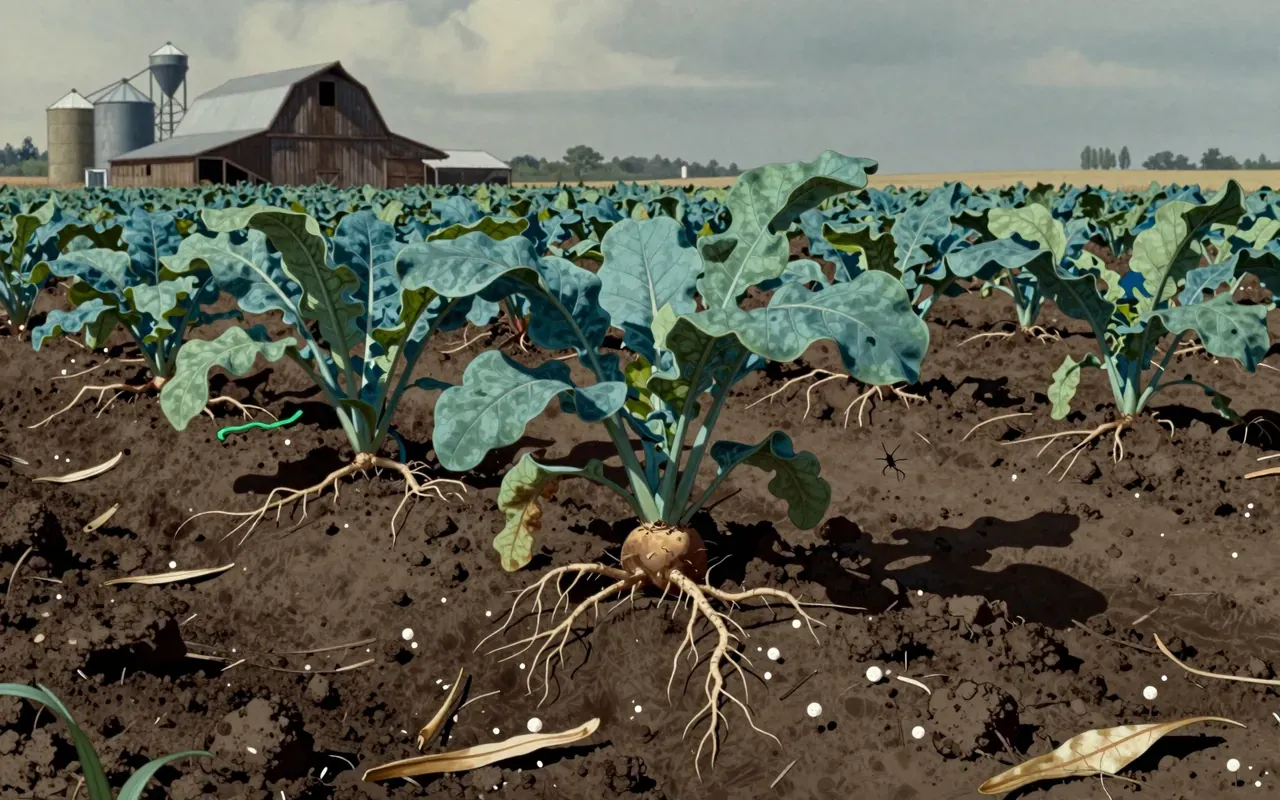
The material’s starting point is scale: soil is not an inert growing medium but a dense living system, and the rhizosphere, the narrow zone of soil immediately surrounding plant roots, can hold up to ten billion culturable bacterial cells in a single gram. A 2011 study identified more than thirty-three thousand distinct bacterial and archaeal species living around sugar beet roots alone, a figure meant to convey how much diversity exists in a space most people never think about. This population’s composition shifts with soil pH, texture, organic matter content and the presence of contaminants such as heavy metals, and it is this same population that drives decomposition, breaking down plant material and dead organisms, and forms symbiotic partnerships such as mycorrhizal networks that extend a plant’s effective root system far beyond its own tissue.
Nitrogen, the nutrient plants run short of
Nitrogen is singled out here as frequently the most limiting nutrient for plant growth in both soil and water, which sets up why the microbial processes that make it available matter so directly to agriculture and to ecosystems generally. Atmospheric nitrogen gas is abundant but chemically inert and unusable by most organisms in that form; converting it into a usable compound, a process called nitrogen fixation, requires either lightning, which the material credits with fixing a modest amount each year, or specific bacteria carrying the enzyme nitrogenase, which combines nitrogen gas with hydrogen to produce ammonia. This biological fixation is described as the dominant natural route by which nitrogen becomes available to the rest of the ecosystem, well ahead of the lightning-driven contribution.
A legume and a bacterium trading resources
The clearest example of this fixation given in the material is the relationship between Rhizobium bacteria and legume plants. These bacteria colonise nodules on legume roots and fix nitrogen there, producing ammonia that the plant can use, and in exchange the plant supplies the bacteria with carbohydrates, a genuinely bidirectional exchange of amino acids and resources rather than the bacteria simply performing a free service. Free-living bacteria such as Azotobacter also fix nitrogen without needing a plant partner at all. Once nitrogen has been fixed, plants take it up largely as nitrate or ammonium through their roots, reducing nitrate through intermediate steps before it can be built into amino acids, nucleic acids and chlorophyll.
From ammonia to nitrate and back to gas
The cycle continues once organisms die or excrete waste, at which point bacteria and fungi convert organic nitrogen back into ammonia through a process called ammonification. From there, nitrification takes over: bacteria in the genus Nitrosomonas oxidise ammonia into nitrite, and bacteria in the genus Nitrobacter then oxidise that nitrite into nitrate, a necessary conversion because ammonia itself is toxic to plants at meaningful concentrations. Nitrate’s high solubility, however, makes it prone to leaching into groundwater, a property the material links directly to methemoglobinemia risk in infants exposed to contaminated water. Denitrification eventually closes the loop, with bacteria such as Pseudomonas converting nitrate back into inert nitrogen gas under low-oxygen conditions, returning the element to the atmosphere in the form it started in.
An industrial process that rivals biology
Set against this natural cycle is the Haber-Bosch process, an industrial method developed in the early twentieth century that fixes atmospheric nitrogen artificially using high temperature and pressure. The material states this single industrial process now accounts for roughly thirty percent of all nitrogen fixed globally, a scale large enough that human activity overall has more than doubled the total amount of nitrogen entering biologically available forms compared with the pre-industrial baseline. That doubling is attributed not only to fertiliser manufacturing but also to legume cultivation, vehicle and industrial emissions, livestock operations and biomass burning, with the material noting that reactive nitrogen generation has increased more than tenfold over the past century as a direct consequence of global industrialisation.
What too much fixed nitrogen actually does
The consequences of that shift are laid out specifically rather than left abstract. Nitrous oxide, a byproduct of this altered cycle, is described as the third largest contributor to global warming after carbon dioxide and methane, and disproportionately potent per unit of mass. Atmospheric ammonia has tripled due to human activity, contributing to air quality problems, while nitrate runoff drives eutrophication in waterways, producing algal blooms and oxygen-depleted dead zones, with the Gulf of Mexico’s dead zone at the mouth of the Mississippi River cited as a persistent example that has not meaningfully shrunk despite some efforts to reduce agricultural runoff. This closing material is what earns the brief its hour: it turns an invisible microbial cycle into a direct, traceable explanation for named environmental problems most readers have heard of without necessarily connecting to soil bacteria.