Blood that would not always mix
In 1900, working at the University of Vienna, Karl Landsteiner noticed something unpredictable happening when he mixed blood serum from different people: sometimes the red blood cells in the mixture clumped together, a reaction called agglutination, and sometimes they did not, with no obvious pattern given how blood had previously been treated as broadly interchangeable between any two people. Landsteiner suspected the inconsistency was not random but reflected some underlying property of the blood itself, differing from one person to another in a way nobody had yet identified, classified, or thought to look for so directly.
Sorting blood into three groups
Landsteiner tested this systematically the following year, mixing blood serum and red cells from various colleagues in different pairings and recording exactly which combinations caused clumping and which did not. The pattern that emerged let him sort blood into distinct groups: he called two of them A and B, based on which agglutinated with which, and a third group, which agglutinated with both A and B, he initially labelled C, a name later changed to O, from the German word for without, since this group lacked the reactive markers found in the other two.
A fourth group found by his students
Landsteiner’s three-group classification was not quite complete: in 1902, a year after his original work, his students Adriano Sturli and Alfred von Decastello identified a fourth group, later designated AB, completing the basic ABO system still used to classify blood today. Together, the four groups accounted for the full range of reactions Landsteiner and his students had observed in their systematic testing, giving medicine, for the first time, a reliable, checkable way to predict in advance whether mixing blood from two given people would cause a dangerous reaction or not.
Explaining transfusions that had gone wrong
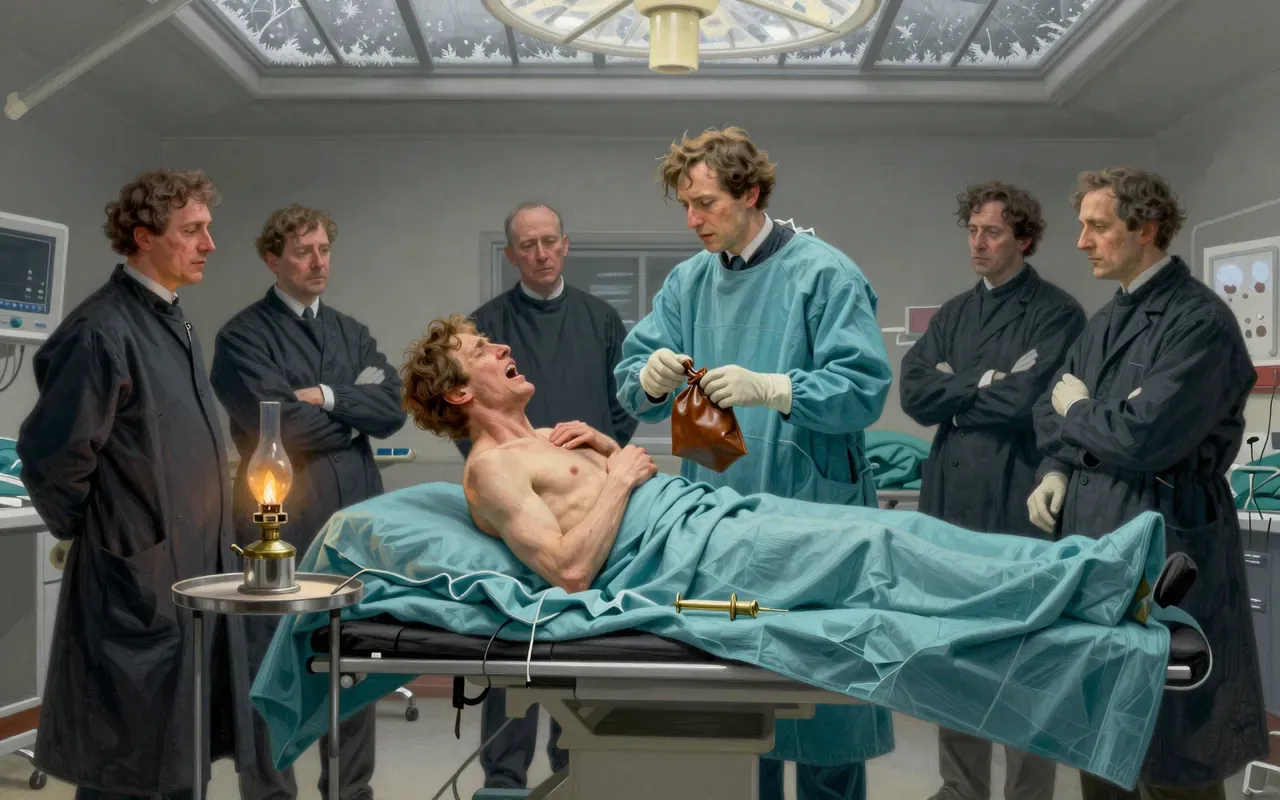
This classification supplied the explanation for a problem that had made blood transfusion a genuine gamble beforehand: without any way to know which people’s blood was compatible, transfusions between mismatched donors and recipients had often triggered severe immune reactions, destroying red blood cells and sometimes killing the patient, with physicians unable to predict in advance which transfusions would succeed and which would fail. Once blood groups were identified, matching a donor’s group to a recipient’s became a straightforward, checkable step rather than a matter of chance, transforming transfusion from a risky last resort into a procedure that could be made reliably safe.
From classification to a working transfusion
The practical payoff followed within a few years: the first blood transfusion performed using Landsteiner’s group-matching system took place in 1907 at Mount Sinai Hospital in New York, carried out by Reuben Ottenberg, demonstrating that the laboratory classification translated directly into safer clinical practice. Landsteiner received the 1930 Nobel Prize in Physiology or Medicine for the original discovery, recognition that came three decades after the initial 1900 observation, reflecting how long it took for the full significance of the finding, and its adoption into routine medical practice, to be established.
A second discovery decades later
The story is worth understanding alongside Landsteiner’s later contribution, since blood group compatibility was not the whole picture: in 1937, working with Alexander Wiener, he identified a separate blood group system, the Rh factor, which accounted for further transfusion complications and for a specific risk to newborns that the ABO system alone could not explain. Taken together, the two discoveries show a single researcher returning, decades apart, to solve two separate layers of the same underlying problem, and reading them side by side gives a clearer sense of how thoroughly the seemingly simple question of blood compatibility needed to be worked out before transfusion became the routine, safe procedure it is now.