A safer alternative to variolation
By the late eighteenth century, protecting against smallpox already had an established method: variolation, in which a person was deliberately given a mild case of smallpox itself, using material taken from an infected person, in the hope of gaining immunity with less risk than catching the disease naturally. It worked, in the sense that variolated patients died far less often than people who caught smallpox by chance, but it still killed a meaningful share of those who underwent it, and anyone variolated could spread full-blown smallpox to others in the meantime. Edward Jenner, a physician in rural England, set out to test whether cowpox, a much milder disease that infected cattle and occasionally the people who milked them, could offer the same protection without the same risk.
Cowpox from a milkmaid’s hand
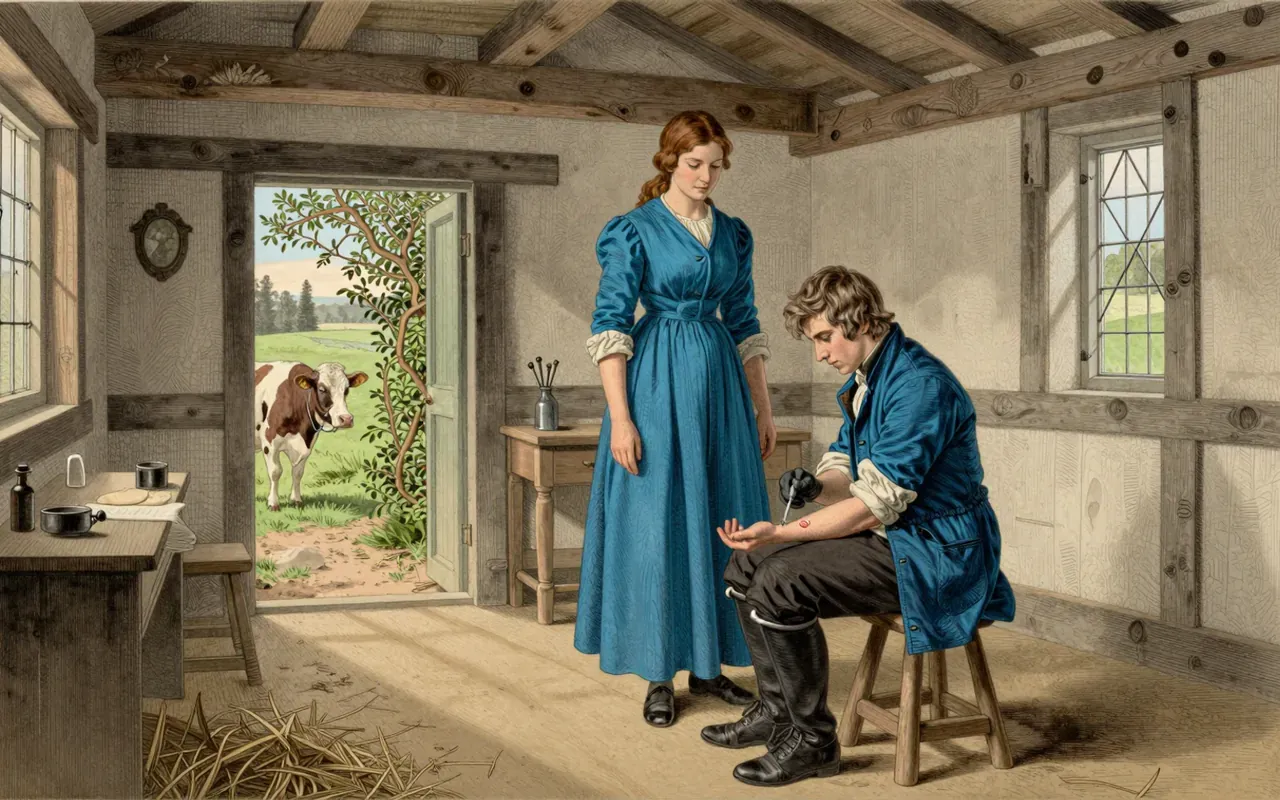
On 14 May 1796, Jenner took material from a cowpox blister on the hand of Sarah Nelmes, a milkmaid who had caught the infection from a cow, and used it to inoculate an eight-year-old boy named James Phipps, the son of Jenner’s gardener. Phipps developed a brief, mild illness, some fever and general discomfort, and then recovered fully, without ever contracting anything resembling smallpox itself. The choice of cowpox rested on an existing, if informal, association between the two diseases: cowpox was known in dairy country to leave milkers with something that looked like resistance to smallpox, and Jenner’s experiment was designed to test that association directly rather than simply repeat the observation.
Testing it against smallpox itself
The decisive step came several weeks later, on 1 July 1796, when Jenner deliberately exposed Phipps to smallpox itself through variolation, the standard method of testing for immunity at the time. Phipps did not develop the disease, and repeated attempts to infect him produced the same result. Jenner went on to test the method on 23 further people before publishing his findings in 1798 as An Inquiry into the Causes and Effects of the Variolae Vaccinae, arguing that cowpox inoculation offered a safe alternative to variolation. He also claimed, incorrectly as it turned out, that the protection it gave was permanent.
A story simpler than the science
The familiar version of this story, that Jenner noticed unblemished milkmaids and had a flash of insight leading straight to his experiment, is treated by modern historians as at best a simplification and quite possibly a later myth; the underlying association between cowpox and smallpox resistance was already circulating informally in dairy country, and other practitioners had experimented with related ideas before Jenner’s own test. What the 1796 experiment does establish cleanly is the direct challenge test itself, cowpox exposure followed by an attempted smallpox infection that failed, which is stronger evidence than an anecdote about a milkmaid’s complexion, whatever the exact route by which Jenner arrived at the idea.
From one boy to a global campaign
Jenner’s findings spread quickly once published, appearing in translation across Europe within a couple of years, and expeditions such as the Spanish Balmis mission of 1803 to 1806 carried the vaccine to the Americas and parts of Asia. Vaccination was progressively refined over the following two centuries, including the development of a heat-stable, freeze-dried version of the vaccine in the 1950s and a simple, low-dose bifurcated needle in the 1960s that made mass vaccination practical even in places with limited resources and training. That refined tool underpinned the World Health Organization’s global eradication campaign, which recorded the last naturally occurring case in Somalia in 1977 and led to smallpox being formally declared eradicated in 1980, still the only human disease eliminated this way.
Why this one case still rewards attention
This case rewards attention because it separates cleanly into two different kinds of achievement that are often blurred together: the original 1796 experiment, a single, carefully designed test of an existing folk association, and the far longer, more collective effort of turning that result into a technology capable of reaching the entire world. The gap between the two, roughly two centuries, and the specific engineering problems solved along the way, storage without refrigeration, a needle simple enough to use with minimal training, are as much a part of why smallpox is gone as anything Jenner himself did. An hour spent on both halves of the story gives a far more accurate picture than the milkmaid legend alone.