Bad air versus living causes
For most of the nineteenth century, the dominant explanation for infectious disease in Europe was miasma theory, the idea that diseases such as cholera arose from bad air given off by decaying organic matter, rather than from transmission between people or from any living agent. Isolated earlier findings pointed the other way, including Agostino Bassi’s 1830s demonstration that a fungus caused a silkworm disease and John Snow’s 1850s tracing of a London cholera outbreak to contaminated water, but these did not yet add up to an accepted general theory. It was the combined work of Louis Pasteur and Robert Koch, across the 1860s to the 1880s, that built miasma’s replacement: the germ theory of disease, holding that specific microorganisms cause specific infections.
A flask shaped to test spontaneous generation
Pasteur’s key contribution was to rule out spontaneous generation, the older idea that living organisms, including disease-causing ones, could arise on their own from non-living matter. He used flasks with long, curved swan necks that let air reach a sterilised broth inside while trapping airborne dust and microbes in the curve of the neck; broth in such flasks stayed free of microbial growth indefinitely, while broth in an open flask, or one with its neck snapped off, quickly grew cloudy with microorganisms. The result showed that growth depended on airborne particles reaching the broth, not on the air itself or on some inherent property of the broth, undercutting spontaneous generation as an explanation for how microbes appear.
Naming the culprit, disease by disease
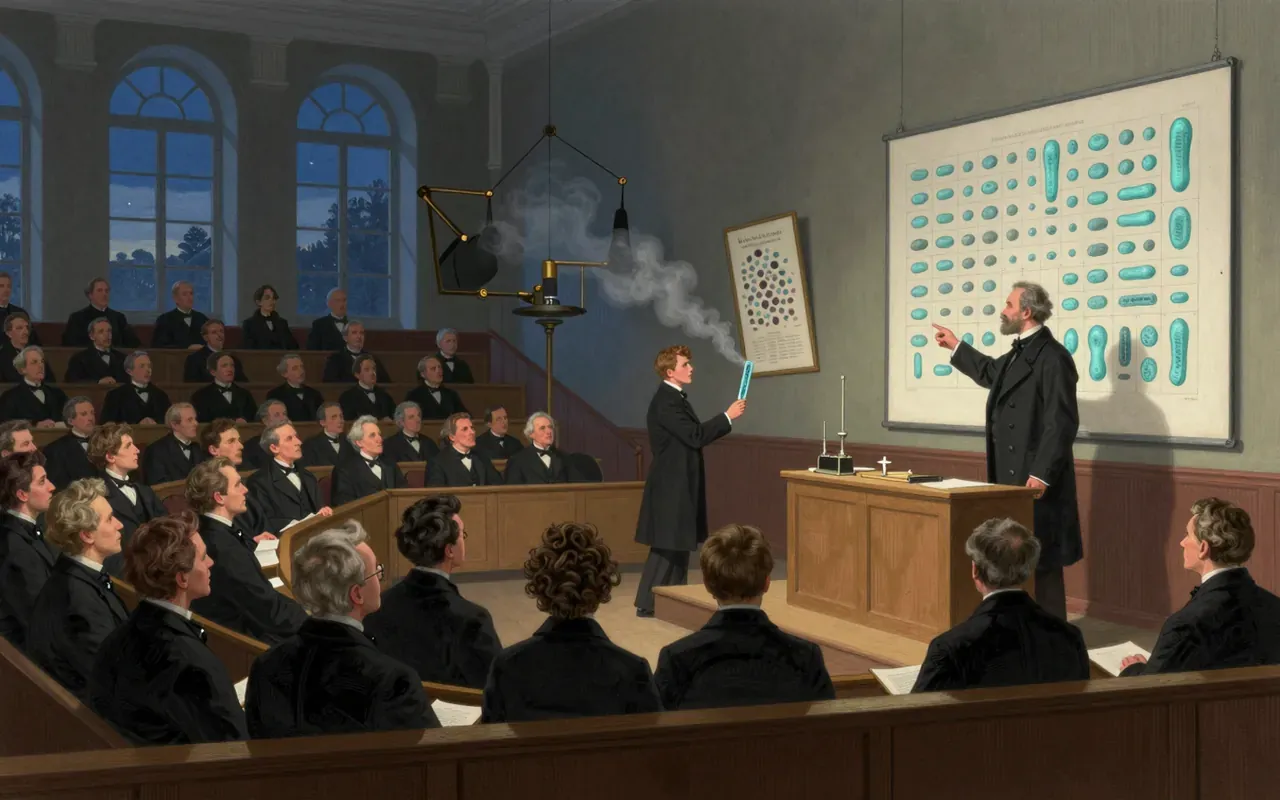
Robert Koch supplied the other half of the case by identifying, disease by disease, the specific bacterium responsible: Bacillus anthracis as the cause of anthrax in 1876, Mycobacterium tuberculosis as the cause of tuberculosis in 1882, and the comma-shaped cholera bacterium in 1884, work that depended on his development of solid culture media and staining techniques that let him isolate and grow individual bacterial species in pure culture. To make this kind of claim rigorous rather than merely suggestive, Koch, together with his assistant Friedrich Loeffler, set out four conditions, since known as Koch’s postulates, that an organism had to satisfy before it could be accepted as the cause of a given disease, giving the field a repeatable standard rather than case-by-case argument.
Four rules for proving a cause
Koch’s record was not free of error. In 1890 he announced tuberculin, an extract of tuberculosis bacteria cultures, as a treatment that could halt the disease’s progression, a claim made publicly at an international medical congress. Clinical use quickly showed the opposite: an autopsy report from January 1891 found that patients treated with tuberculin had died from the treatment itself, and an official German report later that year confirmed that tuberculin did not cure tuberculosis. The substance was eventually repurposed as a diagnostic test for exposure to the bacterium rather than a treatment, a partial recovery from what had been a serious and very public failure by the same scientist whose bacterial identifications had otherwise held up.
A public failure alongside the successes
The practical consequences of establishing germ theory extended well beyond the laboratory. Once specific organisms were confirmed as causes of specific diseases, hygiene measures such as handwashing and water sanitation gained a concrete rationale rather than a vague appeal to cleanliness, and Joseph Lister’s application of antiseptic technique to surgery, using carbolic acid to kill microorganisms at the site of an operation, followed directly from the same reasoning. The identification of the tuberculosis bacterium in particular gave public health a defined target, and the World Health Organization later marked the anniversary of Koch’s 1882 announcement as World Tuberculosis Day, a recognition of how directly that single finding shaped the disease control efforts that followed.
Why this history is worth an hour
This history is worth the time because it marks the point where medicine gained something to actually investigate: a specific organism, isolatable and testable, in place of an environmental condition too diffuse to study directly. Watching Pasteur’s flask experiment rule out one explanation and Koch’s postulates specify exactly what evidence would be needed to establish another shows a field building its own standards of proof in real time, not simply accumulating observations. Including Koch’s tuberculin failure alongside his successes rounds out the picture, since it shows that even the scientist who did the most to establish germ theory could still overreach when moving from identifying a cause to claiming a cure.