A body-made morphine substitute
The claim is that the human body manufactures its own opiate-like molecules, and that these were identified as real, isolable chemicals rather than a theoretical possibility. In 1975, enkephalin was identified as exactly such a substance: a short chain of five amino acids, made naturally in the brain and adrenal medulla, that binds to the same class of receptors that morphine and other opium-derived drugs act on. It comes in two closely related forms, met-enkephalin and leu-enkephalin, differing by only their final amino acid, and both are produced by cutting a larger precursor protein down to size. The significance was not that opiates work, which was already well known, but that the body had never needed opium to have opiate-like signalling of its own.
Two peptides, one gene
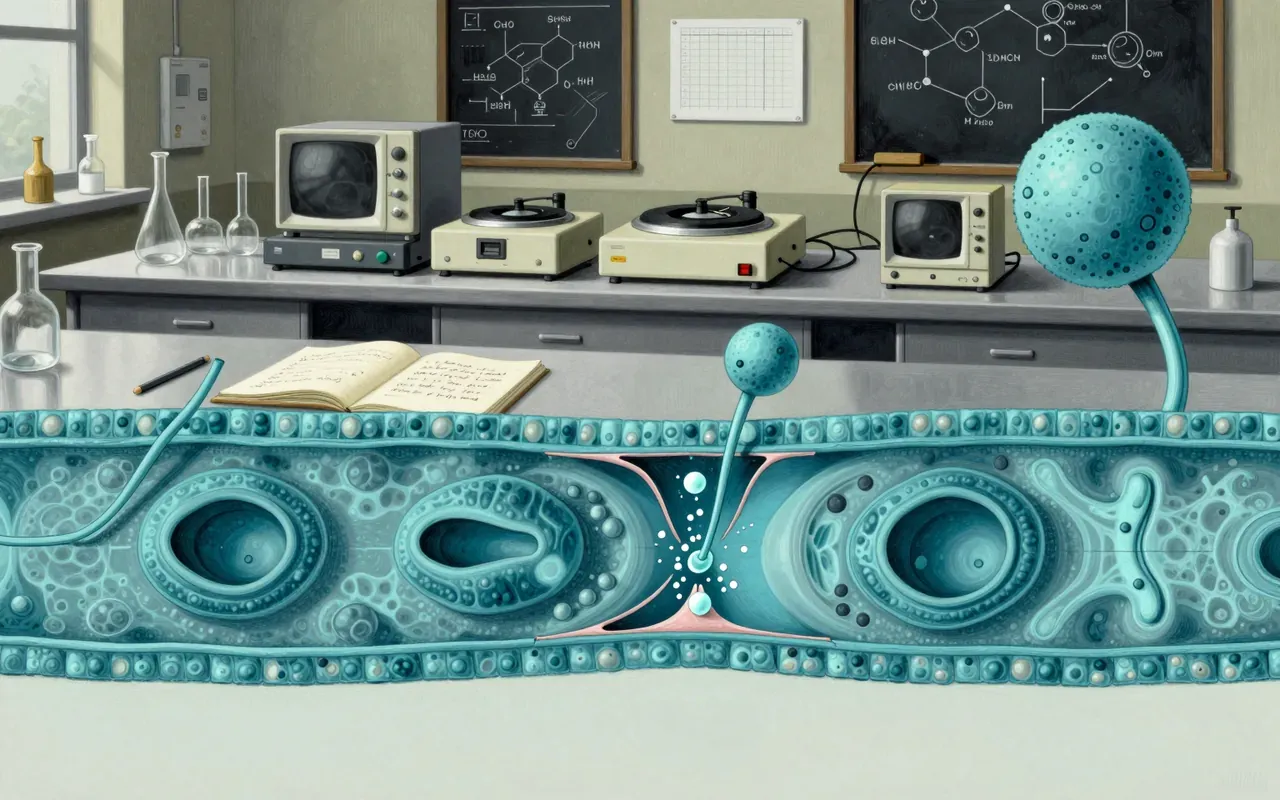
What the material sets out clearly is the molecular architecture rather than the laboratory steps of the original identification. Met-enkephalin and leu-enkephalin are both derived from a single gene, proenkephalin, whose structure in humans was worked out through gene sequencing published in 1982. Both forms act on delta and mu opioid receptors, which belong to the G-protein-coupled receptor family and share roughly forty per cent of their structure with receptors for a different signalling molecule, somatostatin, a similarity that reflects a shared evolutionary origin for several receptor families rather than anything specific to opioid signalling. The identification of the two enkephalins in 1975 is presented as an established fact and a starting point, without a narrative account of the bioassays or tissue extraction involved.
A family, not a single molecule
What has held up, and grown, is the idea of a whole family of endogenous opioid peptides rather than a single one. Beta-endorphin, characterised in 1976 and encoded by a gene sequenced in 1980, acts as the primary natural signal for the mu-opioid receptor. Dynorphins, traced to a gene identified in 1983, act preferentially on the kappa-opioid receptor, and endomorphins, found in the 1990s, added a further layer to the system. Four distinct receptor types, mu, delta, kappa and a fourth for the peptide nociceptin, each respond selectively to different family members, giving the overall system a division of labour rather than one molecule doing everything opiate drugs are capable of doing.
Four receptors, four jobs
What the material does not give is much sense of how confident or contested any of this remains, or how the founding discovery was actually carried out. The 1975 date for enkephalin is stated as settled fact, but no experimental detail survives in this account to let a reader judge the strength of the original evidence directly, which stands in some contrast to founding experiments elsewhere in neuroscience that can be reconstructed step by step. The physiological role of some family members, nociceptin among them, is named without being explained in comparable depth to enkephalin or beta-endorphin. The account also does not address how thoroughly researchers have ruled out other, still-undiscovered opioid peptides, leaving open whether the family as currently described is complete.
What the record leaves out
The practical stakes of this family of molecules are considerable, because they explain why a drug derived from a poppy plant does anything at all to a human nervous system: it is occupying receptors the body built for signals of its own. Brain opioid systems are described as involved in motivation, emotional attachment, the stress response, control of food intake, and the rewarding effects of substances including alcohol and nicotine, which places this peptide family at the centre of both pain treatment and addiction research. Understanding which receptor a given peptide favours, and which peptide a given drug mimics or blocks, is the basis for trying to design pain relief that avoids some of the reward and dependence effects that make opiate medications difficult to use safely over the long term.
Why opium works on a body that never touched it
Selectively yes. The subject rewards someone who wants to understand why opiate painkillers, and opiate addiction, work through a system the body already had rather than a foreign one, and the structural detail here, two peptides from one gene, four receptors dividing the family’s labour, gives that understanding real substance. It is less satisfying as a discovery story, because the record of how Hughes and Kosterlitz actually found enkephalin in 1975 is thin here, reduced to a date and a name rather than a reconstructable method. Read it for the mechanism and the family tree of opioid peptides that followed from one identification, not for a blow-by-blow account of the laboratory work itself.