A small, bright moon
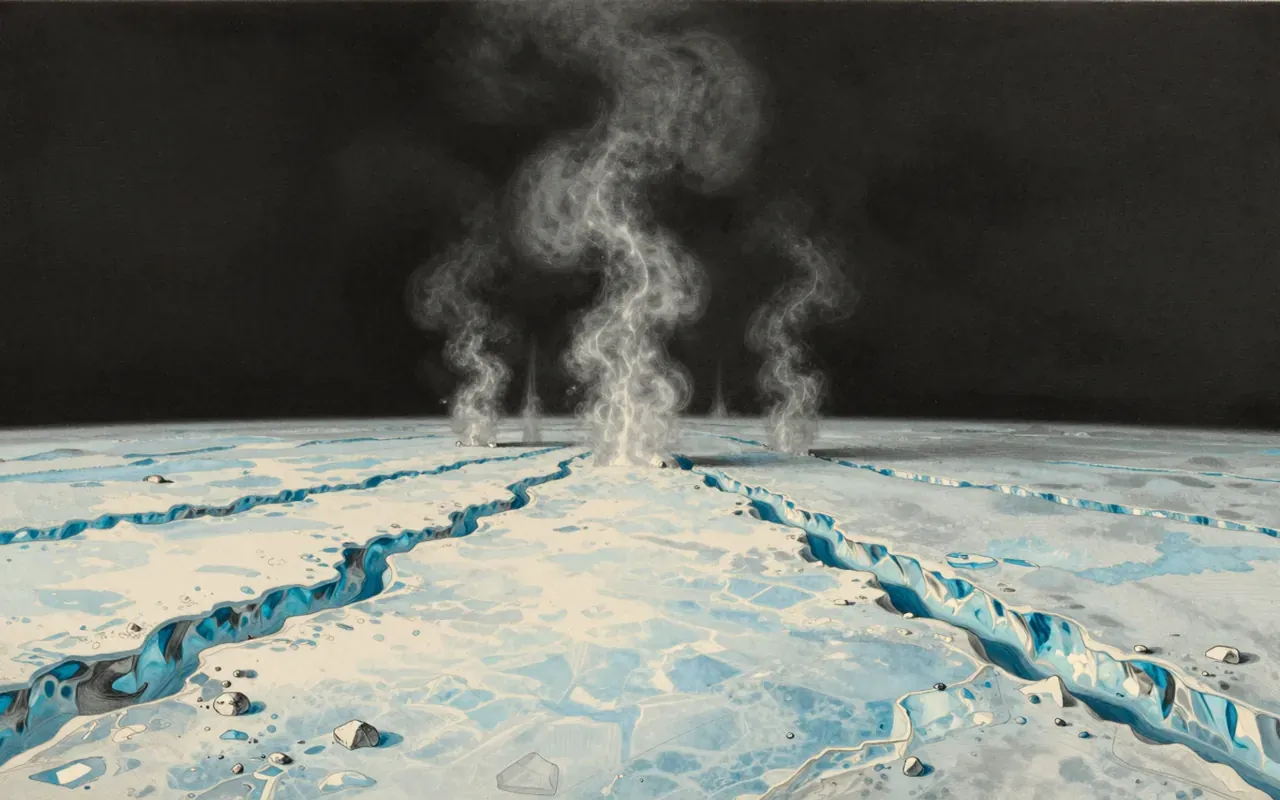
Enceladus is a small moon of Saturn, only about 500 kilometres across, roughly a tenth the diameter of Saturn’s largest moon Titan, and it had been known since William Herschel first spotted it in 1789 without anyone having much idea what its surface was actually like. That changed once the Cassini spacecraft, which had entered orbit around Saturn in 2004 after a nearly seven-year journey from Earth, began making close flybys of Enceladus starting in July 2005. Those flybys revealed something startling for a body so small and so far from the Sun: plumes of water vapour erupting from a set of long fractures near the moon’s south pole, fractures that mission scientists nicknamed the tiger stripes, spraying material out into space rather than sitting as an inert, frozen surface.
Plumes found on approach
Rather than only photographing the plumes from a distance, Cassini was able to fly directly through them on subsequent passes, sampling the erupting material with onboard instruments. That sampling found the plumes to be composed mostly of water vapour, mixed with simple hydrocarbons, along with salt crystals and organic molecules as large as 200 atomic mass units, a mixture scientists noted resembled the composition seen at many comets. The presence of salt was particularly telling, since it pointed toward a liquid water source with dissolved minerals underneath the ice, rather than plumes generated from some drier or more chemically inert process, and it set researchers looking for a hidden ocean feeding the eruptions from below.
Sampling the spray directly
That inference held up under further analysis. Measurements of Enceladus’s gravitational field combined with a careful tracking of its libration, a subtle wobble in its rotation as it orbits Saturn, indicated a global subsurface ocean beneath the ice, estimated at roughly 26 to 31 kilometres deep, considerably deeper than Earth’s average ocean depth of about 3.7 kilometres. The ocean’s chemistry appears to be strongly alkaline, with an estimated pH between 11 and 12, a signature consistent with serpentinization, a chemical process in which water reacts with certain types of rock and generates molecular hydrogen as a byproduct, suggesting active hydrothermal chemistry occurring where the ocean meets a rocky seafloor far below Enceladus’s icy shell.
An ocean beneath the ice
What Cassini’s measurements do not provide, and could not have provided given the mission’s instruments, is direct evidence of biological activity. The tiger stripes themselves are remarkably young geologically, among the youngest terrain found on any moon in the Solar System, with estimates suggesting the surrounding terrain may be less than 500,000 years old and the stripes themselves possibly under a thousand years old, based on the crystalline structure of the ice found there. That youth confirms the plumes are an ongoing, currently active process rather than a relic of some long-past event, but it says nothing about whether anything living exists in the ocean beneath. Later detections added chemical detail without resolving that larger question: phosphates were confirmed in the plume material in 2023, and hydrogen cyanide was detected the same year, both compounds relevant to the kind of chemistry life is thought to require, but neither constituting evidence of life itself.
Alkaline chemistry and hot rock
The wider importance of these findings lies in how they reframed Enceladus, and by extension other icy moons across the outer Solar System, as places worth taking seriously in the search for habitable environments beyond Earth, rather than assuming the search should focus only on planets with warm surfaces and liquid water pools. A liquid ocean, a source of chemical energy through water-rock reactions, and the organic building blocks found in the plumes together describe a set of conditions that, on Earth, are associated with environments capable of supporting microbial life around deep-sea hydrothermal vents. That combination is why multiple space agencies have since proposed dedicated follow-up missions specifically to Enceladus, aimed at studying its plumes and ocean chemistry in far greater detail than Cassini’s instruments, designed for a different mission, were able to achieve.
A candidate, not a confirmation
This is an easy one to recommend without reservation: the specific measurements, plume composition, ocean depth, alkaline chemistry, are concrete and well-supported, and the honest gap between finding the right ingredients for habitability and finding actual evidence of life is exactly the kind of distinction worth understanding clearly rather than blurring. Cassini’s mission ended deliberately in September 2017, when the spacecraft was sent into Saturn’s atmosphere to avoid any risk of contaminating Enceladus or Titan with Earth microbes before dedicated life-detection missions could get there, a decision that itself reflects how seriously scientists now take this small moon’s potential. For anyone wanting a genuinely well-evidenced astrobiology story rather than speculation, this is exactly that.