sciencebriefs
all subjects →
9:28in productionCh. 1 · Where and when/ 9:28 · ceiling 15 min
Astronomy & space · Engineering

Very Large Array

1980

The VLA did not invent radio interferometry — it weaponised reconfigurability.

The VLA is a reconfigurable centimeter-wavelength radio interferometer built in the 1970s in central New Mexico. It uses 28 movable 25-meter dishes on railroad tracks in a Y-shaped array to achieve angular resolution from 0.2 to 0.04 arcseconds across 74 MHz–50 GHz. It has delivered key observations of black holes, protoplanetary disks, magnetic filaments, galactic gas dynamics, and cosmological parameters — supporting investigations across radio galaxies, pulsars, masers, and interstellar hydrogen. It does not claim proof, consensus, or discovery beyond what the sources report.

Chapters & takeaways4
  1. 1:09
    Where and when

    Built in the 1970s on the Plains of San Agustin, the VLA is a centimeter-wavelength radio observatory in central New Mexico.

  2. 2:30
    How it moves

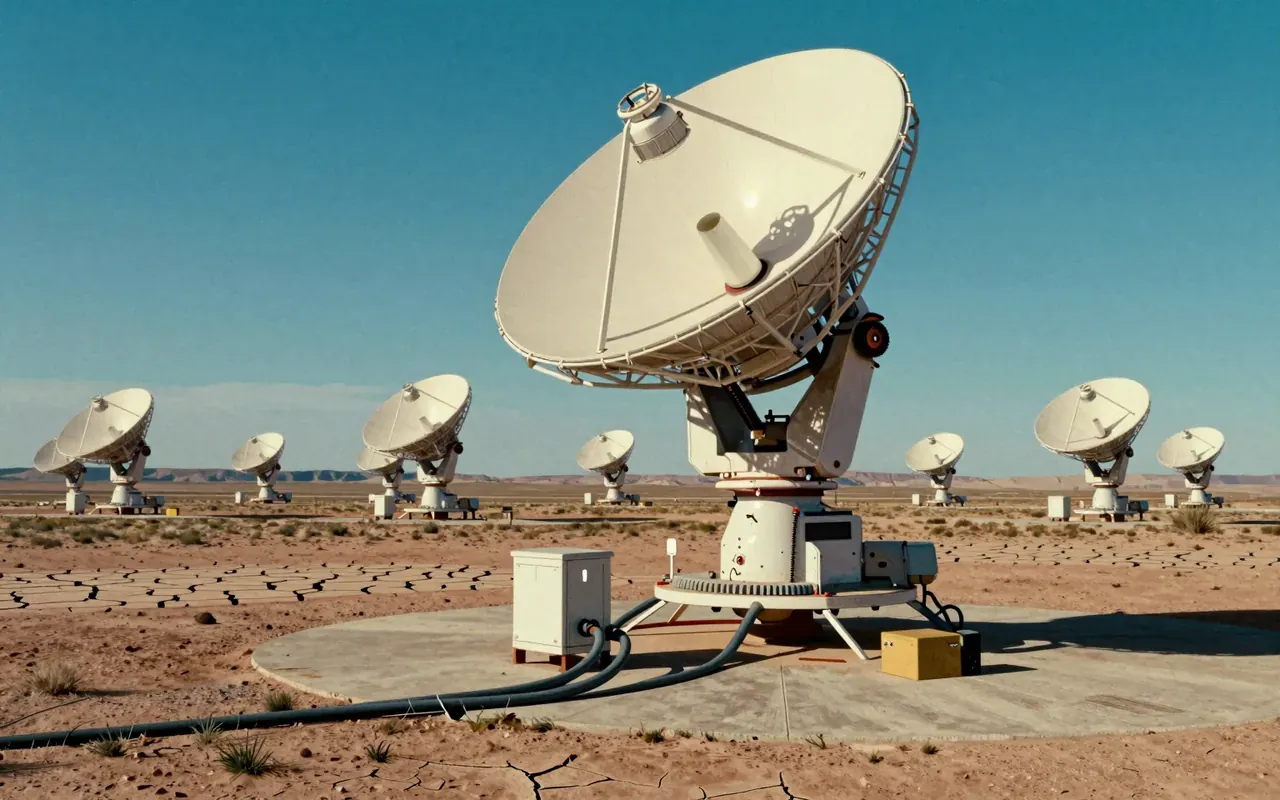
    Twenty-eight 25-meter telescopes on railroad tracks form a Y-shaped interferometer — movable to tune resolution and sensitivity.

  3. 4:02
    What it sees

    It resolves detail down to 0.04 arcseconds and observes from 74 MHz to 50 GHz — a factor of nearly 700 in frequency.

  4. 5:49
    What it found

    It has observed black holes, protoplanetary disks, galactic gas, and cosmological parameters — across radio galaxies, pulsars, masers, and interstellar hydrogen.

Worth your time?

Yes. Study the whole thing.

4.5/ 5
What works
  • reconfigurability
  • angular resolution tuning
  • multi-object survey capability
  • centimeter-wavelength interferometry at scale
What does not
  • proves
  • confirms
  • invents
  • discovers exoplanets
Study it if
  • astrophysicists
  • instrument designers
  • science historians
Skip it if
  • general public seeking breakthrough narratives
  • policy audiences expecting immediate applications
The written brief2 min read

What the work claims

The VLA is a reconfigurable, centimeter-wavelength radio interferometer designed to deliver high-resolution, wide-frequency observations of diverse astrophysical phenomena — from stellar to cosmological scales.

How it was done

The VLA was built in the 1970s in central New Mexico on the Plains of San Agustin. It comprises 28 movable 25-meter radio telescopes arranged in a Y-shaped array. Each telescope runs on double parallel railroad tracks, allowing reconfiguration to adjust angular resolution and surface brightness sensitivity. It operates as a centimeter-wavelength radio interferometer.

What holds up

The VLA achieves angular resolution between 0.2 and 0.04 arcseconds. It covers frequencies from 74 MHz to 50 GHz. It has produced key observations of black holes, protoplanetary disks, magnetic filaments, gas motions at the Milky Way’s centre, and cosmological parameters. It functions as a multi-purpose instrument for radio galaxies, quasars, pulsars, supernova remnants, gamma-ray bursts, the Sun, planets, masers, and interstellar hydrogen.

What does not

The sources do not establish that the VLA proved any cosmological model, confirmed general relativity, discovered exoplanets, measured dark matter directly, or achieved sub-arcsecond resolution at all frequencies simultaneously. It does not claim to observe optical or X-ray wavelengths. No error bars, confidence levels, sample sizes, or replication status are reported.

Why it matters beyond the lab

It shifted radio astronomy from single-dish mapping to quantitative interferometric imaging. Its movable array demonstrated that resolution and sensitivity could be traded deliberately — a principle now embedded in next-generation instruments like the SKA. It made radio data comparable in fidelity to optical surveys, enabling cross-wavelength synthesis.

Is it worth your time

Yes — it remains one of the most productive radio observatories in history. Its design enabled repeatable, high-resolution measurements across a broad frequency range. You should engage with it if you need to understand how interferometry delivers spatial precision in radio astronomy — not as a historical footnote, but as an operational benchmark.

Same field · Astronomy & space4 of 50
Up next in Science

Wow! signal

1977 · 11:30

A single 72-second blip — thirty times louder than noise, narrower than 10 kHz, never seen again — is not evidence of aliens. It is evidence of how easily curiosity outruns verification.

11:30