A draper who ground his own lenses
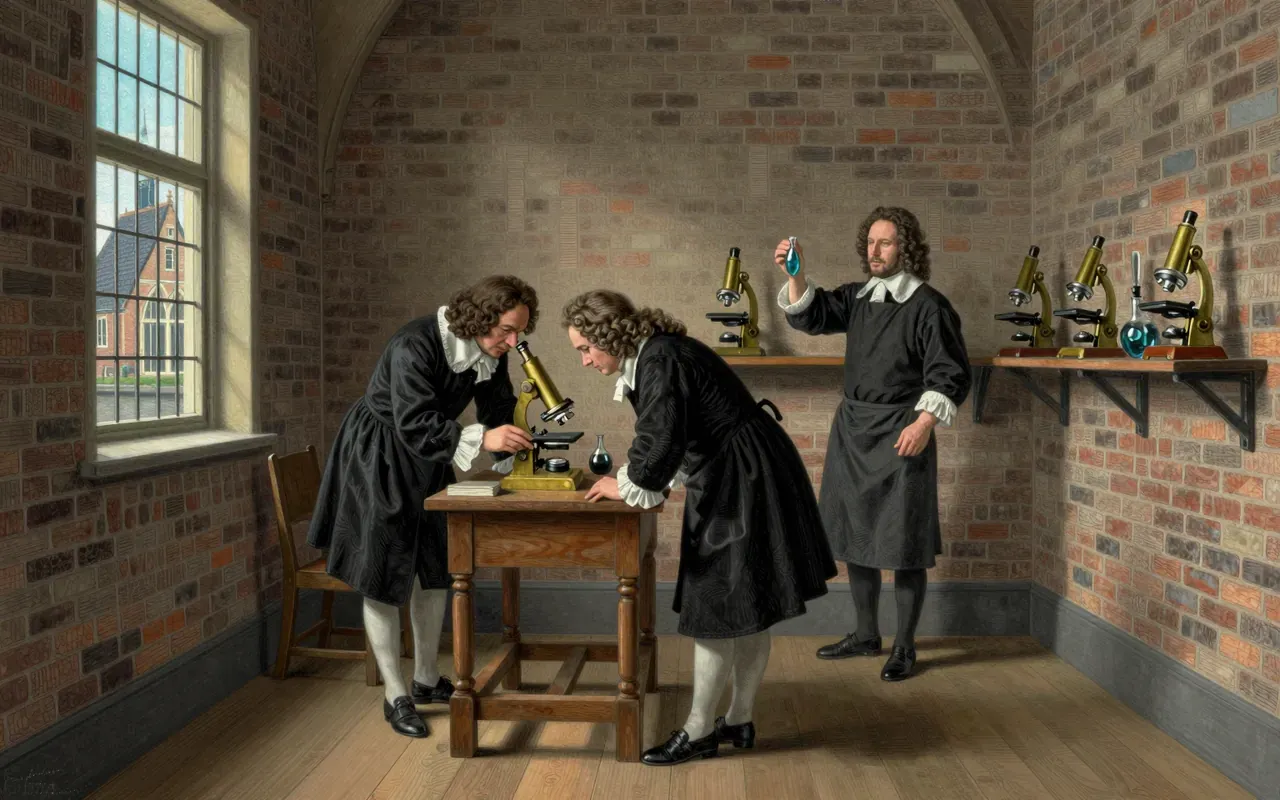
Antonie van Leeuwenhoek was not a trained scientist. He ran a draper’s shop in Delft, held a municipal post as chamberlain to the city’s sheriffs, and later worked as a land surveyor, all while teaching himself, entirely outside any university or formal scientific institution, how to grind glass into lenses of unusual quality. He developed a technique, which he kept secret for the rest of his life, of heating glass rods in a flame and drawing them apart to form small, extremely precise spherical lenses, mounted singly between metal plates rather than combined in the multi-lens arrangement that other microscope-makers of his era favoured.
Magnification good enough to see a living world
That single-lens approach, unfashionable as it seemed next to the compound microscopes already popularised by Robert Hooke’s illustrated 1665 book Micrographia, turned out to resolve finer detail than the compound designs of the time could manage. Van Leeuwenhoek built more than 500 lenses and at least 25 microscopes over his lifetime, with surviving examples reaching magnifications of up to roughly 275 to 300 times, and some estimated to have exceeded 500 times, a level of optical performance that let him see structures far too small for the naked eye or for cruder compound instruments to make out at all.
A claim too strange to believe at first
On 9 October 1676, Van Leeuwenhoek sent a letter to the Royal Society in London describing living organisms he had observed in water, creatures far smaller than anything then known to exist. The claim strained credulity, since nothing in contemporary natural philosophy anticipated a hidden world of organisms invisible without specialised equipment, and the Society responded not by dismissing the report outright but by arranging for independent observers, including local ministers, to examine similar samples and confirm what Van Leeuwenhoek described. That verification process concluded in 1677, and the Society elected him a Fellow by 1680, even though he never once travelled to London to attend a meeting.
A decade of firsts
The observations kept coming over the following years: infusoria, or protists, in 1674, spermatozoa in 1677, the detailed banding pattern of muscle fibres in 1682, and bacteria, including organisms from his own mouth, in 1683, each one a genuine first sighting of a category of biological structure. Van Leeuwenhoek communicated almost all of this through roughly 560 letters written in Dutch rather than the Latin scientific papers conventional at the time, a body of correspondence rather than a formal publication record, but one detailed and consistent enough that other observers, once equipped with comparable instruments, could confirm what he reported.
From one man’s lenses to a discipline
The lasting significance of Van Leeuwenhoek’s work lies less in any single observation than in what it opened up: a previously unsuspected world of microscopic organisms whose existence, once verified, demanded its own field of study, eventually named microbiology, built on the expectation that these tiny structures could be examined, classified and eventually connected to processes such as fermentation and disease. The microscope itself did not stop developing with him; later refinements in illumination, lens design, and eventually electron microscopy from the 1930s onward extended resolving power far beyond what any single ground-glass lens could achieve, but all of it followed a path Van Leeuwenhoek’s instruments first opened.
Why a secretive amateur still matters
This is worth understanding because it is a genuinely instructive case of how an extraordinary claim from an unqualified outsider ought to be handled: not simply believed because the observer seemed sincere, and not dismissed because he lacked formal training, but checked, independently and directly, by people willing to look for themselves. Van Leeuwenhoek’s secrecy about his lens-making method meant that trust in his findings depended entirely on other observers reproducing what he saw, and the fact that they did, repeatedly, over several years, is as much the story here as the organisms he happened to find.