Decades of claims nobody could confirm
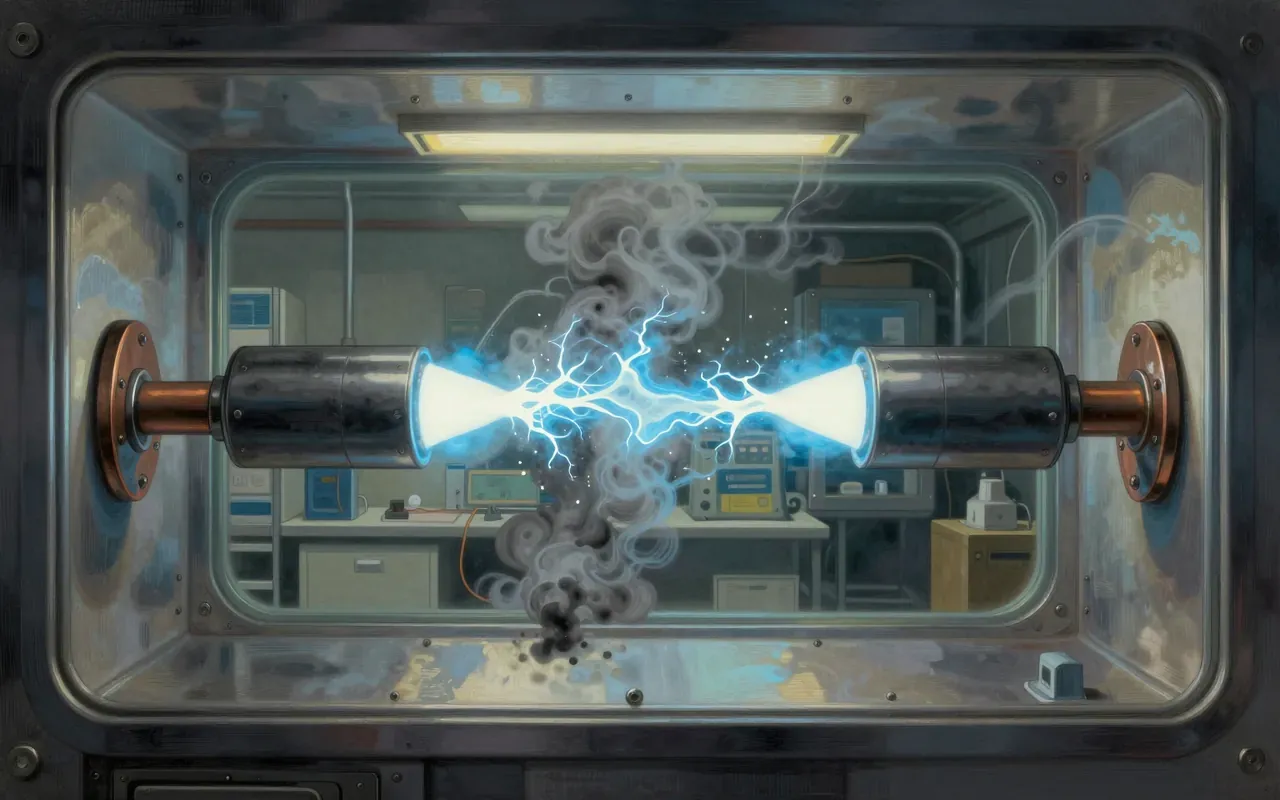
The record before 1954 was a long trail of claims that did not survive scrutiny. Between 1879 and 1928, multiple scientists announced they had synthesised diamond, most prominently Henri Moissan, who reported success in 1893 after heating charcoal with iron in an electric arc furnace to around 3,500 degrees Celsius and then cooling the molten mixture rapidly, expecting the resulting contraction to generate enough pressure to form diamond. When Charles Parsons reviewed the evidence in 1928, he concluded that none of these claimed syntheses, Moissan’s included, had actually produced diamond, with most of the material in question turning out to be synthetic spinel instead.
Thirty-eight minutes at 100,000 atmospheres
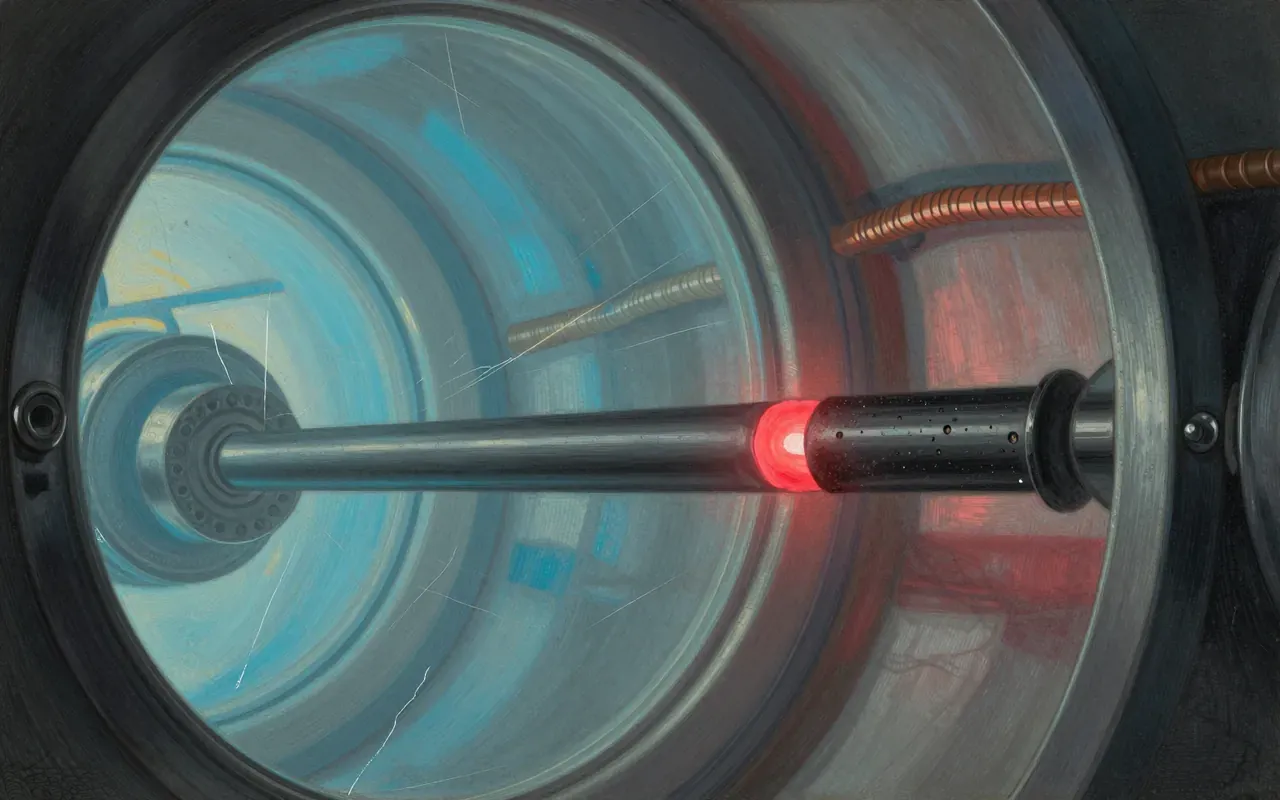
Tracy Hall’s success at General Electric on 16 December 1954 was different because it was both a real result and a reproducible one. Using a high-pressure apparatus of his own design, called a belt press, Hall held a mixture of iron sulfide and powdered carbon at roughly 100,000 atmospheres of pressure and about 1,600 degrees Celsius for approximately thirty-eight minutes, with a tantalum disk acting as a catalyst. At the end of the run he found genuine diamond octahedra had formed, a result GE was able to reproduce reliably afterward, and Hall published the work in Nature in an announcement dated 15 February 1955.
Industrial grade first, gem grade sixteen years later
What Hall had made was industrially useful long before it was decorative. His largest crystal measured only about 0.15 millimetres across, suitable for use in industrial abrasives but nowhere near large enough for jewellery. It took until 1970 for GE to grow gem-quality synthetic diamonds, seeding pyrophyllite tubes with existing diamond and achieving stones of roughly one carat within about a week; the earliest of these came out yellow because of nitrogen contamination, and removing that nitrogen produced colourless stones, while deliberately adding boron instead produced diamonds with a distinct blue tint.
A ten-dollar bond for an industry-defining patent
The reward Hall received for this stood in sharp, well-documented contrast to its value. Despite the belt press becoming the foundation of an industry GE profited from substantially, the company’s compensation to Hall for the invention was a ten-dollar savings bond, a disparity striking enough that it was later referenced on the television series Breaking Bad, in the episode Peekaboo. Hall left GE the following year, in 1955, to take a professorship and research directorship at Brigham Young University, where he continued developing new high-pressure apparatus designs entirely on his own terms and away from corporate ownership.
A second method, and a technology transfer to match
High pressure was not the only route to synthetic diamond. William Eversole reportedly achieved diamond growth through chemical vapour deposition as early as 1953, though the work was not reported until 1962, and the method was independently confirmed by researchers including Angus in 1968 and Deryagin and Fedoseev in 1970, who showed diamond could be deposited directly onto non-diamond surfaces, opening the door to diamond coatings at far lower cost than bulk crystal growth. Hall’s own belt-press design, meanwhile, was transferred to China around 1960 and now underlies the vast majority of the world’s synthetic diamond powder production, running on thousands of presses built to his basic design.
From drill bits to diamond wedding rings
The scale synthetic diamond has reached today makes the ten-dollar bond feel almost absurd in hindsight. Synthetic stones now share identical chemical composition and nearly all physical properties with natural diamonds, in some cases exceeding them in hardness and thermal conductivity, and account for an estimated 98 percent of industrial-grade diamond demand, used in cutting tools, drill bits, heat sinks and radiation detectors at facilities including the Stanford Linear Accelerator. The gemstone side of the market has grown rapidly too, from a market share of 0.28 percent in 2013 to about 17 percent by 2023, a trajectory that makes the story worth following not just for the original discovery but for how thoroughly it has reshaped an entire material’s supply.